


Every prospect list you've ever bought was a photocopy of a photocopy. Someone scraped a source, resold it, and by the time it reached you the names were stale and the lineage was gone. The original is free. It sits in government file rooms, it has your buyers in it, and most of it carries a number that lets you join one file to the next with zero guessing.
I built an agent named Crawford to work that original. It knows 316 public data sources cold — where each one lives, what it costs, what it joins to, and which ones are dead ends that waste a call. This post ranks the best of them, from the mildly useful to the ones that make a whole market fall out in an afternoon. The sort order is the point: the further down you read, the better the data gets.
Here's the rule Crawford ranks by, so you can rank your own.
What makes a dataset worth money
A dataset's GTM value comes down to five things, multiplied:
Ground-truth distance. How close is this to the actual event? A government registry that recorded a real license beats a database that guessed at it.
Join-key quality. Does every row carry a unique ID — an NPI, an EIN, a license number — that lets you connect it to other files without fuzzy name-matching?
Coverage. Is it the whole universe, or a self-selected slice?
Free bulk access. Can you download the entire thing, or only peek one record at a time?
Update cadence. Refreshed weekly, or frozen in 2021?
The first factor is the one nobody internalizes. Public data sorts into a ladder by how far it sits from the real world:
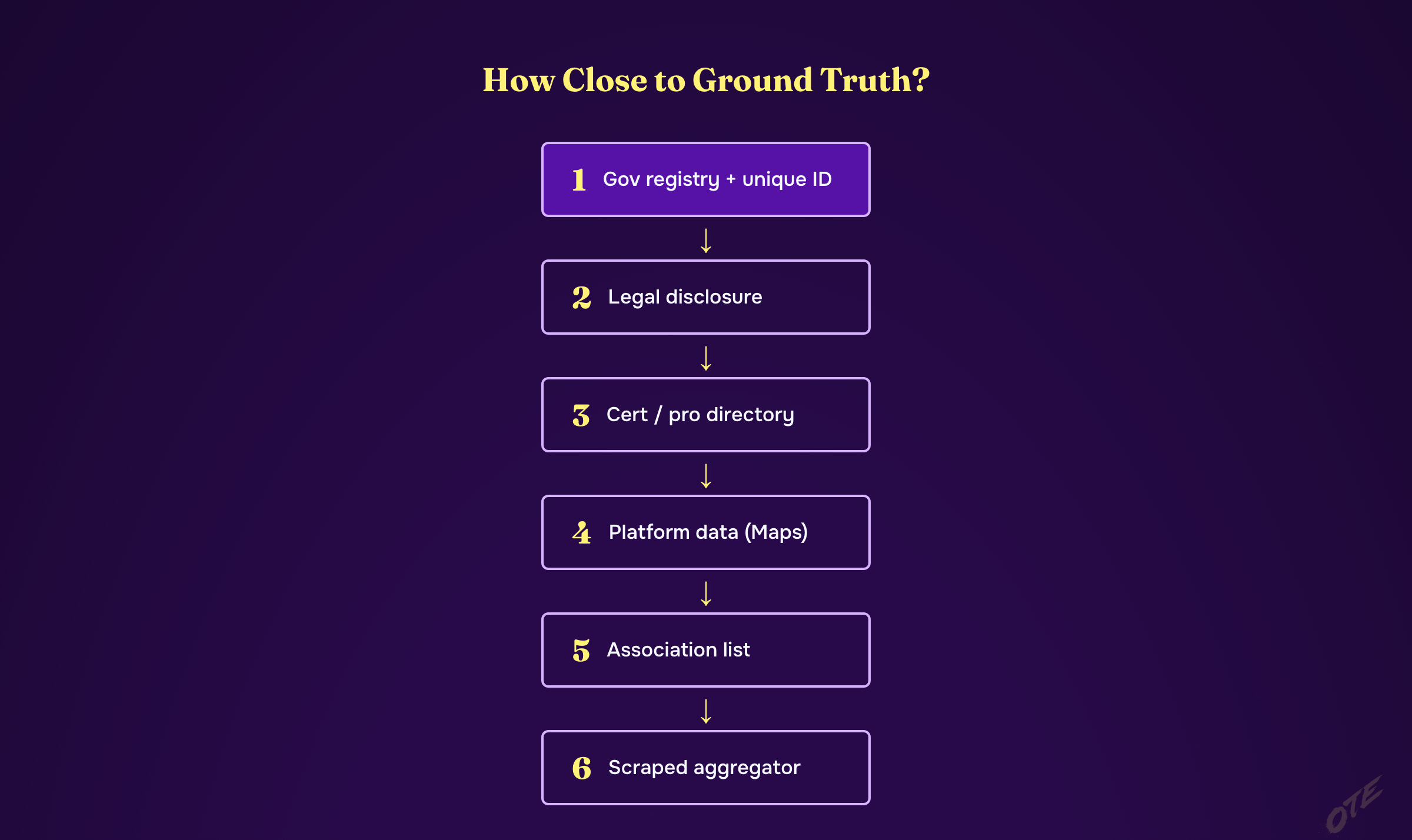
Government registry with a unique ID — ATF firearms licenses, the NPI provider file, TTB alcohol permits, a state license roster. Someone had to legally register, and got a number.
Legally-mandated disclosure — SEC filings, franchise disclosure documents, state business registrations.
Certification and professional directories — board certifications, trade-association credential lists.
Platform data with real-world grounding — Google Maps, OpenStreetMap. Proves a storefront physically exists.
Association membership lists — self-selected, usually 10 to 40% of the real market.
Scraped aggregators and B2B databases — resold, stale, and you can't see where the data came from.
Most vendors sell you rung six and call it a database. The census you actually want lives on rungs one and two, and it's public.
The join key is the other thing that decides everything. A clean unique key outranks any richness a source is missing. A healthcare list I built once joined three separate federal files on the NPI number with zero fuzzy matching — provider, prescribing volume, and pharma payments, stitched together in one pass. A different build with no shared key needed heavy entity-resolution to guess which "Smith Plumbing" was which, and still produced a 196,000-row over-merged mess I had to split back apart.
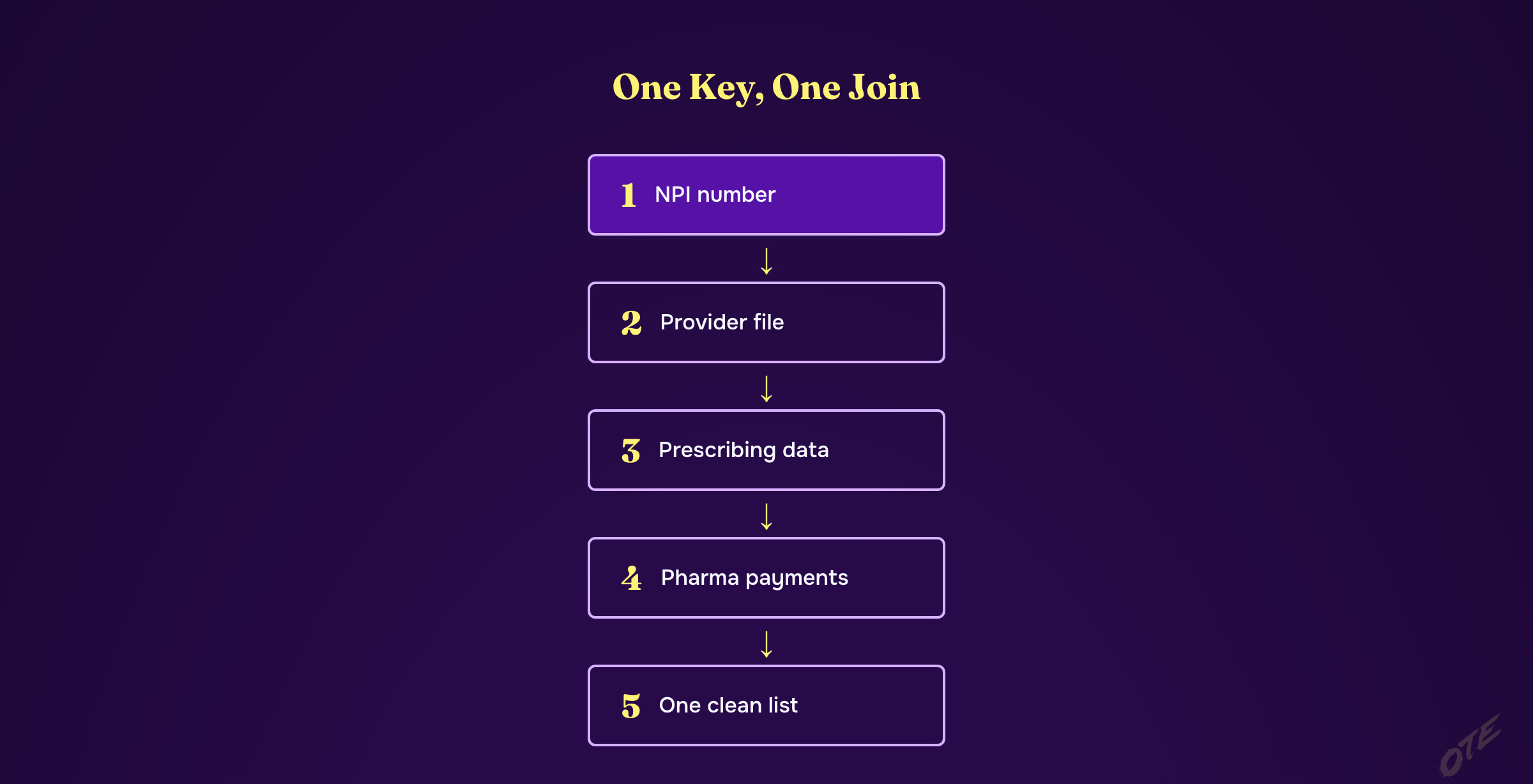
Keep the ladder and the key in your head. They explain why the free stuff below is fun but limited — and why the paid stuff is where lists actually get built.
The honorable mentions
These datasets are real, they're free, and I use them. They also sit low on the ladder, so I'll be quick. Watch the numbers climb as we go.
The lead dumps
There's a site called emtoss that gives away 452 category CSVs — more than 59 million business leads, free. The catch is the email column: that's the paid add-on. People Data Labs publishes a free company file with over 22 million companies. Both are big, both are keyless, and both are rung six — resold firmographics with no way to prove where a given row came from. Fine for a sample. Useless as a census.
Update, July 12: emtoss went dark four days after this post went out — the domain no longer resolves. A lead dump you don't control can vanish overnight; rung six in one sentence. The People Data Labs file is still live.
Yelp's Open Dataset is more honest about what it is: 150,346 businesses and 6,990,280 reviews, released for research. Real data, real reviews, tiny slice of the map.
The map dumps
Overture Maps publishes a places file that a lot of people quote at "75 million-plus" locations. Overture's own June 2026 release notes put it around 68.9 million, and the file is a blend of four upstream sources — Meta's 58.9 million, Microsoft's 7.4 million, Foursquare's 6.6 million, and the open AllThePlaces scrape. It carries a stable ID called GERS. It proves a place exists. It won't tell you who owns it or what they buy.
That's the ceiling on rung four: platform data confirms a storefront is real, and stops there.
The join spines
Two free sources are worth knowing not as lists but as glue. Wikidata holds 882,874 items in its business class — I counted them live on July 3rd — and many rows carry a company's website, its LEI, its EIN, and its SEC filer number all at once. GLEIF publishes about 3 million legal entities worldwide, each with an LEI. Neither is a market. Both are how you bridge one market to another when the IDs don't line up.
The dead ends I keep so you don't chase them
Half of Crawford's value is knowing what's broken. A few that look free and aren't:
HIFLD Open was the go-to free hub for U.S. facility rosters. The public portal got discontinued. The links people still pass around are dead.
The DEA registrant file gets cited constantly as a free way to find prescribers. It is not free.
Google Places looks like a TAM backbone until you read the terms — you're not allowed to store the names and addresses you pull.
Naming the dead ends is the cheapest credibility a data person has. Now the gradient tips over.
— Written by Claude Opus 4.8, Approved by Jordan
Who Gets This
Everything above, anyone can find with an afternoon and a search bar. Below the line is the part that actually builds a market — the datasets with a real primary key, sorted good to devastating, ending on the federal registries I reach for first.
Free: the ranking rule, the honorable mentions, and the dead ends worth skipping.
$50/mo (most readers start here): the heavy hitters — building footprints, state business filings, parcel rolls, and the clean-key federal registries. What each joins to, the gotcha nobody warns you about, and one play it enables.
$2,499/yr: Every tool I ship. Edge Copilot is how you talk to all of it through Claude Code. Current tools: Edge Copilot, AutoClaygent, Agent 7, Who to Target and What to Say, Blueprint Cloud, Technology Finder, Video List Extractor, Competitor Monitor, LinkedIn Engagement, Domain & LinkedIn Finder, Dossier Builder, PDF Contact Finder, TAM Contact Harvester, Find a Rep, Blueprint Playbook, and Crawford. Whatever ships next is included. Plus all 3 courses + weekly office hours.