
Here's why you should care about pre-AI search as a GTM engineer
I tested seven ways to buy Google's results. Then I looked at the bills.

If you need cheap information about the web at scale, buying Google's search results is still the best way to get it. A query costs a fraction of a cent, and it answers questions that nothing else answers as well.
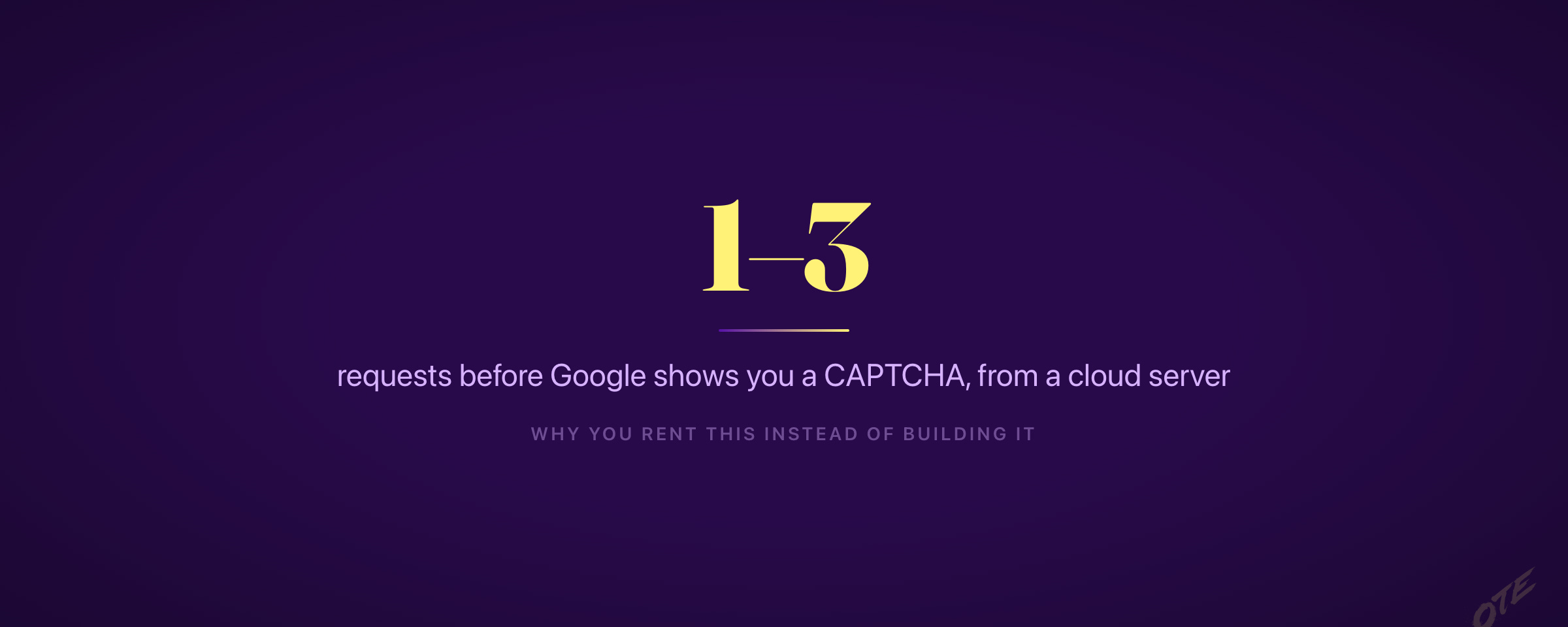
You can't run those queries yourself. Google started requiring JavaScript to search in January 2025, which killed plain scraping outright — the maintainer of the main Python library for it says flatly that "HTTP scraping does not work anymore." Run it from a cloud server and you hit a CAPTCHA in one to three requests. Rotating residential addresses buy you 200 to 500 before the same thing happens. So you rent it from someone who has already solved that, and the whole market below exists for that reason.
Here's the kind of work it does:
Turn 60,000 company names into 60,000 real websites — the join key that everything downstream depends on.
Check whether a business still exists, or quietly died.
See what actually ranks for the query your buyer types.
Watch what a competitor publishes, in the order Google shows it.
None of that needs AI. It's a lookup. It wants to be cheap, boring, and correct.
Nobody is winning on accuracy
I gave seven of these services 116 companies whose websites I already knew and asked each one for the company by name. They all got it right about two-thirds of the time, and the gaps between them were too small to mean anything. Accuracy is not the decision here. Nothing separates them on it.
Which makes sense once you look at what you're buying. Three of the seven — DataForSEO, OpenWebNinja, Bright Data — just resell Google. They pass your query along and hand back what Google says. There's no mechanism for them to disagree with each other.
The bill is where they differ, and it isn't close. The same 60,000-row job costs $36 with one and $420 with another.
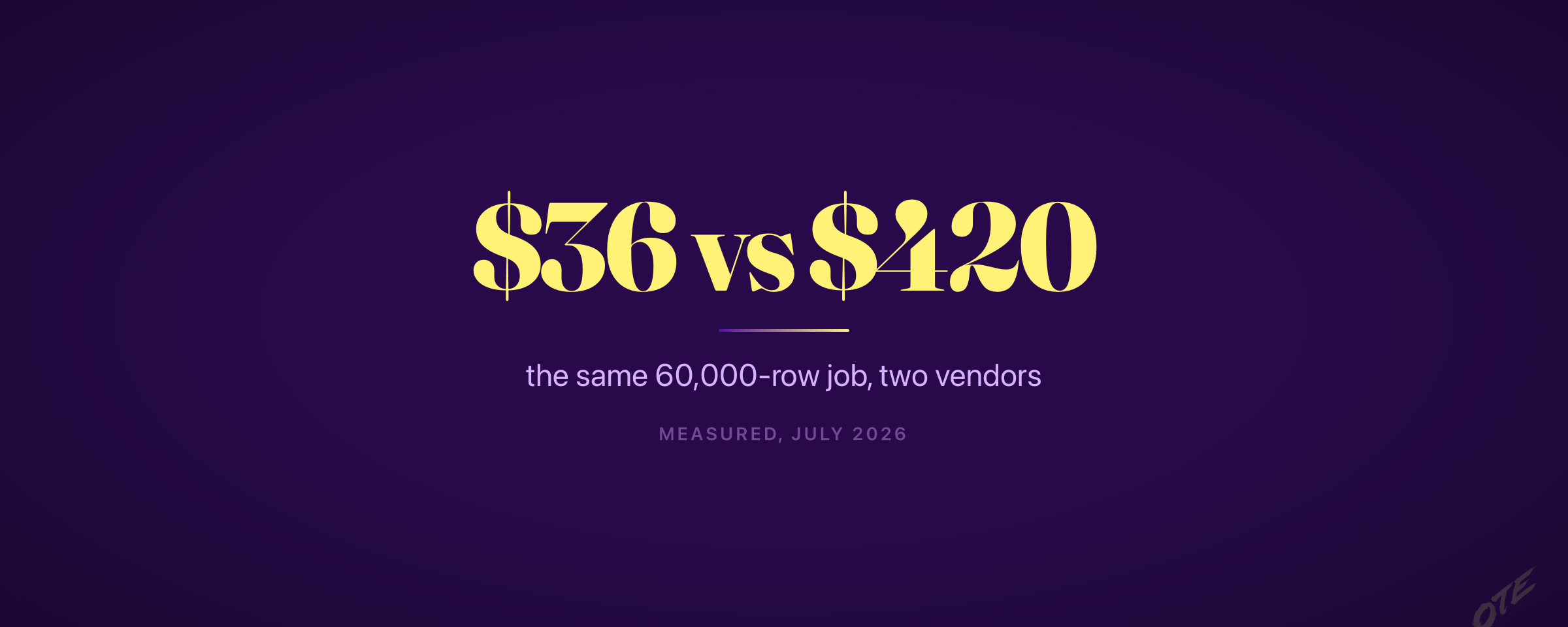
For the ones reselling Google, that settles it: identical product, 12x price range, buy the cheapest. The real question is a different one, and it's about the job rather than the vendor.
When you want Exa or Parallel instead
Google gives you links. Exa and Parallel do things Google's results can't, and it's worth knowing which job is which — because I use both, constantly, and the choice isn't about who's more accurate.
Exa takes a URL as the question. Hand it a company's website and ask for pages like this one. No Google API does that — the old related: operator is long dead. It costs $0.007 a call. Fair warning from my own test: point it at clay.com and most of what comes back is Clay's own subpages, so exclude the domain you started from or you'll get a tour of the site you already had.
Exa's Websets gives you rows instead of links. You describe the thing — "Series B fintech companies in Denver" — plus the columns you want, and it searches, checks each candidate against your criteria, throws out the ones that fail, and fills in the columns. That verification step is the product. A search API hands you ten links and leaves the judging to you. It runs $49 a month for roughly 800 verified rows, about six cents each. The catch is in their own FAQ: it stops when it hits its search ceiling, so treat it as a good list, not a complete one, whatever the marketing says.
Parallel charges by the row, not the column. Their words: one run "can populate many output fields — whether you request 1 field or 20 fields, the cost is the same," and failed runs aren't billed. Twenty columns for the price of one, each with its own citation, from half a cent a row. Nothing else in this market prices that way, and it's the most GTM-shaped thing I've seen in a while.
Parallel's Entity Search builds a starting list in seconds. I asked it for Series B fintechs headquartered in Denver and had ten companies back in 2.6 seconds. Three of them weren't fintech. That's not a bug — their docs say results are "ranked but not individually verified" and that it returns your requested count "even when few entities satisfy the objective." So over-ask and filter. If you need each row actually checked against conditions, that's their FindAll product, which only enriches the candidates that passed.
What neither of them can do, and this is the part that matters:
Tell you what Google shows. They're searching their own index. Rank, AI Overviews, People Also Ask, the local pack — an own-index engine can't report on a page it doesn't produce. Any question shaped like "what does my buyer see when they search for my prospect" has exactly one source.
Local businesses. Neither has a Maps product. Our own code disables that path entirely for both of them. If you're chasing dental practices or roofers, you need Google Maps.
Cheap bulk. Exa is roughly 12x DataForSEO per lookup. For 60,000 name-to-website rows, that's the $36 versus $420 I mentioned. Parallel's cheapest search tier closes most of that gap at a tenth of a cent.
The trade runs the other way too. An AI-native index is built to be read by a model, and for open-ended research — the kind where you want everything on a topic rather than the ten best pages — it's the better instrument. The nine research passes behind this post ran on Exa and Parallel, not Google. I'm not telling you to stop using them. I'm telling you they answer a different question, and it costs 12x to ask it.
What Google did in 2025, and why it reshaped this market
Google spent 2025 making its results harder and more expensive to get, in three moves. Each one moved somebody's price.
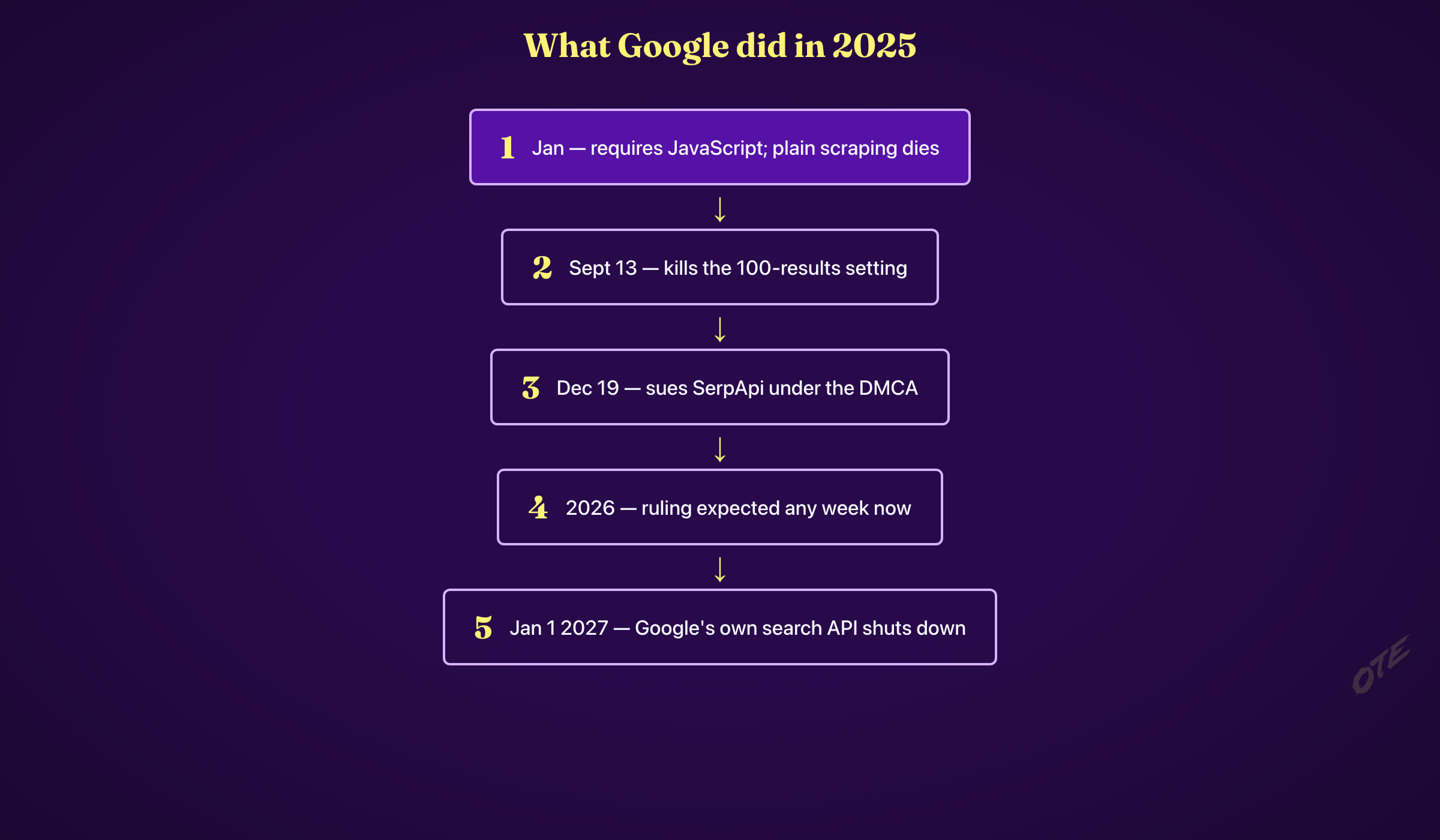
January 2025: it started requiring JavaScript. That killed plain-HTTP scraping outright and forced every vendor onto full browser rendering — roughly 30x the bandwidth per query, right where it hurts. Alongside it Google rolled out SearchGuard, which doesn't just gate you at the door: it keeps watching how the session behaves. Search Engine Land pulled it apart in January after the lawsuit filings exposed how it works.
September 13, 2025: it removed the setting that returned 100 results at once. You used to ask for a hundred and get a hundred, one fetch. Now you ask for a hundred and get about ten. No announcement, no explanation.
That second one is the one in your bill. A hundred results costs ten fetches instead of one. Every vendor woke up to a cost roughly ten times higher, and they split into two camps over who eats it.
One camp passes it to you. They bill per page, so your hundred-result pull now costs ten pages. Their prices went up about 10x. Traject Data's own write-up called it "close to 8x more than before." Scrapingdog's staff blog independently landed on "10 times more expensive." That camp is DataForSEO, SerpHouse, Scrapingdog, ScrapingBee, Apify, Zyte, Scrapfly, Decodo.
The other camp eats it. They bill per result or per query, they still make the same ten fetches behind the scenes, and they don't charge you for them. Serper, OpenWebNinja, Nimbleway sit here. Their prices didn't move.
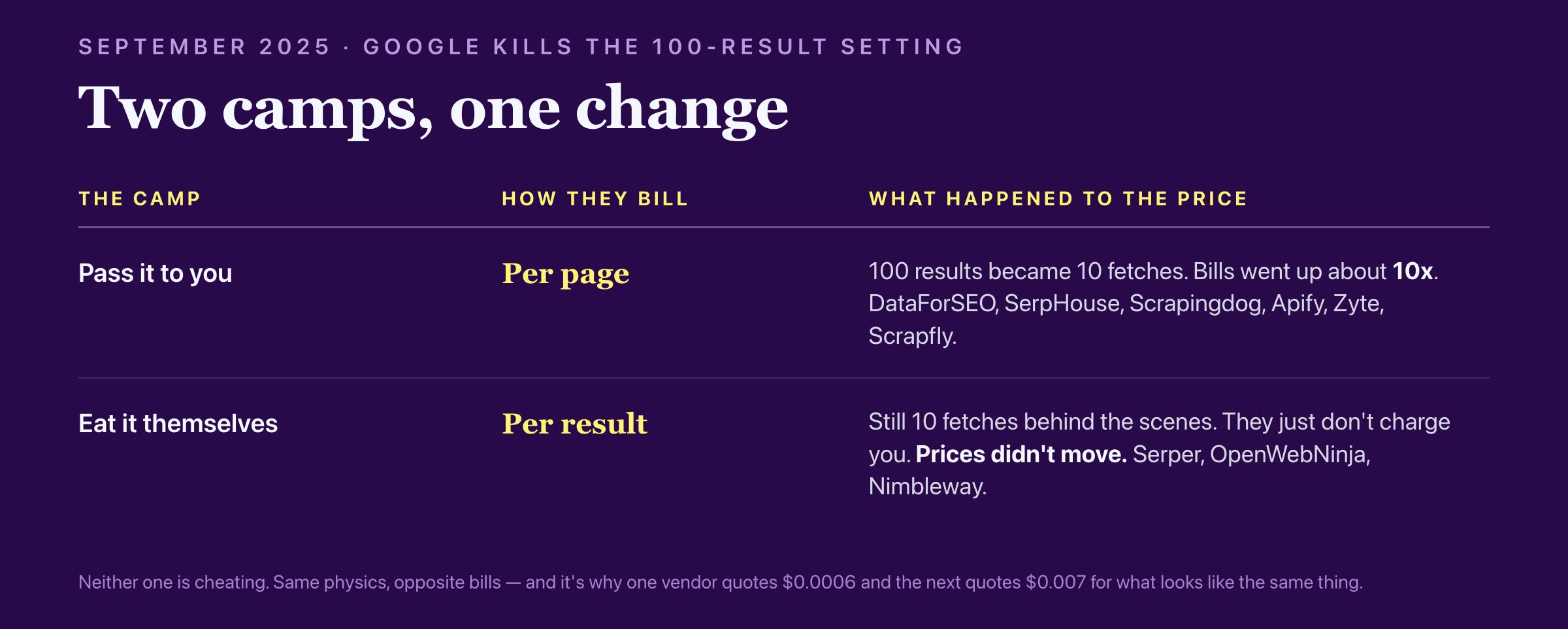
Neither one is cheating. Same physics, opposite bills. That single split is why one vendor quotes you $0.0006 and the next quotes $0.007 for what looks like the same thing.
December 19, 2025: it sued one of the vendors. Google took SerpApi to federal court in California — its own announcement is here, and The Verge, Ars Technica and Search Engine Land all covered it the same day. The claim is worth understanding: it isn't "you broke our terms of service." It's anti-circumvention under the DMCA — the same law that makes breaking a DVD's copy protection illegal. Google is arguing that getting around SearchGuard is itself the offense, which sidesteps the messy question of whether search results can be copyrighted at all.
SerpApi moved to dismiss in February, arguing search results are facts and facts can't be owned. Arguments were heard June 30. As I write this, the docket shows no decision, and one is expected within weeks.
Here's the part that makes the whole market strange. Google's own official search API costs $5 per 1,000 queries — up to 8x what the scrapers charge. It caps you at 10,000 a day. It's closed to new signups. It dies on January 1, 2027. And Google's own guidance tells you to "explore third-party providers" — the category it is currently suing.
So the split is clean. If the job is "understand this market, build me a list, enrich these rows with cited columns," reach for Exa or Parallel — that's what they're built for, and it's why every research pass behind this post ran on them.
If the job is "what does Google say," you're buying a commodity, and the only thing left to decide is who you buy it from.
For those who are paying me COLD HARD CASH, here are the winners…