
How I'd Go to Market for a Horizontal SaaS Company
Sendoso sells to everyone. So we targeted a moment.

I gave a talk last month on Sendoso's track at GTM Shift, on stage with their co-CEO, and I ended it by building the thing live in a terminal in front of the room.
This is what the talk argued, what we built to prove it, and what it cost. Short version: Sendoso sells physical gifts to any company with a sales team, which by my own published advice makes them nearly impossible to target well. The way out wasn't finding a vertical. It was finding a moment — the week a person who publicly praised you at their last job shows up at a new one. Nine companies' case-study libraries gave us 213 of those people, and reading them cost nothing, because the raw material was already sitting on their own websites.
This is the message an AI SDR sends
Here is a real one, sent to me. I have not edited it.
Hi Jordan,
Your LinkedIn post about the challenges of adapting to LLMs resonated with me. As we navigate this paradigm shift, many founders are seeking ways to leverage AI effectively in their businesses.
We've built an AI SDR that fully automates outbound over email and LinkedIn, eliminating time-consuming manual tasks in sales. Over 300 companies have already integrated our solution, freeing their teams to focus on closing deals.
Our office isn't far from you, how about a quick in-person walkthrough over coffee?
That came from the founder of Artisan, an AI sales-agent company that has raised more than $45 million — an $11.5M seed and a $25M Series A — to automate outbound email.
Read it out loud and you can hear the machinery. It saw a post, matched a keyword, and produced a coffee invitation. The message is about them. Nothing in it required knowing anything about me.
AI didn't fix that message. It sent ten thousand more of it.
Unlimited intelligence, pointed at the wrong thing
Start the talk with a better question: what would you do if you could deploy unlimited intelligence for every single prospect?
Every time I put that question to a room, the answers come back as personalization. An agent that reads everything about one human being and writes them a letter no one else could have received.
Try it and you find the ceiling fast. Unlimited intelligence aimed at one person doesn't read as thoughtful. It reads as surveillance. There's a line where "I saw your podcast" becomes "I noticed you didn't brush your teeth last night," and AI crosses it without noticing.
What matters is knowing which people deserve the effort at all. Targeting beats personalization, and it isn't close.
So I run the question backwards, the way the asymmetry engine sets it up. Don't ask who to target and then write copy for them. Ask: with perfect information, what is the single message I'd most want to send? Then go find every person that message is already true about.
Vertical SaaS gets the message for free
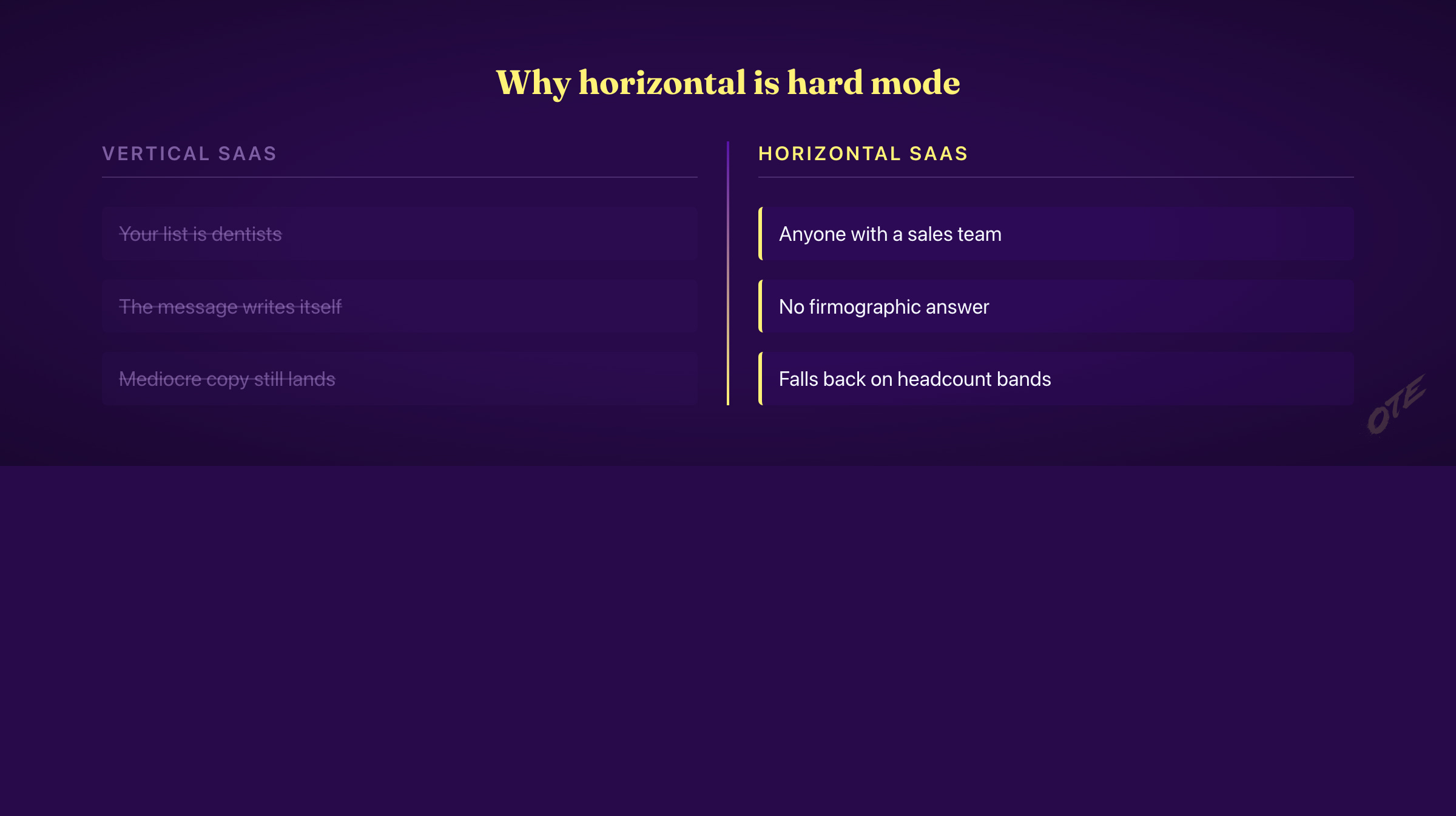
If you sell software to dentists, targeting is a solved problem. Your list is dentists. Your message is about the thing dentists complain about. You can be mediocre at copy and still land, because you described their week better than the competition did.
I've said this about as bluntly as I say anything: "You shouldn't be horizontal. You will never, you will continue to grow nowhere if you continue to be horizontal." And: "Words like industry agnostic is like a huge red flag to me."
Sendoso is horizontal. They send physical gifts to prospects and customers on behalf of B2B sales teams. Their buyer is any company with quota-carrying reps and deals big enough to justify a fifty-dollar gift. That's tens of thousands of companies across every industry there is, and no two of them have the same bad day.
My own training material has a name for this — the horizontal positioning trap. A company that sells into every industry is a mile wide and an inch deep, so it can't reach for the specific, checkable insight that makes a message worth receiving. Run the process on a horizontal brand and you get broad pain groups. A real gift needs something true about one company.
Sendoso's co-CEO picked hard mode. So the interesting question is whether hard mode has an answer.
Every campaign answers three questions
Whatever you sell, a campaign has to answer three things before a word gets written.
Who's qualified to buy? Not who'd enjoy it. Who is structurally able to.
How much might they buy? What separates a fine account from an A+ one.
What will they value? What you can hand them that's worth something on its own.
For a vertical, question one is an industry code and you move on. For a horizontal, question one has no firmographic answer at all — which is why so much horizontal outbound falls back on headcount bands and hope.
So we asked Sendoso's co-CEO to answer it by hand instead.
Six gates you have to clear
He'd already written his real rubric down. The disqualifying half came out as six gates, and the logic is AND, not OR — clear all six or you can't buy, no matter how much you'd like the product.
Sell to businesses, not consumers.
Run a real sales team. Roughly fifty-plus people, with a handful carrying quota. A signup page isn't a sales motion.
Close deals too big for one call — big enough to gift. A $50–100 gift against a deal under about $2,000 never pencils.
Be growing. Recent go-to-market layoffs kill it.
Have a champion — and their boss. One fan with no executive behind them means the deal dies quietly.
Work where gifts aren't regulated. Government and parts of healthcare and finance cap gift acceptance at $25, which ends the conversation.
What an A+ account looks like
The positive half was a portrait, and each line came with rungs — good, great, ideal.
50+ SDRs, 150 people carrying quota.
6+ stakeholders in every deal.
$100K+ deals, on cycles of six months or more.
Series C or D, hiring a Sales Development Leader — the open job posting is the tell.
Already uses other sales tooling — Outreach, Salesloft, intent data.
Already spends $100K+ a year on gifting. By hand.
That last line is the one to sit with. The ideal Sendoso customer is already doing this, badly, at six figures a year, with a spreadsheet and an intern.
Here's the part that matters more than the rubric itself: that entire ladder lived in one executive's head, and got applied one account at a time, by hand. Which is the normal state of affairs at almost every company I've ever worked with. The rubric is real, it's good, and it doesn't scale past the person holding it.
The play: a champion who just changed jobs
Now put the three questions back together, because the third one has a twist.
Once you can disqualify and score, you know roughly what a qualified prospect is worth to you. And if you know what they're worth, you can spend some of it before they ever reply.
The best way to spend it is to run your own product on their behalf. Not describe it. Not demo it. Run it, for them, on their actual situation, and hand them the output. For a gifting company this is almost too neat — the acquisition dollars are the product.
That leaves one question: which stranger deserves it?
The answer was sitting in every seller's own marketing folder.
A case study is a public document where a named human being says, on the record, that your product changed their working life. Companies publish hundreds of them and then leave them alone. Meanwhile the person in the story keeps having a career. They get promoted. They move.
When that person lands at a new company, their new employer becomes the warmest prospect you have — a leader who already loves your tool just walked in the door, and no one on your team was watching.
That's the niche. Not an industry. A moment, and a checkable one: this named person praised you publicly, and today they work somewhere else.
Run it through the three gates I hold every message to. Hyper-specific — a name, a former employer, a link to the story. Factually grounded — the case study is on your own website and the new job is on their profile. Non-obvious — the story is still live on the seller's site, written as though the person never left.
Which means a horizontal product can produce a real gift. It just can't get there through an industry.
Who Gets This
Everything above is the argument. Below the line is the build — the five steps, the real tools, and the receipts.
Free: the theory, why horizontal targeting breaks, and the play itself.
$50/mo (most readers start here): everything below the line in this post, and every paid article.
$2,499/yr: Every tool I ship. Edge Copilot is how you talk to all of it through Claude Code. Whatever ships next is included, plus all 3 courses and weekly Applied Office Hours. (Go annual — $2,499/yr.)
Below the line in this post:
The five-step build, with the tool and the bill at every step.
The full cost ledger — $95.52, itemized, and what came back free.
The scoring rubric as code, including the five signals we refused to score.
Three finished letters, verbatim, with real gifts and real prices.
Every week I run Applied Office Hours on Zoom — bring what you're building and we'll work it live.