
I Scored 16,000 People to Find Who Really Moves a Market. Only 441 Did.
The most influential one already worked for a competitor.
An advisory board is supposed to do work. Open doors you can't open yourself. Give you air cover when you walk into a deal. Lend weight to your name in a market that doesn't know it yet.
Most boards get assembled from the people the founder can already see — three friendly customers, an investor's buddy, the advisor who said yes fastest. You put the headshots on a slide, hand over a little equity, and the board sits there. The people are fine. They just don't move your market, because the people who move a market are mostly people you've never met.
So the move is to go find them. Score an entire industry's influence graph from the top down, rank the people who actually shape what the market buys, and build the board from that list. I built the machine that does it. Here's the method on a real run, then the recipe.
Who actually shapes what your industry buys
The question that builds a real board is about the market. Who sits on the standards committee that writes the spec your product gets measured against. Who chairs the association whose endorsement opens a hundred doors. Whose column every buyer in the category reads on a Tuesday morning.
Pharma and medtech marketers have a name for these people: key opinion leaders, or KOLs — the handful in any market whose voice moves what everyone else buys. Most industries have KOLs without using the word. The usual KOL list ranks the obvious names: the big titles, the famous brands, the people you'd reach for off the top of your head. Score the whole market properly and the real ones surface. The real ones are exactly who belongs on your board.
You can know who they are, better than the market knows it about itself. That's the whole move.
The asymmetry, pointed at relationships
I write a lot about manufacturing more information about a buyer's situation than the buyer has, then handing it over as a gift. People usually apply that to outbound. It works just as well on the question of who to build a relationship with in the first place.
A market's influence graph is public — it's just scattered. Association board rosters. Technical standards committees. Conference keynote lists. Trade-press mastheads. Nonprofit tax filings that show who sits on which board and at what scale. Archived bios that reveal a role someone quietly scrubbed. None of it is hidden. It's annoying to assemble by hand, so assembling it is an edge. That's the thing I built.
Score the whole market, not your contacts
You score the whole market, not the slice you already know. The people you know are a biased sample — they're the ones who already talk to you. The influencers worth recruiting are mostly the ones you've never met.
So you go top-down. Take the whole geography of a market. For a US run, that's the 50 states plus DC. Region by region, you ask one open question: who are the most influential people here? You point a research agent at each region with real tools behind it — a web-research engine built for AI, a cited-answer research service, public nonprofit filings. Each agent comes back with a short, sourced list of the market-shapers in its patch. You merge them. Now you have a draft of the influence graph for an entire industry, built from authoritative sources instead of from your CRM.
Then you score it.
Influence is sparse
I ran this for a company that sells software into a regulated public-safety market. The named universe was about 16,000 people. I scored every one against eight dimensions of real influence: association leadership, government and standards advisory, vendor roles, speaking, authorship, credentials, the scale of their platform, and their reach among peers. Exactly 441 cleared a meaningful influence bar.
Less than 3%.
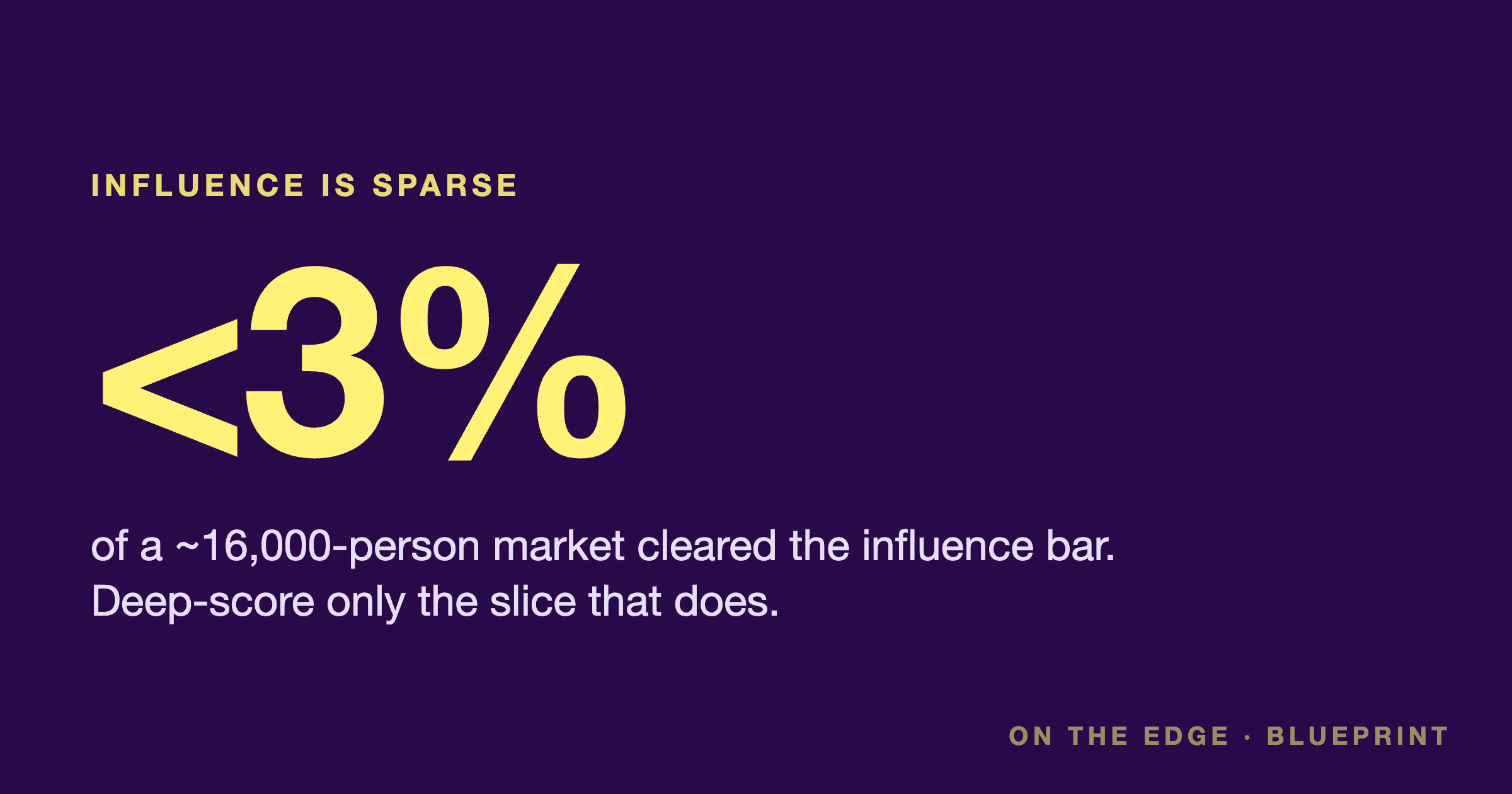
That number reshapes the whole approach. Ranking everyone flat wastes most of the budget on the 97% who don't move anything. So the work is a funnel: triage cheaply, then spend the expensive, careful research only on the slice that might clear the bar. And when you find the real influencers, there are far fewer of them than the market pretends — that scarcity is exactly what makes knowing precisely who they are worth so much.
Title is a separate thing from influence. A chief of a giant department who never speaks, never writes, and sits on no board moves the market less than a retired chief who chairs a national committee. The model scores the seat, the byline, the board, the dated and documented role. The size of the org on the business card counts for very little.
Capture: the best name is often already taken
A plain "most influential people" list will quietly ruin your board.
In that run, the single highest-influence person in the entire dataset was already on the payroll of a competing software vendor. A past national-association president. A textbook author. The kind of name that opens any door in the industry — and completely unavailable to you. Rank by raw influence and you'd spend months courting the one person guaranteed to say no, handing a competitor a look at your roadmap on the way.
The same pattern repeated across the top of the list: a standards-committee member who was a named spokesperson for one competitor, a state-association officer who turned up in a competitor-sponsored conference session. Great intelligence. Wrong board picks.
So influence alone is the wrong score. You need two more axes.
Influence × independence × recruitability
You rank each candidate by multiplying three numbers.
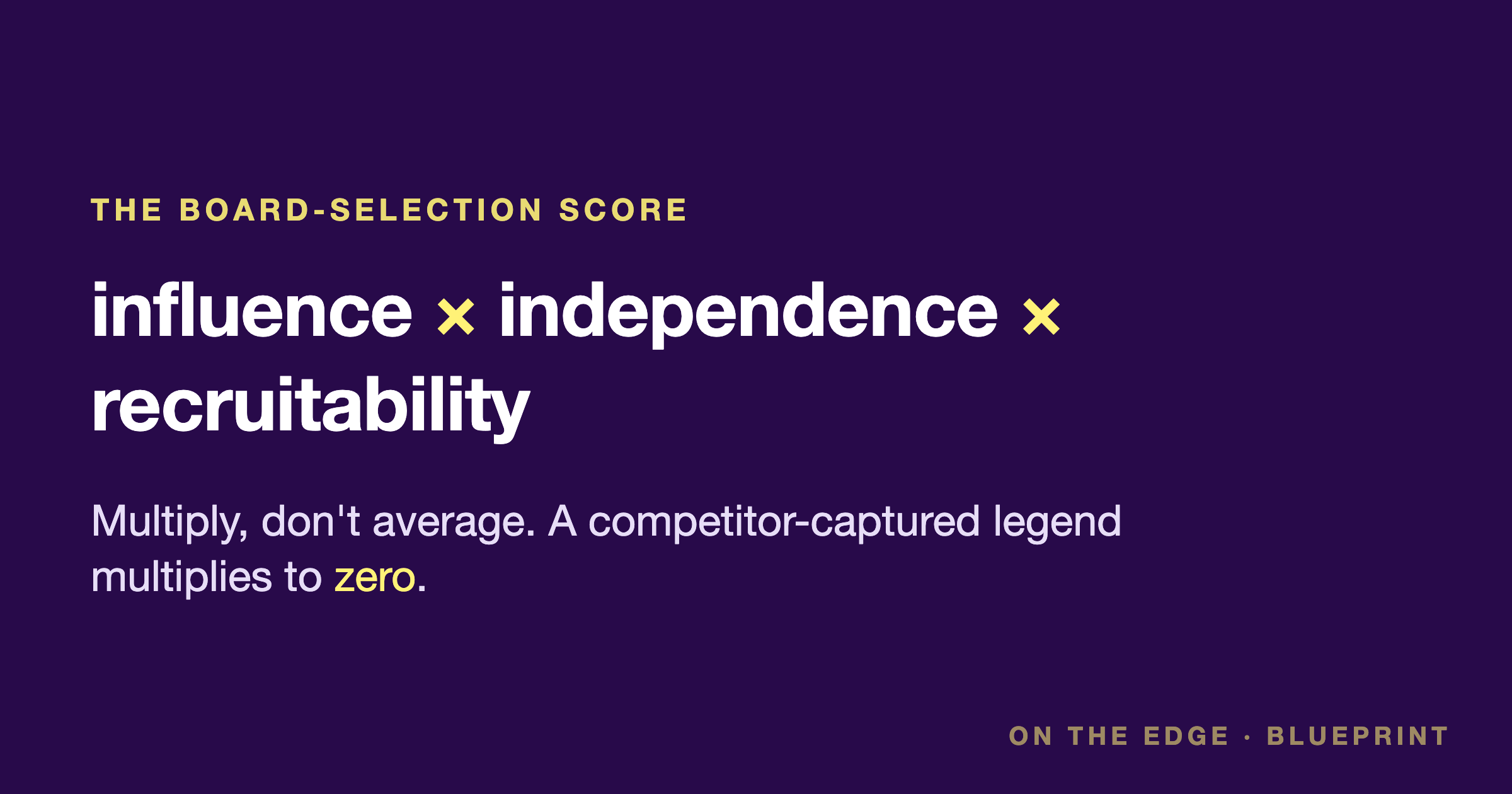
Influence. How much they actually shape the market, scored from evidence, not titles.
Independence. Whether they're already captured. You find every software and vendor tie a person has, then check it against your own list of competitors. Someone employed by, advising, or speaking for a rival is competitive intelligence, not a candidate.
Recruitability. Whether you can realistically win them. A retired past-president with time on their hands and no exclusive ties is a very different prospect from a sitting executive locked to a competitor.
Multiply, don't average — that's the point of the design. A near-zero on any one axis tanks the whole score. The captured legend with influence 0.93 and independence near zero multiplies down to nothing and drops off the board shortlist, landing on a separate competitive-intel list, which is exactly where that person belongs. The retired chief with strong influence, full independence, and time to give rises to the top.
What comes out the other end is two lists. A board shortlist — the independent, recruitable, genuinely influential people, each with the evidence for why they matter and the angle for how to approach them. And an intel list — the high-influence people your competitors already locked up, which is its own kind of gift.
One is a logo collage. The other is a board that does something.
Who Gets This
The method above is the free part. The build that produces those two lists is the paid part.
Free: the method — score a market top-down, separate influence from title, and catch competitor-capture before you recruit.
$50/mo (most readers start here): the build below — the exact pipeline, the per-stage tools, the rubric, and the cost discipline that keeps it cheap.
$2,499/yr: Every tool I ship. Edge Copilot is how you talk to all of it through Claude Code. Current tools: Edge Copilot, AutoClaygent, Agent 7, Who to Target and What to Say, Blueprint Cloud, Technology Finder, Video List Extractor, Competitor Monitor, LinkedIn Engagement, Domain & LinkedIn Finder, Dossier Builder, PDF Contact Finder, TAM Contact Harvester, Find a Rep. Whatever ships next is included. Plus all 3 courses + weekly office hours.