
Sort all of your customers by their influence
I scored 1,145 customers by how connected each owner is — board seats, conference stages, podcasts. Not truck count. The list nobody had.

June 7, 2026 · Build log
A vertical-SaaS company that sells to the trades had about 1,200 customers and a new idea. Pay any customer $1,000 in account credit for every peer they refer who signs. Good program. One problem.
Nobody could say which customers actually carried weight in their industry. The CRM knew revenue, seat count, and renewal date. It didn't know which owner sat on a state association board. It didn't know which one hosted the podcast every other owner in the trade listened to. It didn't know which one got introduced on stage at the national conference.
The company already knew more about its buyers than it had ever looked at. Twelve hundred owner-operators, and the signal for "who can send us deals" was sitting in public — board rosters, conference agendas, podcast feeds, award lists. It had just never been pulled together.
So I built a skill that pulls it together. It's called referral-notability. Point it at a customer list. For every account, one Claude subagent finds the owner-operator, reads their full LinkedIn, and researches their real-world footprint — association seats, speaking, podcasts, press, awards, review scale. A fixed rubric turns all of that into one number: a 0–100 Referral Notability Score.
The score ranks the owner, not the logo
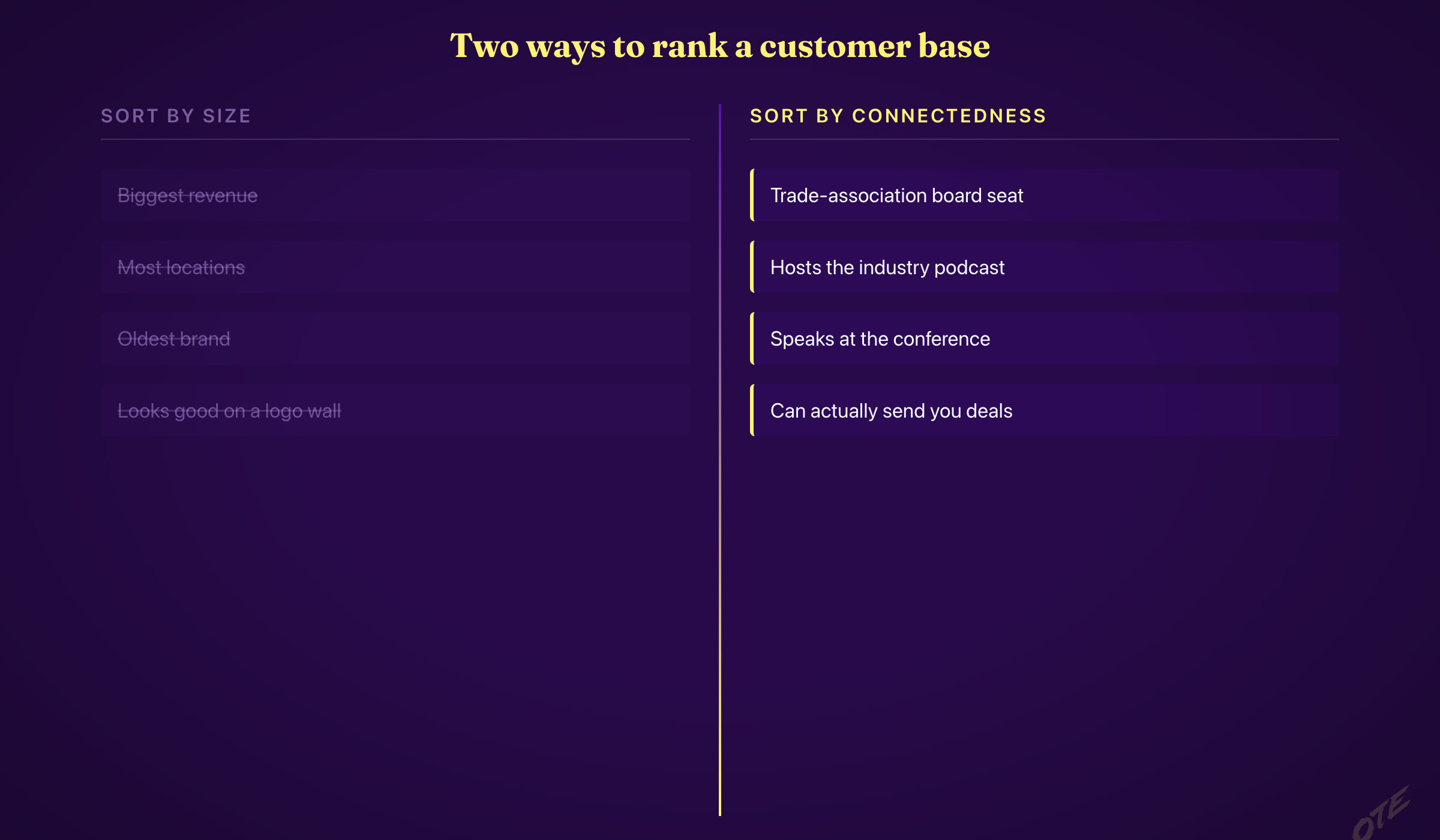
The number ranks the owner's connectedness, not the company's size. That's the part that changes how the list reads.
A 40-year-old, hundred-person institution whose owner keeps his head down ranks below a small shop whose owner chairs the state trade association. The big brand looks impressive on a logo wall. The small-shop owner can walk a peer over to you and vouch. An affiliate program needs the second list, not the first.
Sort a customer base by revenue and you get the org chart you already have. Sort it by who's connected and you get a different list entirely — one your competitors can't buy, because nobody sells "which of your customers other operators actually trust."
The biggest companies didn't top the list
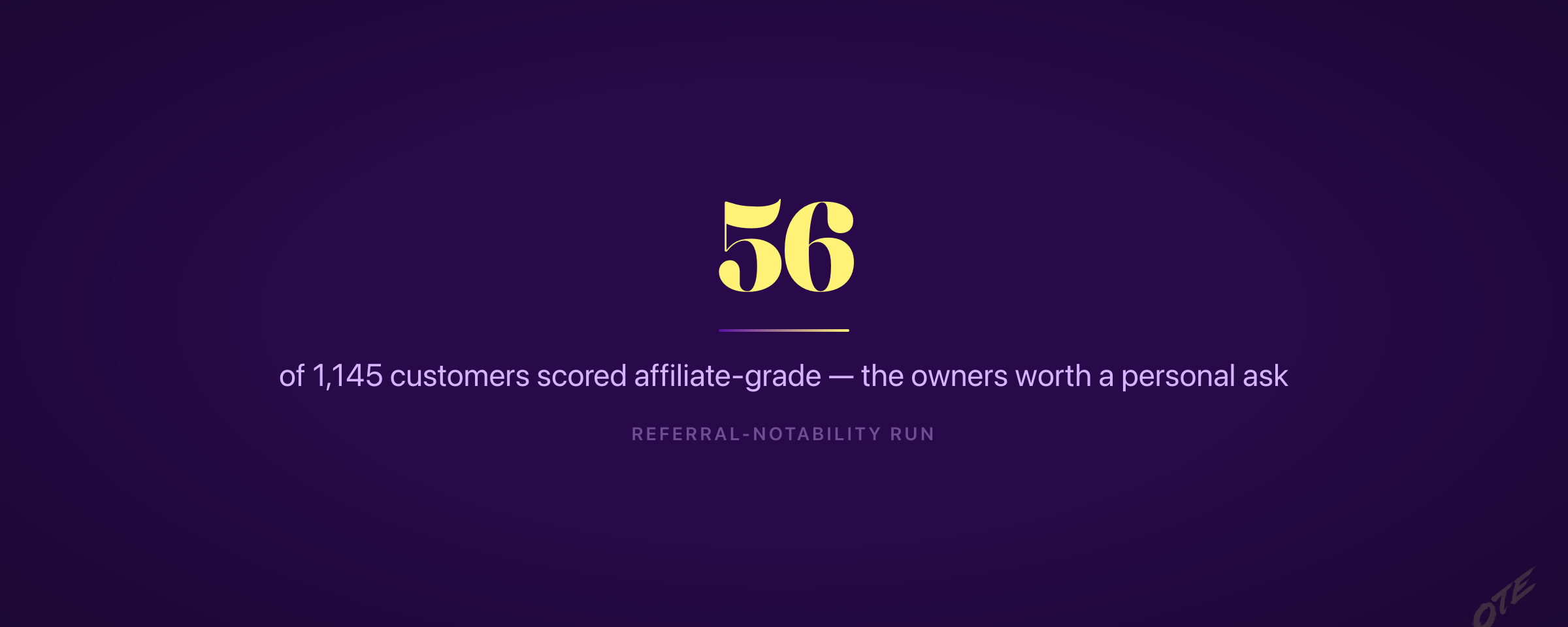
I ran it on the full base. 1,182 accounts scored, 1,145 unique companies after dedup. Fifty-six of them cleared 55 — the affiliate-grade tier, the owners worth a personal ask. Nine cleared 80.
None of the top owners run the largest companies in the file. The number-one owner hosts the most-listened-to podcast in their industry, sits on a national trade-association board, and has won his city's top industry award many years running. Number two founded his state's trade association and still presides over it; he speaks at the national conference and turns up on local TV as the industry's explainer. Another, mid-list, holds an Inc. 5000 placement, a state trade-association board seat, and an operator-of-the-year honor at once. All of them are people other owners in the trade already trust. That's the trait the affiliate program was actually buying.
The CRM never had the owner's name
The CRM almost never named the owner. A company record, a billing contact, a renewal date — but rarely the person who founded the place. So the system never trusts the CRM for it. It goes and finds the owner for every account, and it resolved a named owner for 1,112 of the 1,145 companies. About 97%.
It looks the cheap way first. A LinkedIn data lookup that's already on the plan, then a two-tenths-of-a-cent web search, and only a pricier deep search when there's a real thread to chase. On an account with no digital footprint — a tiny shop, no press, a thin profile — it stops. You don't pay to dig a dry well. (The full cascade is in the recipe below.)
The bug that quietly ate data
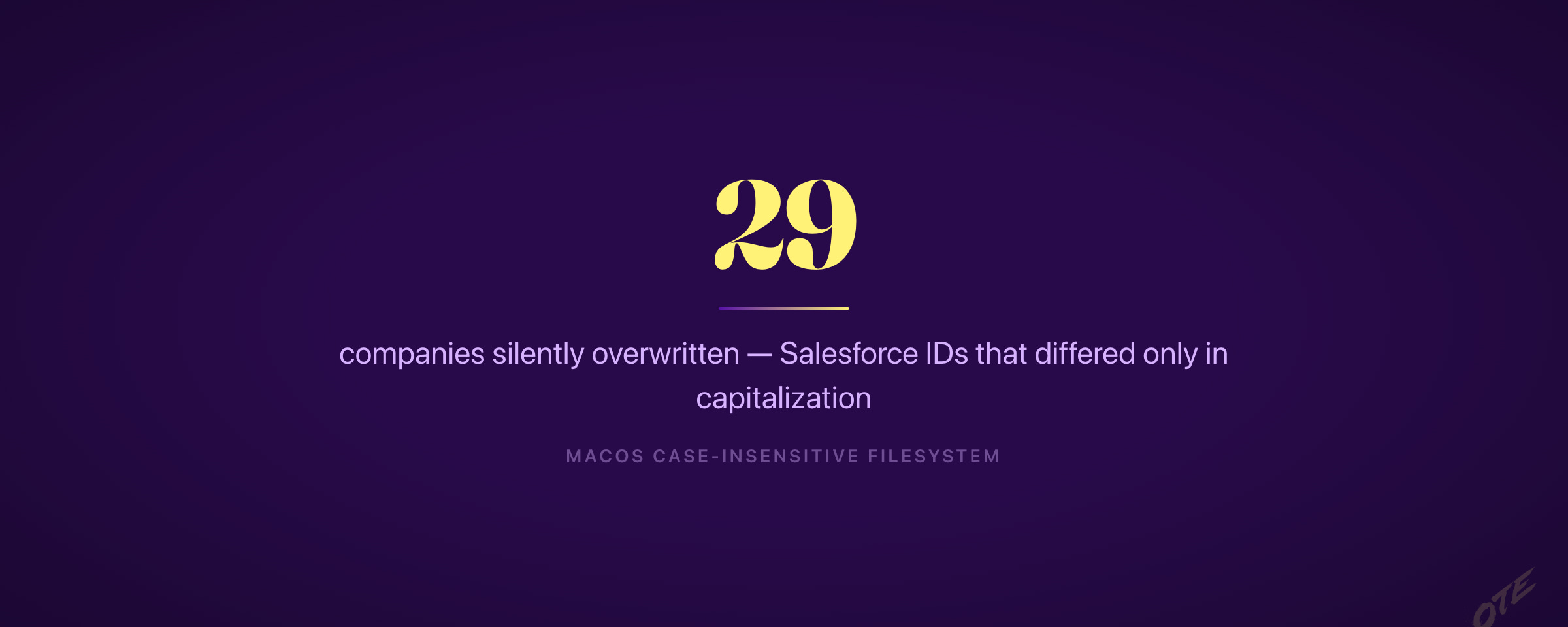
The system writes each account's evidence to a file named after its CRM ID. Twenty-nine times, different companies had Salesforce IDs that collided on case alone — sPSNT versus sPSnT. macOS treats those as the same filename.
So one company silently overwrote another's score file. No error. No crash. Just data that quietly wasn't there. I caught it, re-keyed every file so case can't collide, and re-scored the affected accounts. The boring infrastructure detail is the one that eats your data — the filesystem you never think about decided two of your customers were the same company.
Why this keeps working
This is the move I keep coming back to. You almost always know more about your buyers than you've bothered to look at. The data to rank your own customers by influence is public, and it's free to read. Assembling it is the work nobody does — so the operator who does it ends up with a list no competitor can purchase.
Run it once and you stop guessing who to ask. You email the fifty-six owners the rest of the trade already listens to, not the fifty-six biggest invoices.
— Jordan
Written with Claude Opus 4.8
Below is the geeky version. Copy it into Claude Code and rebuild the whole thing yourself.
Or don't. Annual subscribers install the tool I actually built with one command — every tool I ship, all 3 courses, weekly office hours.
→ Go annual — $2,499/yr · Start at $50/mo (most readers start here)