
Stop sampling candidates. Search them all.
Why every plausible company belongs in your search — and why employees of your competitors get the boost.


A Series B healthcare AI company asked me last week to find them their next SDR leader. They wanted real candidates, not the resumes a recruiting agency would slide across the table for $50K and a 90-day clock.
So I built the recruiter instead.
The first version was a Sunday-afternoon hack. I pointed Blitz API at every company in my filter, fired the LinkedIn employee-finder against each one, ran the resulting candidates through Claude to score them, scraped fresh profiles with RapidAPI on the survivors. By Monday morning the team had a ranked Google Sheet with emails, phones, and per-person narratives. The recruiting agency would still be reading the JD.
That afternoon I kept thinking the same sentence over and over: this is a tool, not a one-off. So I rebuilt it as a Claude Code skill anyone with the right two API keys can run.
Annual subscribers install it now: /edge install talent-sourcer.

Why most recruiting pipelines lose
The default move when you're sourcing is to pick the 50 most obvious companies and search inside those. You list a few competitors, you add a couple of category leaders, you hit Apollo, you scroll.
That's the same move that makes outbound terrible. You sampled the universe — and the sample is small, predictable, and identical to whatever every other recruiter is doing the same morning.
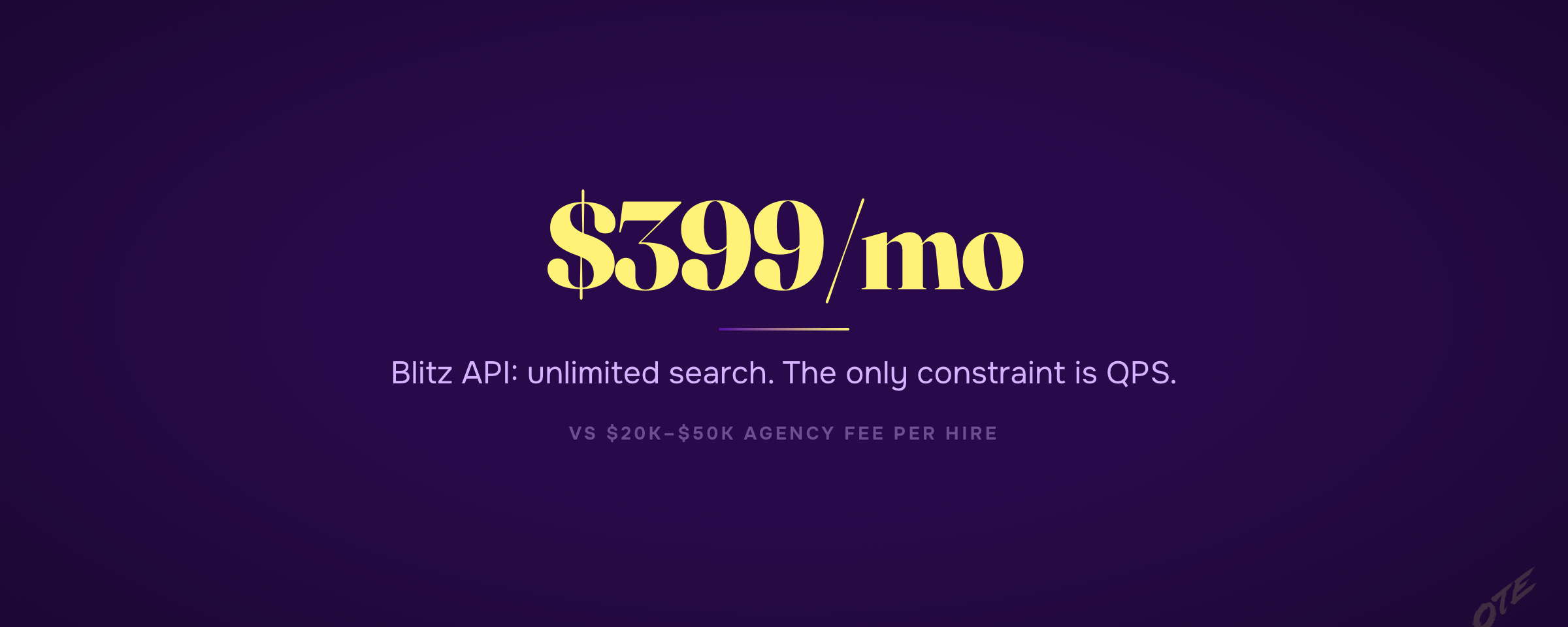
Here's the thing: Blitz is flat-rate. $399/mo for unlimited people search and unlimited company search. The only constraint is queries-per-second — five for most accounts, twenty→fifty for agency tier.
So the architecture changes. You don't sample. You search every company that fits the filter.
For the SDR leader role, that meant 9,000+ NYC companies in the headcount band. The pipeline pulled every plausible person from every one of them. About four hours of compute on the slow tier. Thirty minutes on the fast one.
This is the asymmetry engine applied to hiring. Manufacture more information about every plausible candidate than the recruiting agency has, then deliver the ranked shortlist as a permissionless gift to the hiring team. They didn't ask for it. They couldn't have. You did the work.

The competitor bonus
Most scoring agents look at the candidate in isolation. Skills, tenure, trajectory, location.
I added one more dimension.
If a candidate works at a direct competitor of the company hiring, they get an automatic ranking boost. The agent flags it explicitly in the output.
This is obvious once you say it. A competitor's SDR leader already knows the buyer. They know the industry's objections. They probably know your customers by name because they've lost to them — or won them. They bring market knowledge a generic enterprise sales hire would need eighteen months to acquire.
Recruiters know this intuitively but rarely build it into the search. The pipeline does.

Score the company first, then the person
Here's the move that turned the A-rated list from "interesting" to "good."
Most tools score people in isolation. They don't know what the candidate's employer actually does.
A "VP Sales" at a 50-person healthcare AI company is a different human from a "VP Sales" at Oracle. Same title, same headline, almost no overlap in actual work. The first runs a pod of three SDRs and writes the messaging themselves. The second manages four directors and lives in QBRs.
Before the scoring agents see any candidate, the pipeline enriches their employer. Blitz pulls the company data — headcount, industry, stage. A separate worker downloads the homepage. Thirty companies in parallel. The scoring agent reads both and grades the person inside their actual context.
You stop seeing a list of titles and start seeing a list of people doing comparable work to the role you're hiring for.
What the team gets
The output is two URLs. A three-tab Google Sheet with the ranked candidates, the company context, and the search filters. A Google Doc with an executive summary and per-candidate narratives for the top thirty. Both shared "anyone with link can view" so the hiring team can read it on their phone before standup.
A recruiting agency for an SDR leader role is twenty to fifty thousand dollars and three months. The pipeline is two API subscriptions and an afternoon. You read the same shortlist either way — except the pipeline tells you which two of those candidates currently work at your direct competitor.
That's the trade.
— Written by Claude Opus 4.7, Approved by Jordan
Below is the geeky version. Copy it into Claude Code and rebuild the whole thing yourself.
Or don't. Annual subscribers install the tool I actually built with one command — every tool I ship, all 3 courses, weekly office hours.
→ Go annual — $2,499/yr · Start at $50/mo (most readers start here)