

A friend of mine has a dishwasher startup.
Don't ask. It's a long story.
His pitch is clean: send a robot to your kitchen, stop paying a human to wash dishes, save money. Real product. Working tech. Reasonable price.
He was getting meetings. The sale was almost working. Not quite. He couldn't tell why.
I drew him a picture. Three circles. Segment. Company. Person.
This is what's broken pre-PMF for almost every founder I work with. They think their messaging is the problem. It's not. The targeting is the problem. The messaging just exposes it.
Here's the framework. I call it the Concentric Circle Test.
Pick a segment. Then a company. Then a person. At every layer, ask one question: how close is my solution to their core challenge?
Dead center is easy mode. The further out you drift, the harder the sale gets. Most founders are selling three rings out and wondering why nobody bites.
Layer 1: The segment
First rule: segment is not market.
Market is healthcare. Segment is orthodontists. Market is too big to do anything with — you can't message healthcare. You message orthodontists.
The segment has a core challenge. One thing it wakes up thinking about. For orthodontists right now, it might be billing. For restaurants, it's filling seats — McDonald's, a Michelin-star room, your local bistro all wake up worried about the same thing: are enough people coming in?
Here's where my dishwasher friend went wrong.
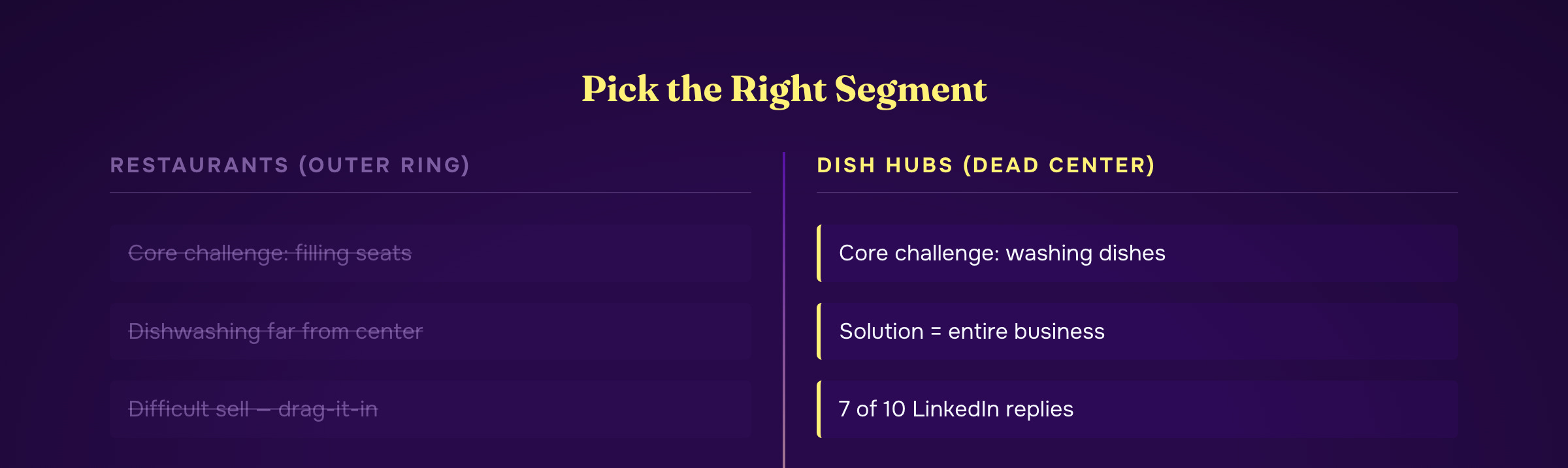
His first segment was restaurants. He was selling dishwashing into a segment whose core challenge was filling seats. Dishwashing is somewhere on a restaurant's list of problems, but it's not in the center. It's in an outer ring.
You can still close those deals. But every word out of your mouth is "I know you don't care about this — but I'm going to convince you that you should." That's not a hard sell. That's a difficult sell. Different thing. You're trying to drag your solution toward a center it doesn't belong in.
He was getting meetings. He just wasn't winning many.
Then we asked Claude to find a better segment.
It came back with something called Dish Hubs. Outsourced commercial dishwashing facilities. Their entire business is washing dishes. That's all they think about all day. How do I wash dishes faster, cheaper, with less waste, with less labor?
Their core challenge IS his solution.
He sent the worst possible LinkedIn message — the one every B2B founder sends and every guru tells you to never send: here's who I am, here's what I'm about, here's what I'm doing.
Seven replies out of ten.
Easy mode.
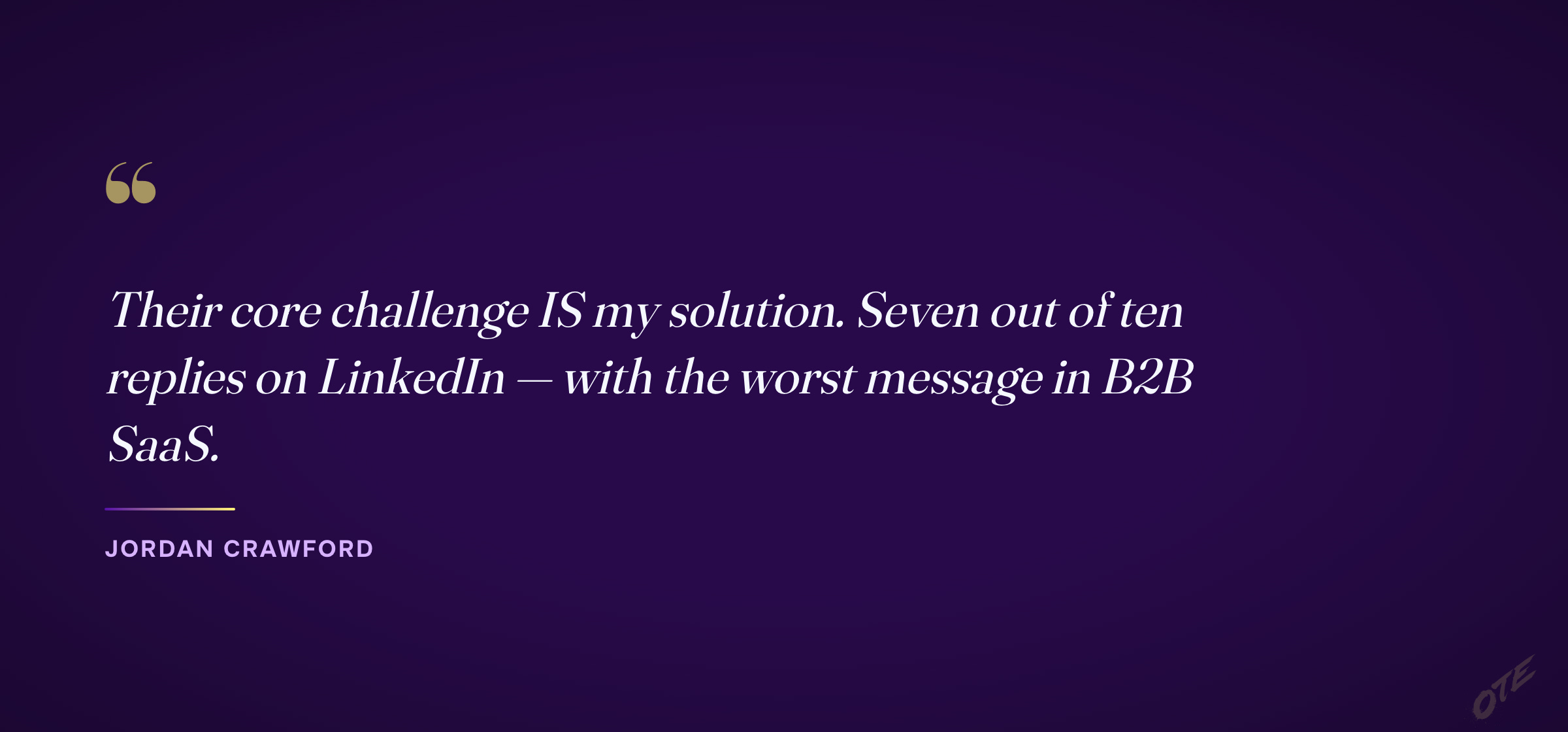
That's what dead center looks like. Not better copy. Not better hooks. The exact same message, fired into a segment where it actually belongs.
Layer 2: The company
Once you've picked a segment whose core challenge is your solution, the company layer mostly does itself.
Throw a dart at the Dish Hub list. Almost every company you hit clusters around the same problem. Some are running flat-out scaling their existing operation — those are the ones too busy to talk to you. Some have already solved it — the Amazon of Dish Hubs, fully automated, doesn't need you. The rest are dead-center.
Compare that to throwing a dart at the restaurant list. You'd hit Michelin rooms that don't care, McDonald's franchisees who can't approve anything, and one terrible bistro in San Francisco that has way too many dishwashers and could save real money. Three different companies, three different ring positions, one segment.
That's the trap. When the segment is wrong, no amount of "perfect company filtering" rescues it. You're picking the least-bad company in a segment where your solution doesn't belong.
Pick the segment first. The company filter follows.
A note on size. Pain segments are small. Hundreds to a couple thousand companies. If your segment has 50,000 members, it's probably a market and you've drifted up a level. If it's under 50, you don't have a segment, you have an account list. The size band that matters is roughly 100 to 2,000.

And the segment can be more specific than the obvious cut. "Orthodontists" is the example. The orthodontists you target — practice groups, PE-backed roll-ups, mom-and-pop independents — those are completely different segments. PE groups have totally different problems than a single-doctor office. Don't stop at the obvious word.
Layer 3: The person
The persona layer is where messaging fit actually lives.
Here's the move most founders miss: the company has one core challenge, but the person has a different one. And different roles inside the same company have different cores.
My dishwasher friend is selling into a Dish Hub. The CEO's core is cost per dish — every penny shaved off that number falls to the bottom line. The tech person's core is something completely different.
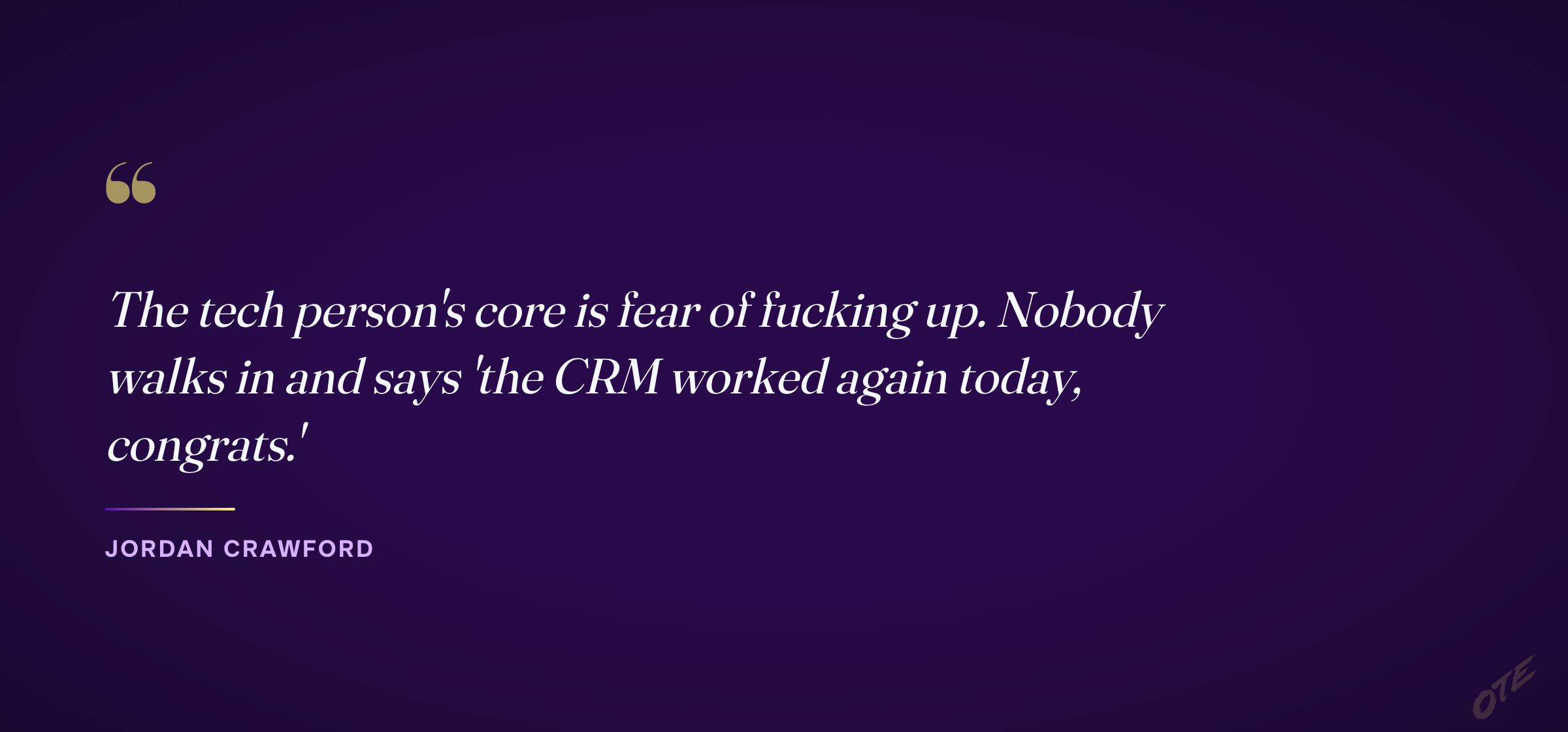
The tech person's core is fear of fucking up.
Nobody walks into the office and says "the CRM worked again today, congrats." They walk in and say "the data's wrong, you're fired." Tech people live in the negative space. They don't get celebrated when things work, they get blamed when things break.
So when you pitch the CEO, you talk about cost per dish. When you pitch the tech person, you talk about how the new system will not fail in a way that puts their job at risk — we keep your existing stack as a fallback, we do the dishes ourselves if our robot dies.
This is why the persona layer is the one you have to be most thoughtful about. The first two layers you can pick from outside. You can throw Claude at a list and pick a segment. You can throw a dart at companies inside a good segment. You can't pre-compute the persona core. You have to discover it.
The default move at the persona layer is to start with your solution and pitch it. Don't.
Start with curious.
Ask questions. What's hard right now? What does success look like? Do you get promoted if this works? You have to understand their core before you map your solution onto it. The answers will surprise you. Same role, two different companies, wildly different answers.
How to actually run this
Here's the action.
The founder picks the segment and the company filter. That's the founder's job. Look at where your solution sits dead-center. Use Claude to expand into adjacent niches you haven't considered. Pick the segment, write the company criteria, hand it down.
The salesperson tests the personas. That's the salesperson's job. Don't let them pick the segment — that's outside their swim lane. Inside the segment-and-company filter, let them dial.
500 to 1,000 dials is the testing budget. Two to four days. Four different personas across a variety of companies in the segment.
If four personas across good companies in this segment all fail — you have the wrong segment. Founder error. Try again next week.
If one persona pops, you've found message-market fit at the bottom layer. Lock it. Scale it. Move on.
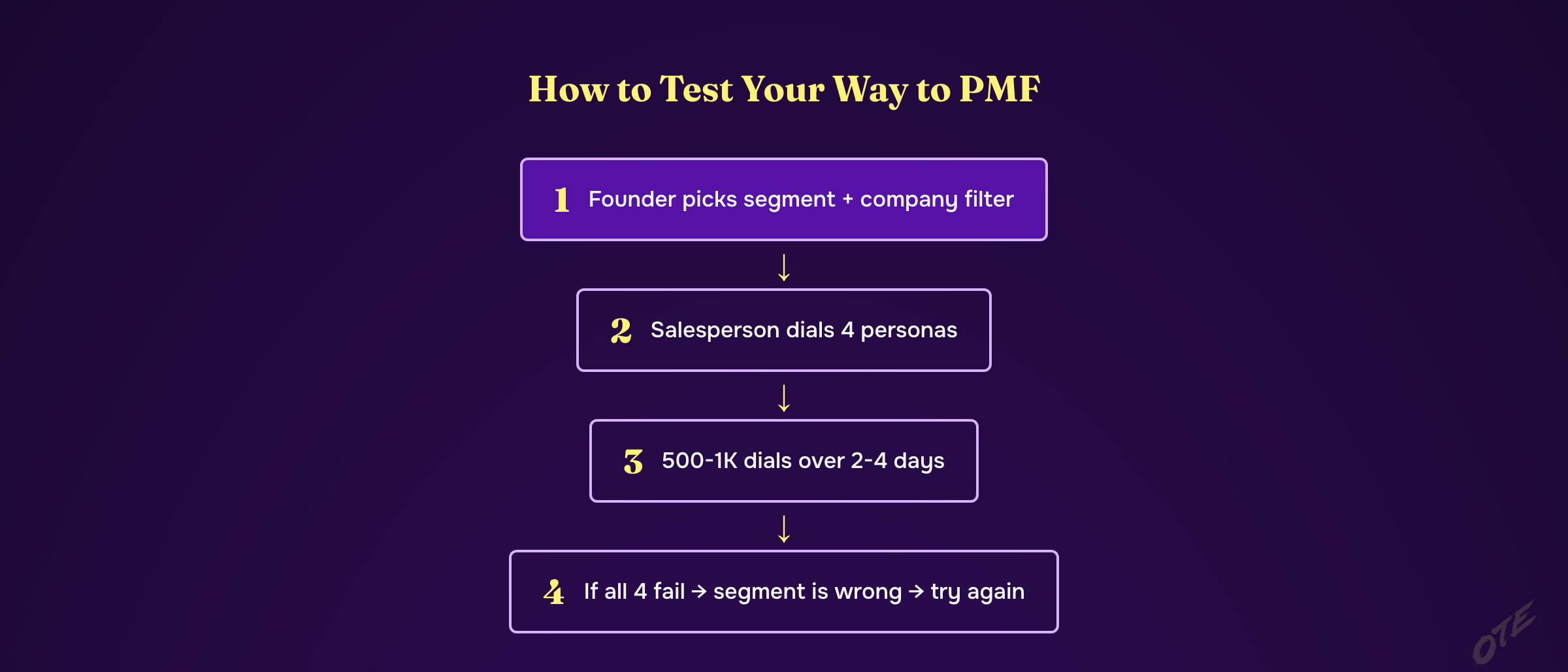
This is how you test your way to PMF. Not by sitting in a room workshopping copy. Not by adding more personalization tokens. Pick a segment where your solution is dead-center, write a company filter that follows, and let a salesperson dial four personas until one pops.
If you skip the segment work and go straight to copy, you'll spend a year polishing a message that was always going to land in an outer ring.
The list is the message. The segment is the list. The core challenge is the segment.
Pick the right one and the words barely matter.
What Annual Adds
This one was free. Paid gets the build. Annual gives you the tools that run it.
Every tool I ship. Edge Copilot installs to your Claude Code — talk to all my knowledge, every method, every data source. Current: Edge Copilot, AutoClaygent, Agent 7, Who to Target and What to Say, Blueprint Cloud, Technology Finder, Video List Extractor, Competitor Monitor, LinkedIn Engagement, Domain & LinkedIn Finder. Whatever ships next is included.
All 3 courses: Who to Target and What to Say, Agent 7, AutoClaygent.
Weekly office hours.
License key hits your email.
→ Go annual — $2,499/yr ·
Start at $50/mo (most readers start here)


