

Well, hello. Good to see you.
There's a line I keep coming back to. William Gibson, early '90s: "The future is already here — it's just not very evenly distributed."
AI is the same. It's here, and it's unevenly amazing. The best place you can stand is in the future, at the top of the peak.
TL;DR: A job is just a collection of tasks, and AI is jagged — incredible at some of those tasks, useless at others. Most people approach their AI transformation by working backwards from the jobs they already have. Flip it. Start from the impossible thing you'd do with a magic wand, then work back to what has to exist to make it real — on the sharpest tools that exist. That's where the value hides.
A job is just a collection of tasks
I said this on the podcast with Kyle Norton a couple months ago: a job is just a collection of tasks. And AI is jagged. Amazing at coding. Can't tell you how many r’s are in strawberry or how to get your car to a car wash (just walk if you’re close, it says).
Some of those tasks you should never hand to AI. They're human judgment, and they stay yours.
Donald Rumsfeld had a framework I love (I like the framework not the bombing of Iraq): there are known knowns, known unknowns, and unknown unknowns. The tasks we know about, we can sort — is a human better at this, or is the machine? That's what forward-deployed engineers do when they study your job. They ask what they can take off your plate to give you time back.
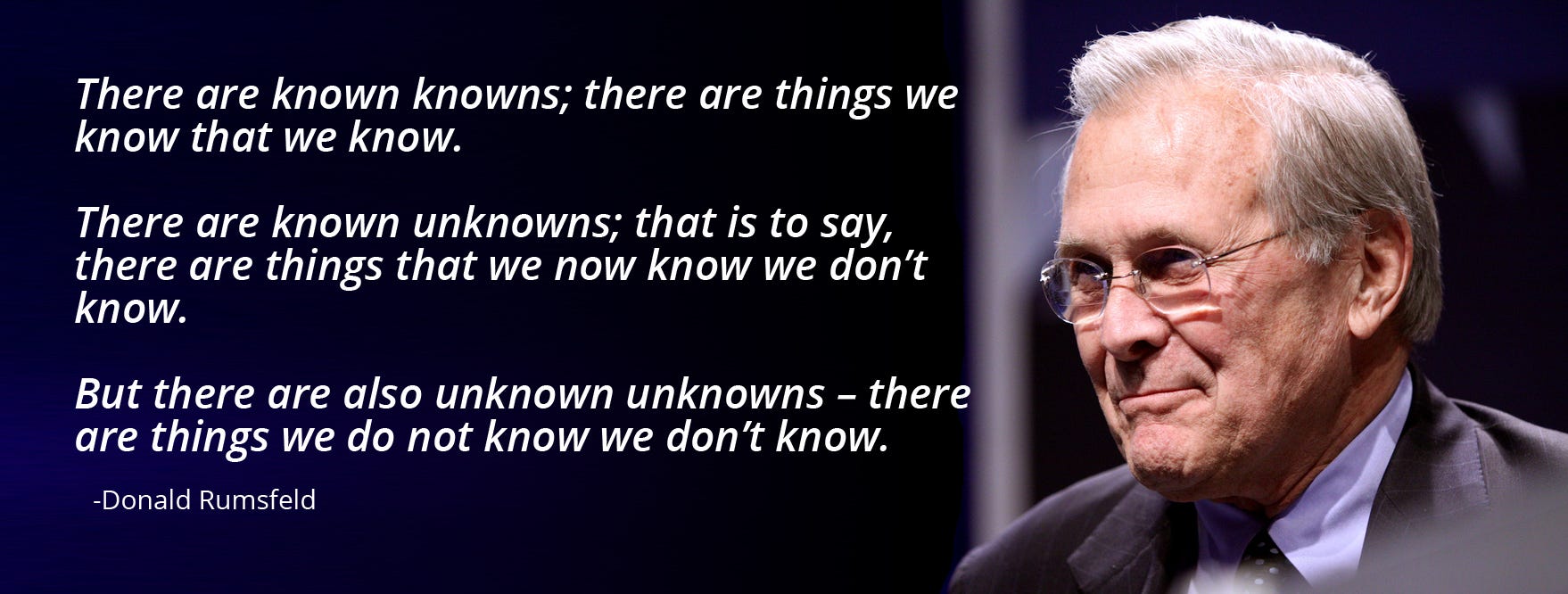
But the real prize is in the unknown unknowns: the task that only the very peak of a jagged AI edge can do. Nobody's mapped it yet, because nobody could do it before.
Live at the top of the peak
The future is here and it's unevenly distributed. AI is here and it's unevenly amazing. So stand in the future, at the top of the peak.
That's how I've built my whole business since Claude Code. I don't like being tied to a tool — tools come and go. But this agentic way of working isn't going anywhere.
The edge is the meeting point of two peaks: the very latest in AI — the best model (Opus 4.8 today, Fable soon, hopefully), the best harness (Claude Code in the terminal), the best tools — and the most imaginative use case you can point it at.
What AI is still bad at
I got a message on Substack today. A guy with 300 followers wanted us to recommend each other. Here's part of what he wrote: "I came across your Substack and really like your approach to AI and go-to-market. Your focus on sharing actual use cases and practical tools people can use Monday stands out in a space that often gets lost in theory."
The thing is, what he's saying isn't bad. A person could have written that. But it's so AI-coded.
You won't get much out of these models by asking them to write better in a box. That's not what they're great at. Taste, judgment, knowing what's worth saying — still yours.
What AI is incredible at
Now here's what they're amazing at: sorting the world.
I took 16,000 fire chiefs and asked who has the most influence. Who's the most well-known nationally? In Pennsylvania? In California? Who has associations with other software vendors? Who actually shapes the standards your software has to live up to?
I attacked that from multiple angles and ranked all 16,000. About 400 came out the other side. If you were going to give equity in your company to one person in this market, this is the one — and here's exactly why. They open the doors. They influence the standards that govern your product.
You could never ask that question before. That's the kind of thing AI is incredible at.
The two questions
So when you think about your AI transformation, ask two things:
Am I using the very latest tools and capabilities?
What are these tools — Claude Code, Codex — incredibly amazing at, and how does that capability fit my problem?
I hate tool-forward thinking as a general matter. But this is such a step change that exploring the tool is the only way I know to find the creativity you need.
Work forward from the magic wand
Here's the inversion. Don't work backwards from a job. Don't work backwards from a task. Work forward from the impossible action.
If you could wave a magic wand, what would you wave? Then ask: what has to exist to make that real? You start to see you're not so far off.
I worked with a client who kept asking about churn. Who's churning, why, what are people saying — over and over. A reasonable place to begin. But there's a better question than why. Ask: what's the lightest lift for the highest value, which customers are in that exact spot, and can I test it tomorrow?
It doesn't even matter if the model is wrong. If you never try to change anything, you'll never know.

Use the sharpest tool
And use the latest tool. When I hear someone say they're using Claude Cowork, I say stop — it's not nearly as powerful as the terminal.
Claude will quietly set you up on Sonnet, too. You open it and you're on Sonnet, low effort. Change it to the latest Opus 4.8 and crank the effort to the top. Do it in Claude Code.
Then begin from the action. What would I need to know? And what action would have the biggest outcome?
You don't need the best model for everything
I read a post from a team that had been paying six figures for Claude and got excited about a great open-source model. I think the approach was wrong, but the intuition was right: you don't need the latest model to do everything.
What you need is tranches. You divide the work.
Split the work into tranches
I was finding the technologies a company runs. How are we detecting that? We read the HTML. So I asked — can we just download the whole website locally? Sure. What does that cost? Nothing for 80% of sites, because they're not behind Cloudflare. I can pull the whole thing for $0.
So half the job is free. The next slice is harder — maybe a little AI here. Then there are problems that need the very best intelligence, some that need none, and a lot that sit in between.
Divide your problem into that gradient and you can point near-free tools at most of it, and the expensive intelligence only where it earns its keep. Low cost, a lot of output.
Open your eyes
So that's the lens. Don't work backwards from a problem, a job, or a task. Start from the biggest form of your imagination. Figure out what that is, then work back to what has to exist to make it happen — and make sure you're on the very latest tools to do it.
Once your eyes are open, you can't close them again. It changes the way you work.
Have a beautiful Monday. Thanks for letting me ramble.
Chapters
00:00 — The future's here, just bunched up at the edge
01:07 — A job is a collection of tasks, and AI is jagged
02:12 — Live at the top of the peak
03:19 — What AI is still bad at
04:24 — What AI is incredible at: ranking 16,000 fire chiefs
05:26 — The two questions to ask
06:29 — Work forward from the magic wand
08:35 — Use the sharpest tool: Opus 4.8, in the terminal
09:40 — You don't need the best model for everything
10:43 — Split the work into tranches
12:46 — Open your eyes and you can't close them again
What Annual Adds
This one was free. Paid gets the build. Annual gives you the tools that run it.
Every tool I ship. Edge Copilot installs to your Claude Code — talk to all my knowledge, every method, every data source. Current: Edge Copilot, AutoClaygent, Agent 7, Who to Target and What to Say, Blueprint Cloud, Technology Finder, Video List Extractor, Competitor Monitor, LinkedIn Engagement, Domain & LinkedIn Finder, Dossier Builder, PDF Contact Finder, TAM Contact Harvester, Find a Rep. Whatever ships next is included.
All 3 courses: Who to Target and What to Say, Agent 7, AutoClaygent.
Weekly office hours.
Your license key installs /edge in one command — then every tool above drops in on top, each one a /edge install away.
License key hits your email.
→ Go annual — $2,499/yr · Start at $50/mo (most readers start here)

