
What You Get at Each Tier — Free, $50, $2,499
Exactly what each tier buys, itemized and client-free: 443 Corpus entries, 10 installable Claude Code tools, 3 courses, /edge in any session. The free tier is genuinely complete — here's the honest math.

I publish everything I build.
Every pipeline. Every enrichment waterfall. Every government dataset I turn into a list nobody else has. Every time something breaks at 2am and I have to figure out why.
Some of it's free. Some of it's behind $50/mo. And the tools that actually run all of it live in the annual tier.
People keep asking me the same question: what do I actually get at each level? So here it is. The whole thing. Exactly what reaches you, and how deep it goes — as of today, not as a roadmap.
There are 443 Corpus entries, 10 tools, 3 courses — and the math on what each price actually buys.
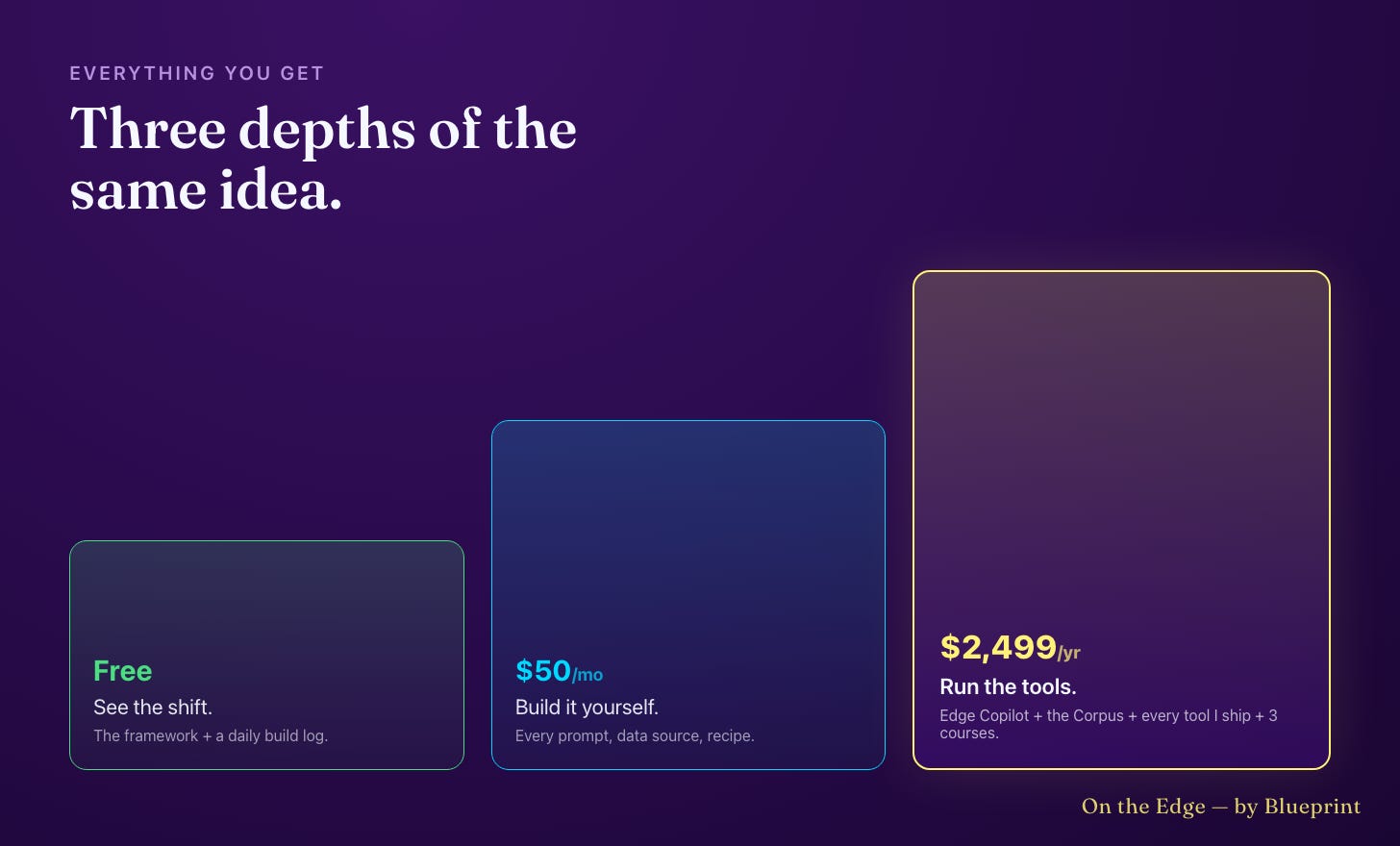
The shape of it
Three levels. One idea underneath all of them.
Old-world GTM goes: pick an ICP, pick a persona, write a message, hand it to a 21-year-old SDR to "personalize," spray the TAM. It doesn't work anymore. It barely worked before.
My world goes the other way: find a pain segment — companies with an expensive problem right now — find the public data that proves who has it, and write the message that references the proof. The list is the message.
That one inversion is the spine of everything I publish. And the three tiers are just three depths of it:
Free — you see the shift. Why the old way broke, who you should actually target, and a daily build log of what I'm shipping.
$50/mo — you see the build. The prompts, the data sources, the exact mechanics behind every tool I make. I do black some stuff out here.
$2,499/yr — you run the tools. They install into your own Claude Code and talk to my entire brain.
Free readers understand it. Paid readers can rebuild it. Annual subscribers don't have to — they just install it.
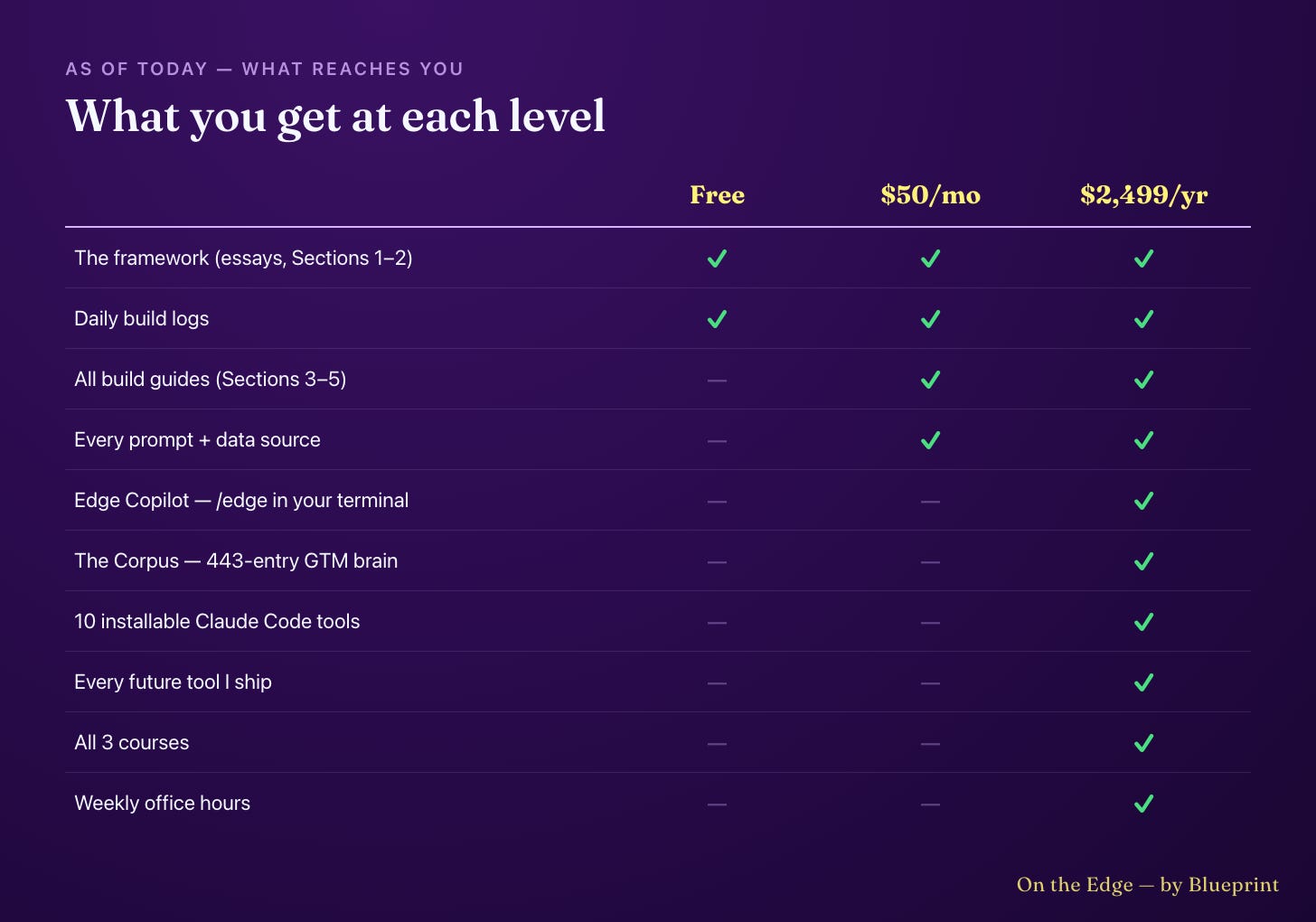
Free — $0
Free is not a teaser. It's the proof.
Two things land in your inbox for nothing:
The framework. Why your ICP is killing your AI GTM. Why personalization is the problem, not the solution. How to find a pain segment instead of a demographic. The whole "old world vs. the new world" argument, with the receipts. Right now that's a dozen free essays, and the foundational ones — Your ICP is killing your AI GTM, Where AI Go-To-Market Is Headed, What AI Transformation Looks Like on the Ground — are the ones I'd hand a new GTM hire on day one.
The daily build log. Most days I publish what I built that day. The swarm I wrote to read every call. The $67K Anthropic bill that wasn't. The Supabase key I found sitting in a client's source code. Six research agents before one line of code. These are free, every time. They're me thinking out loud while the paint's still wet.
If you read nothing but the free tier and never pay me a dollar, you'll still change how you target. That's the point. Free has to earn the rest.
$50/mo — the build
Here's how I put it to a reader last month who asked if monthly and annual were the same access at different prices:
They're two different tiers, not the same thing billed two ways. Monthly gets you the build guides — the how behind everything.
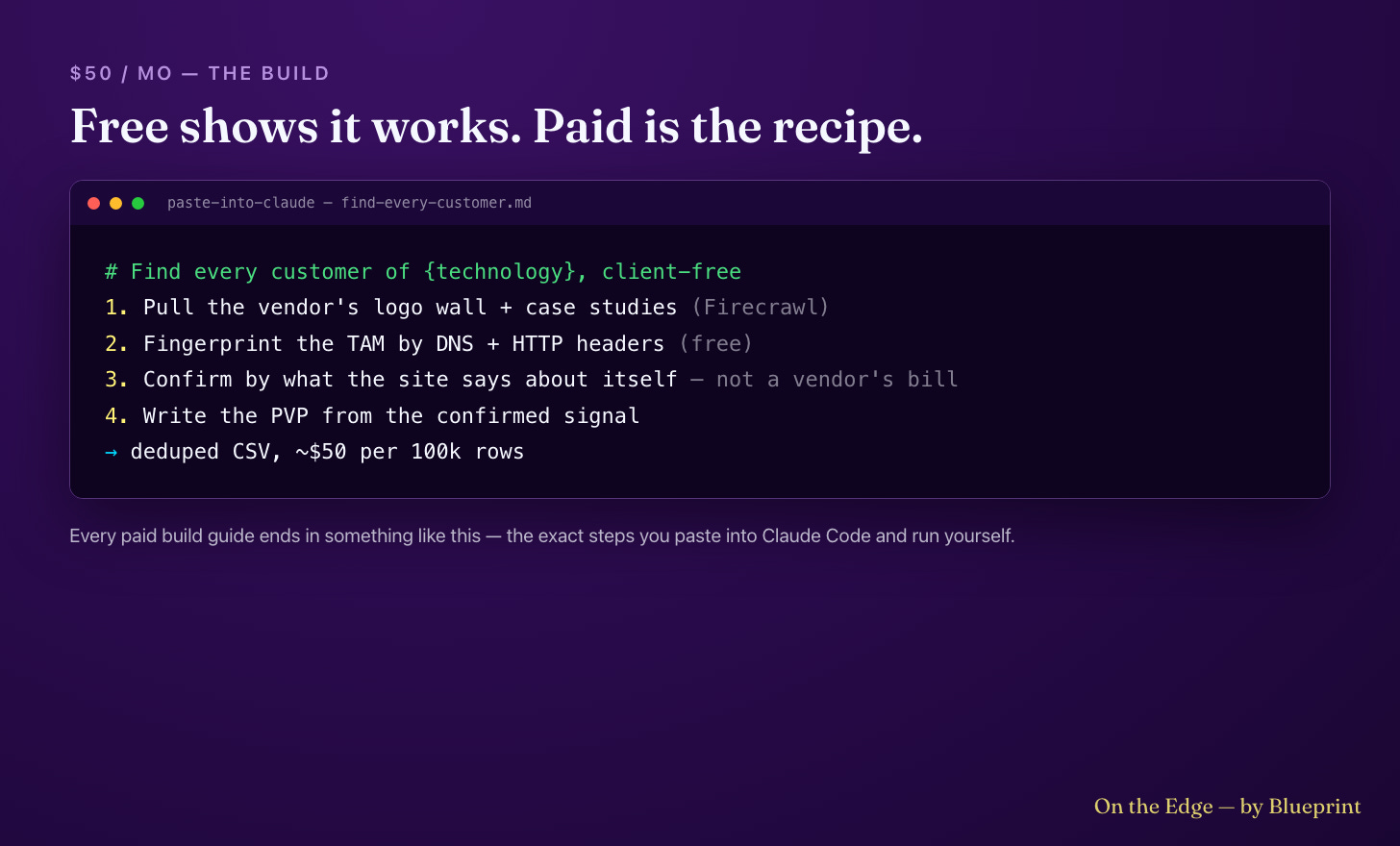
Free shows you that a thing works. $50/mo shows you how I built it, in enough detail to rebuild it yourself.
When I score every parking lot in America for $45, the free half tells the story. The paid half is the recipe — the exact federal photo source, the cheapest vision model, the prompt, the crop logic. When I find every customer of any technology, or send a prospect back 4,614 cardiologists from a 16-page doc, or A/B test Exa against itself and watch the cheap option win 9x — the paid post is the part you paste into Claude Code and run.
Every essay in What Do I Say, How Do I Build It, and What Does the Frontier Look Like lives here. The PQS and PVP message frameworks. The buyer-critique rubrics. The enrichment waterfalls. The data sources most people don't know are public. Today that's 25 paid build guides and counting, and I ship more most weeks.
$50/mo is for the builder who wants to make it themselves. Most readers start here.
$2,499/yr — you stop rebuilding
This is the one I care about most, so I'm going to be specific.
At annual, you don't rebuild my tools. You install them. And you get a thing I've wanted for years: a brain that compounds instead of decaying.
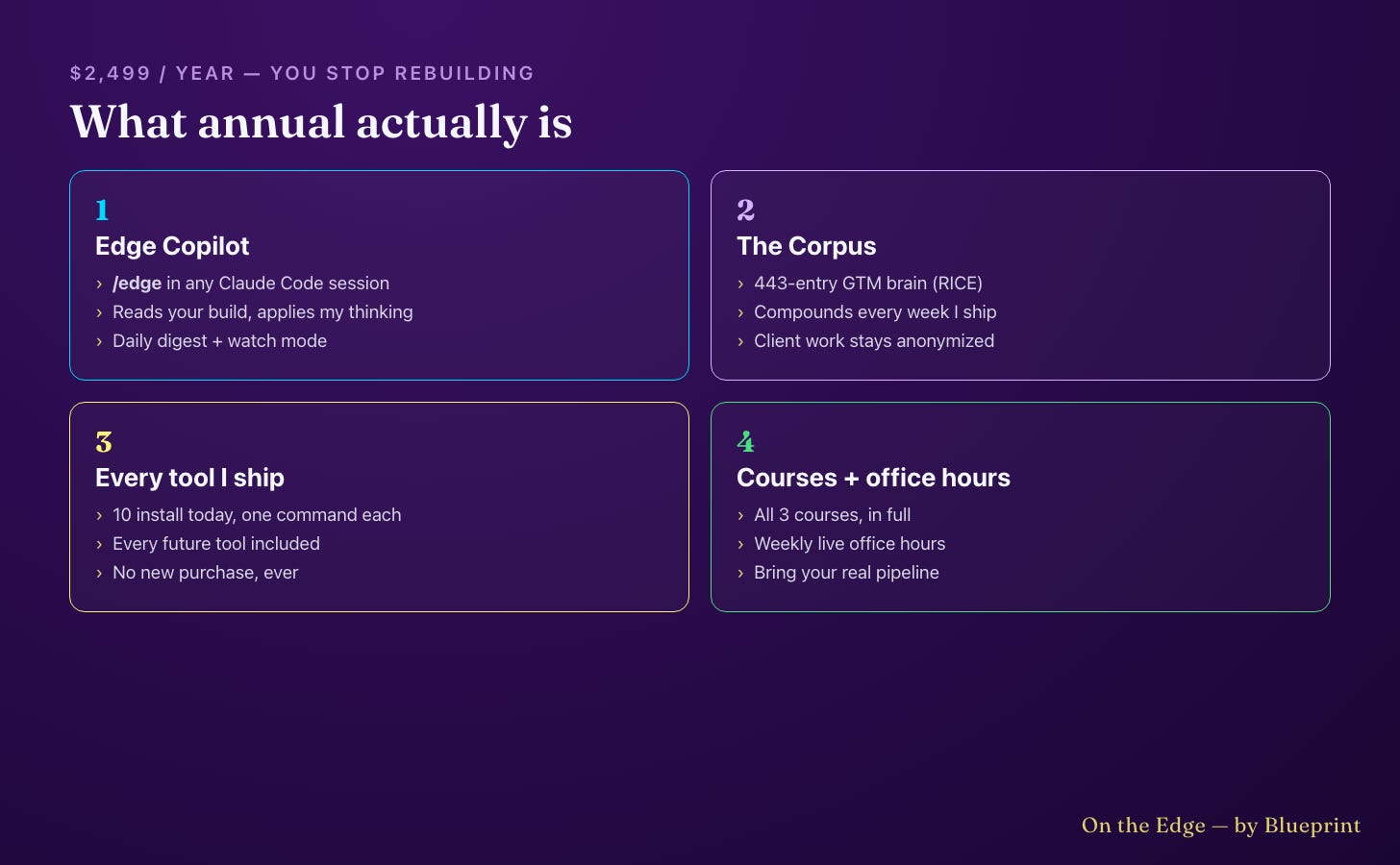
It comes in four parts.
1. Edge Copilot — me, in your terminal
Edge Copilot is a Claude Code skill. You install it once with the license key in your welcome email:
curl -fsSL https://edge-copilot.blueprintgtm.com/install.sh | bash -s -- you@example.com --license 'OTE-...'After that, in any Claude Code session, any project, you type /edge.
Here's the part that matters: it doesn't hand you a post. It reads the session you're already in — the files you're editing, the errors you're hitting, what you're trying to make happen — cross-references that against everything I know, and synthesizes. It quotes me on the piece that fits, applies it to what you're actually doing, and asks the question that moves you forward.
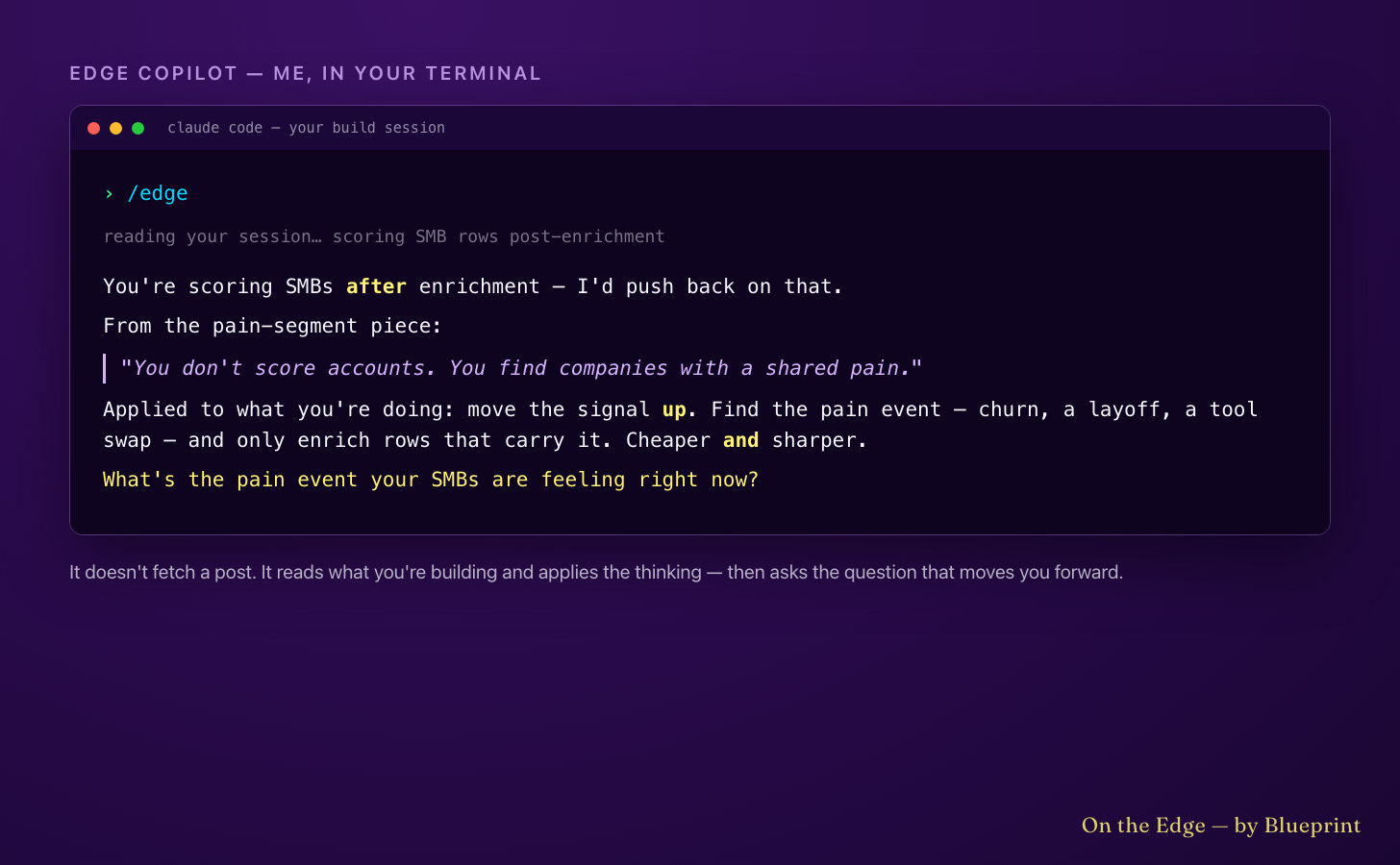
Three things can happen when you ask:
I've written it. You get the exact take, applied to your build. "You're scoring SMBs post-enrichment — push back on that. Move the signal up. Find the pain event first, only enrich rows that carry it. Cheaper and sharper."
It's close but not exact. You get the nearest framing and the gap named. "Closest I have is the PVP piece — the missing layer is persona. Who at the SMB actually feels this?"
I haven't written it yet. You get told that, plainly — and it becomes the thing I write next.
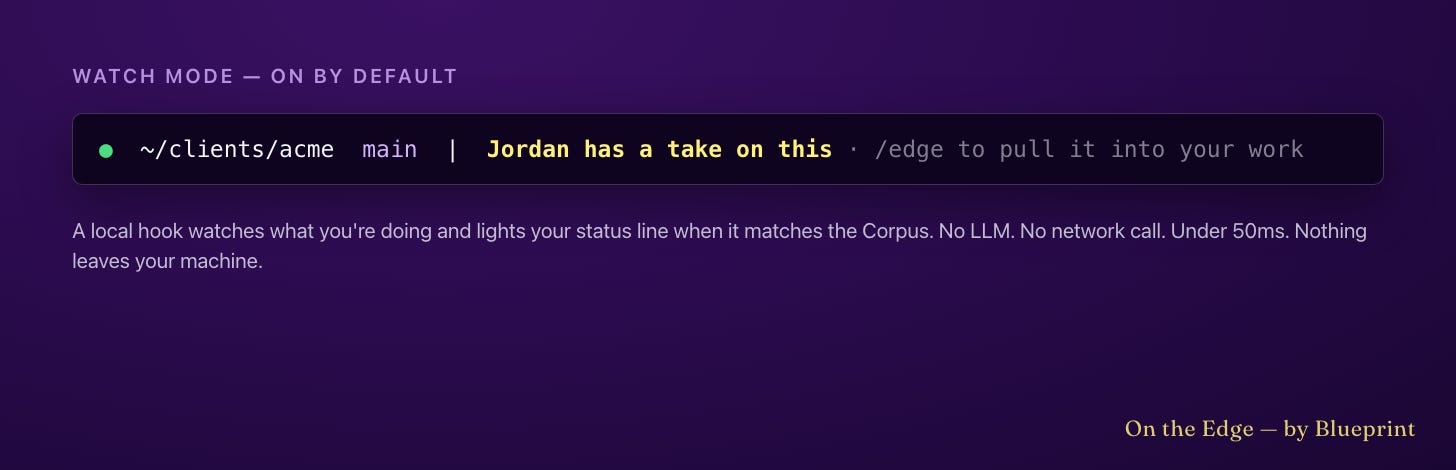
You don't memorize commands. Mostly you just say /edge. But there's a quiet utility surface underneath: a daily digest (each morning, a reasoner reads what you built yesterday and gives you 3-5 takes), watch mode (a local hook lights your status line — "Jordan has a take on this" — when something you're doing matches the Corpus; no LLM, no network, under 50ms), and /edge contribute, where you push back something you built. You pick the privacy level — attributed, anonymized, or anonymous — and nothing leaves your machine without a preview you approve. The server never sees your code, your transcripts, or your client data. Only the slug you asked about and the body I sent back.
2. The Corpus — what "my knowledge" actually means
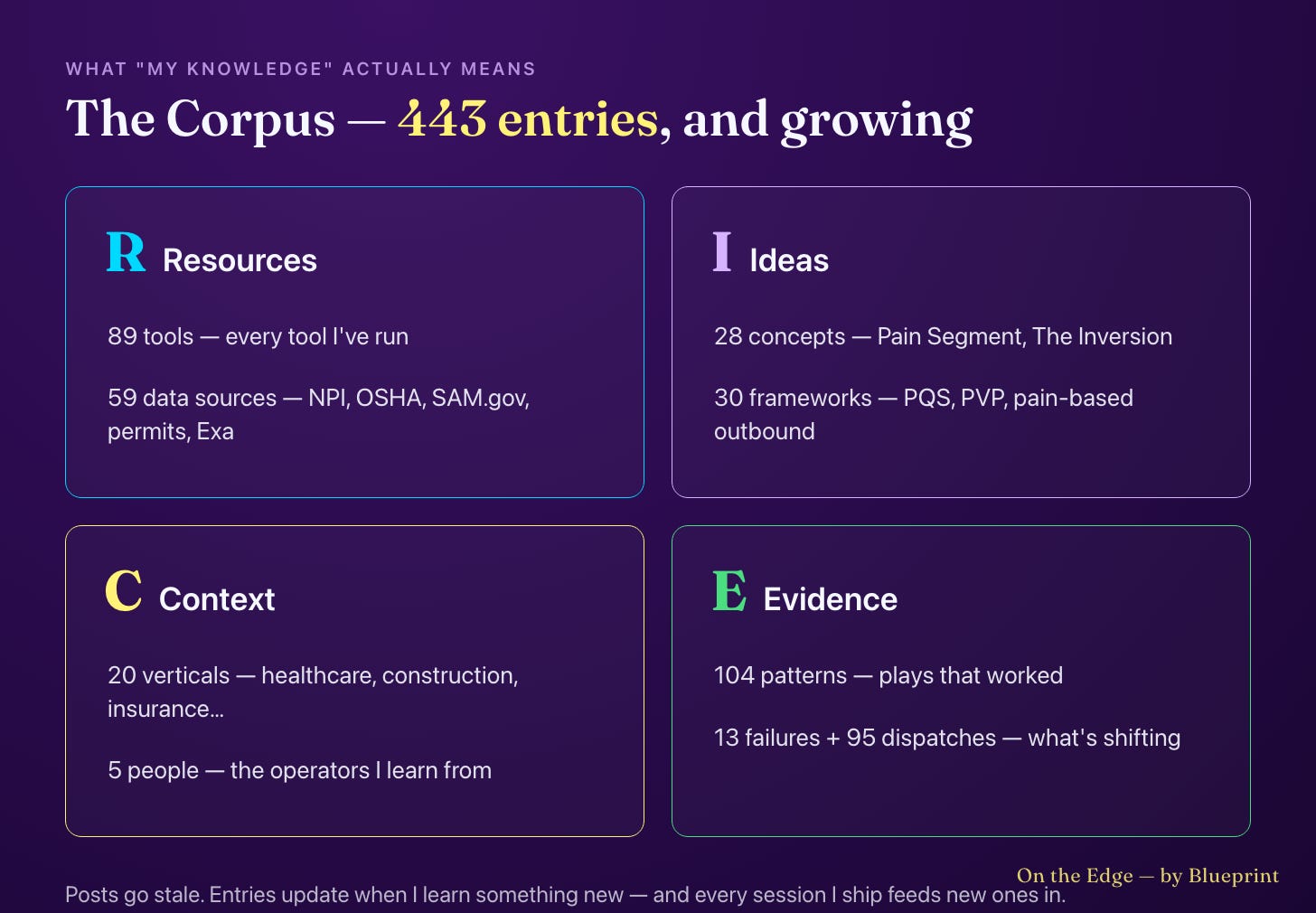
Behind /edge is a wiki. Not a folder of blog posts — a structured brain. Right now it holds 443 entries, and it grows every week I ship something.
I organize it four ways. I call it RICE.
Resources — 89 tools, 59 data sources. Every tool I've actually run, and every data source I pull signal from. NPI, OSHA, SAM.gov, FCC licenses, business permits — the free government stacks. Apify, Exa, Serper — the paid ones. Not a vendor directory. The stack pieces I personally use.
Ideas — 28 concepts, 30 frameworks. Pain Segment. PVP. PQS. The Inversion. Old World vs. Jordan's World. Every load-bearing term I use, defined once and cross-linked.
Context — 20 verticals, 5 people. Healthcare, construction, insurance, financial services, logistics — every industry I've built pipelines for. And the people I learn from, their frameworks linked in.
Evidence — 104 patterns, 13 failures, 95 dispatches. Patterns are plays that actually worked. Failures are the ones that didn't, and why. Dispatches are the frontier notes — what's shifting, day to day.
Two things make it worth more than my archive.
It compounds. Posts go stale the day after they publish. Entries update when I learn something new. When I ship a tool on a Tuesday, a capture script proposes new entries from that session — I review, edit, promote — and your next /edge pulls it before the post exists.
And it stays clean. Every entry that came from real client work has its private evidence held off the wiki entirely. Company names, deal sizes, specifics — they never touch the page you read. You get the pattern. The client stays protected.
"Why pay for that when I can just ask Claude?" Fair question — it's the one I'd ask. A blank Claude prompt gives you something plausible. The Corpus gives you what actually worked: the play I ran, the data source that paid off, and the 13 documented failures so you don't burn a week on one I already burned. Plausible is the enemy of correct. The Corpus is the part Claude can't guess.
3. Every tool I ship
Edge Copilot is how you talk to my knowledge. The tools are how you run it. Each one installs into your Claude Code with one command — /edge install <name> — and each one started as a free build log you can already read.
As of today, ten install on demand:
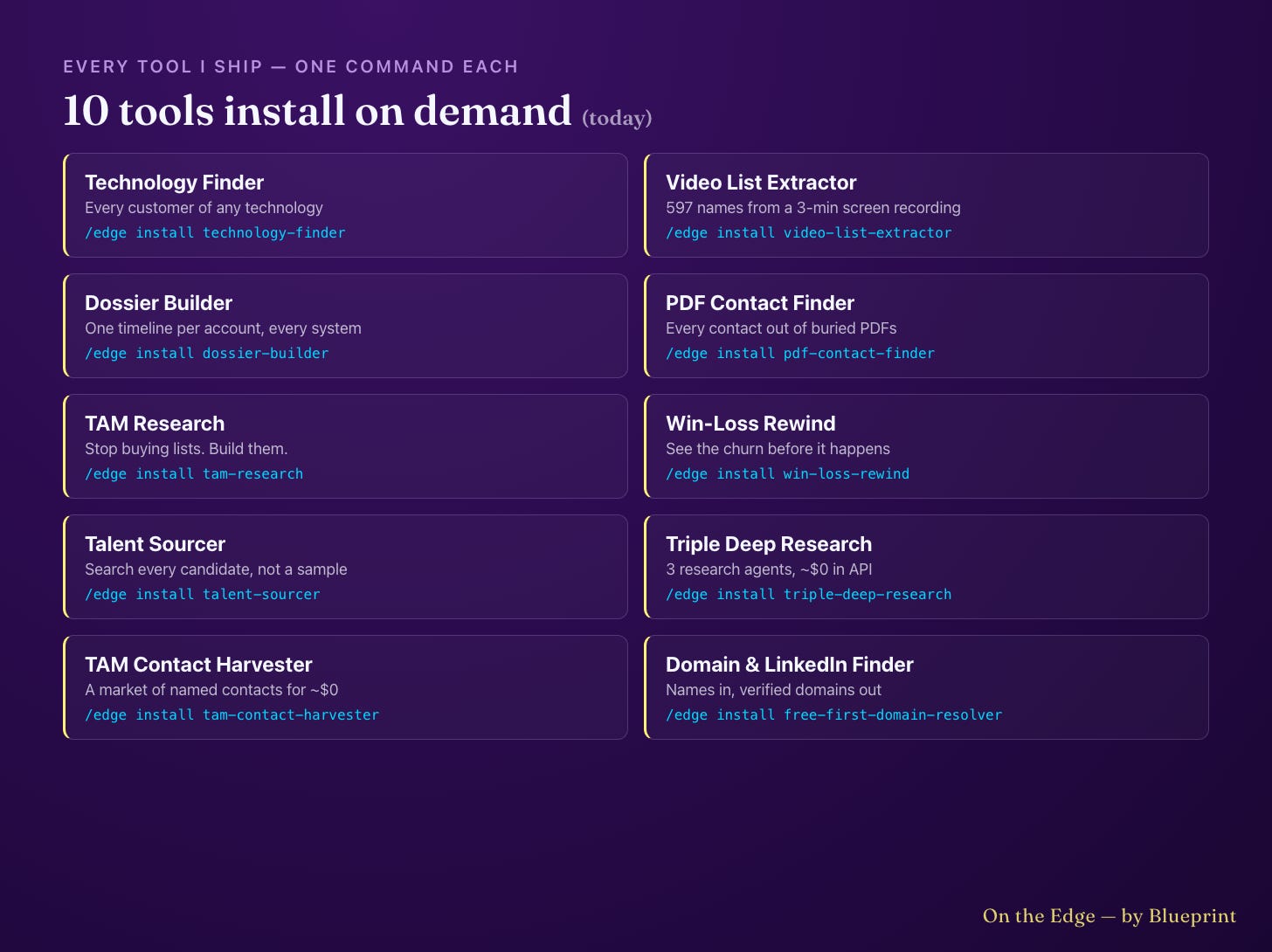
Technology Finder — find every customer of any technology, from DNS and HTTP signals.
Video List Extractor — pull a clean list out of a screen recording. 597 attendees from a 3-minute video with no export button.
Dossier Builder — one unified timeline per account from every system: CRM, calls, billing, product, support.
PDF Contact Finder — find contact-bearing PDFs across federal and state sources, extract every row into a deduped CSV.
TAM Research — stop buying lists. Build them.
Win-Loss Rewind — could you have seen the churn coming? Replay the account and find out.
Talent Sourcer — stop sampling candidates. Search all of them.
Triple Deep Research — three deep-research agents (Claude, ChatGPT, Gemini) at near-zero API cost.
TAM Contact Harvester — a market of named contacts for almost nothing: read the free pages with free code, pay only for the residue.
Domain & LinkedIn Finder — company names in, verified domains and LinkedIn URLs out. ~$50 per 100k.
That's the list today. Whatever I ship next is included the day it ships. That's the whole promise of annual — not a fixed bundle, an open subscription to everything I build.
If you've watched a Clay seat sit half-used three months after you bought it, I get the worry: ten tools can read like ten things to feel guilty about not using. These don't sit in a dashboard you forget to open. They install into the terminal you already work in, and watch mode taps you on the shoulder when one of them fits what you're doing. You don't go find the tool. The tool finds your work.
4. All three courses + weekly office hours
The three courses I sell separately are all included here, in full. (More on buying them à la carte below — including why that math is strange.) Plus weekly office hours, where you bring your actual pipeline and we work on it live.
The courses — buy one, or get all three inside annual
Some people aren't ready for annual. They want one specific thing. Fine. Each of these stands on its own, and you can buy it right now. All three are also included in annual.
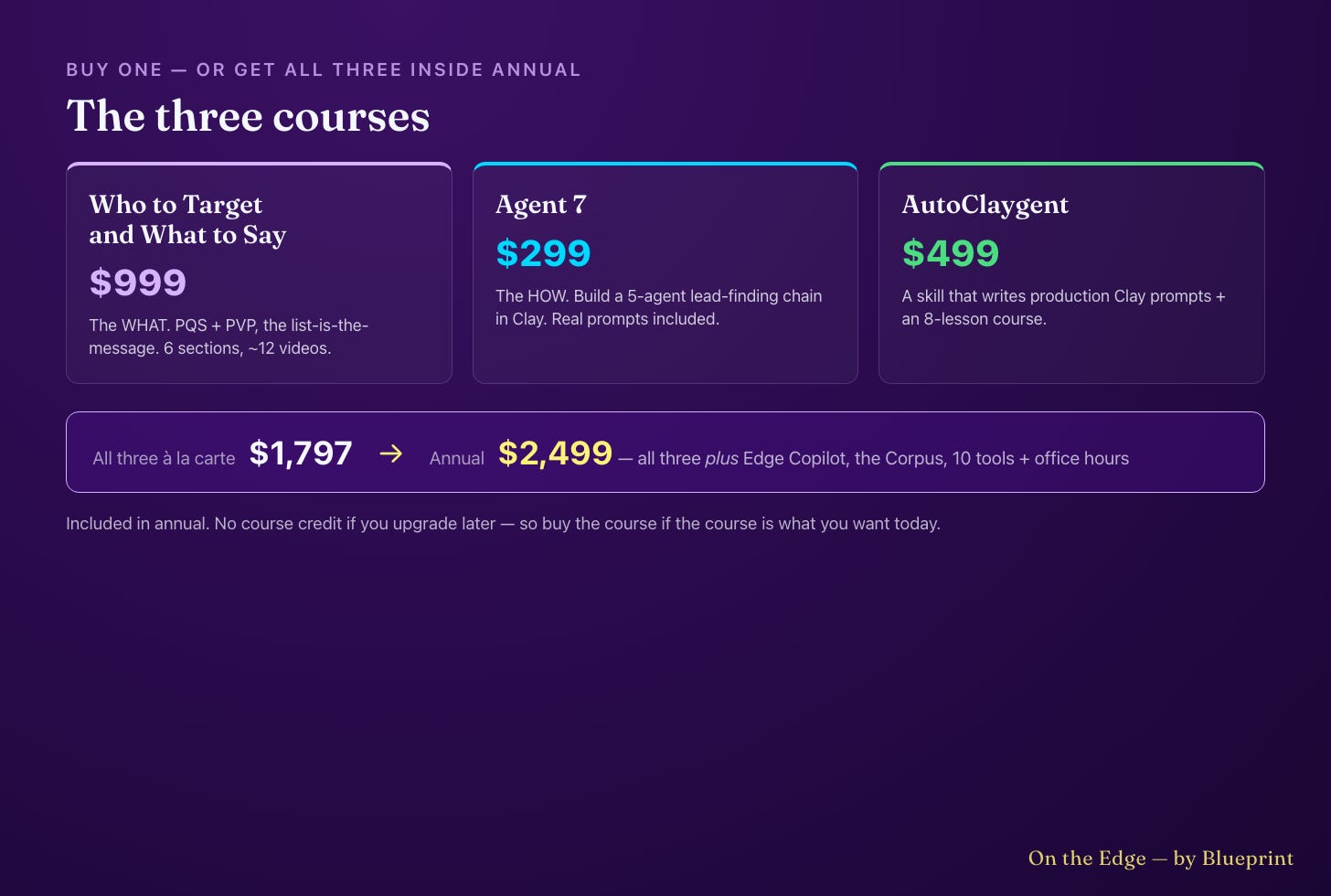
Who to Target and What to Say — $999
The deepest thing I've made. Six sections, about a dozen walkthrough videos, and a copy-paste prompt in every one.
It starts where most outbound dies: personalization. {first_name} tokens and "saw your LinkedIn post" don't fix a weak list — they decorate it. So the course flips the order. You learn to build a Pain-Qualified Segment (PQS): two to five public data points that prove a company has an expensive problem right now — the kind ZoomInfo and Apollo can't give you. Then a Permissionless Value Proposition (PVP): an insight so specific the prospect would value it even if they never bought from you.
The construction walkthrough is the one I'd watch first — idle high-value equipment matched against public permit and DOT data until the message writes itself: your excavator's sitting, this $530k job two towns over needs it. It's calculated, not invented. The final section even hands you a small Clay pipeline that enriches a lead for about two cents.
Built for companies with 50–10,000+ customers and real pull, scaling with AI instead of hiring more SDRs. The rule of thumb from the course: if your list is 100,000 names, you did it wrong; if it's 200, don't automate it.
→ Buy Who to Target and What to Say — $999
Agent 7 — $299
Where Who to Target teaches the what, Agent 7 teaches the how. It's a live, unedited build inside Clay — me writing and debugging the actual prompts, co-hosted with Doug Bell.
You build a five-agent chain. Search finds leads on the open web. Ensure structures them and confirms they still work there. Validate pulls real profile data and tells you something about the person. Enrich waterfalls emails and phones. Narrative researches the company and the person so you know what to say. Each agent inherits everything the one before it produced. You split the work across cheap models instead of forcing one mega-prompt, cap each agent at three leads, and write the results to the next table.
The standout build: every plane in the country matched to the FAA rule that affects it — your 52 Cessna 172 Skyhawks face a new rule; that's a $6M repair bill. The real prompts come with it, plus a phone-enrichment trick that drops best-quality numbers from ~25 Clay credits to ~2. You'll need a Clay account to follow along.
AutoClaygent — $499
A Claude Code skill that writes production Claygent prompts for you — plus an eight-lesson course on exactly how it does it.
The premise: most people reach for a custom Claygent when Clay already has a native integration that does the job for a fraction of the cost. So lesson two is "native first" — check the 150+ integrations before you write a prompt at all. From there you learn the five-part prompt anatomy, nine production patterns (business-model classification, platform detection, CRM mismatch validation, and more), and the strict, non-standard Clay JSON rules that quietly break schemas when you get them wrong.
The part that makes it production-grade: it writes the prompt once with Opus, then runs it in Clay on a model about 30x cheaper, and a test loop keeps rewriting until the prompt scores 8.0+ on a seven-criterion rubric. Quality enforced, not eyeballed. The skill is licensed and pulls its patterns live, so it sharpens without a reinstall.
The math, and the one catch
Buy all three on their own and you'll spend $1,797. Annual is $2,499 — and it includes all three courses plus Edge Copilot, the 443-entry Corpus, all ten tools, every tool I ship next, and weekly office hours.
So for $702 more than the courses alone, you get everything else.
One honest thing, because I'd rather say it than have you find out the hard way: buy a course, later go annual, and there's no credit for the course. No games — here's the straight version. The courses are priced to stand alone. Annual isn't "three courses plus some extras" — it's the tools and the compounding brain, with the courses thrown in. So if a course is the one thing you want right now, buy the course. If you want the machine, go annual. Just don't buy a course as a down payment on annual, because it isn't one.
Where to start
If you're not sure: subscribe free, read for a week, and watch what happens to how you think about targeting.
If you build your own tooling and want the recipes: $50/mo.
If you'd rather install the tools than rebuild them, and you want a brain in your terminal that gets sharper every week I ship: annual.
I'm shipping at 100x. The yearly model exists so you never have to keep up by reading — you just pull whatever I built into your own work the moment you need it.
Build something. Tell me about it.
What Annual Adds
This one was free. Paid gets the build. Annual gives you the tools that run it.
Every tool I ship. Edge Copilot installs to your Claude Code — talk to all my knowledge, every method, every data source. Current: Edge Copilot, AutoClaygent, Agent 7, Who to Target and What to Say, Blueprint Cloud, plus ten install-on-demand skills. Whatever ships next is included.
All 3 courses: Who to Target and What to Say, Agent 7, AutoClaygent.
Weekly office hours.
Run /edge install <tool> for anything I've shipped — they all install the same way. License key hits your email.
→ Go annual — $2,499/yr · Start at $50/mo (most readers start here)