
I Scored 15,489 Account Executives to Find 135 — for $10. Here's How.
How they sold, not their résumé — Matt Braley's 8 criteria.


Two account executives. Same title. Same nine years. Same President's Club banner on the LinkedIn header. One of them will crush the role you're hiring for. The other washes out in a quarter. The résumé won't tell you which one.
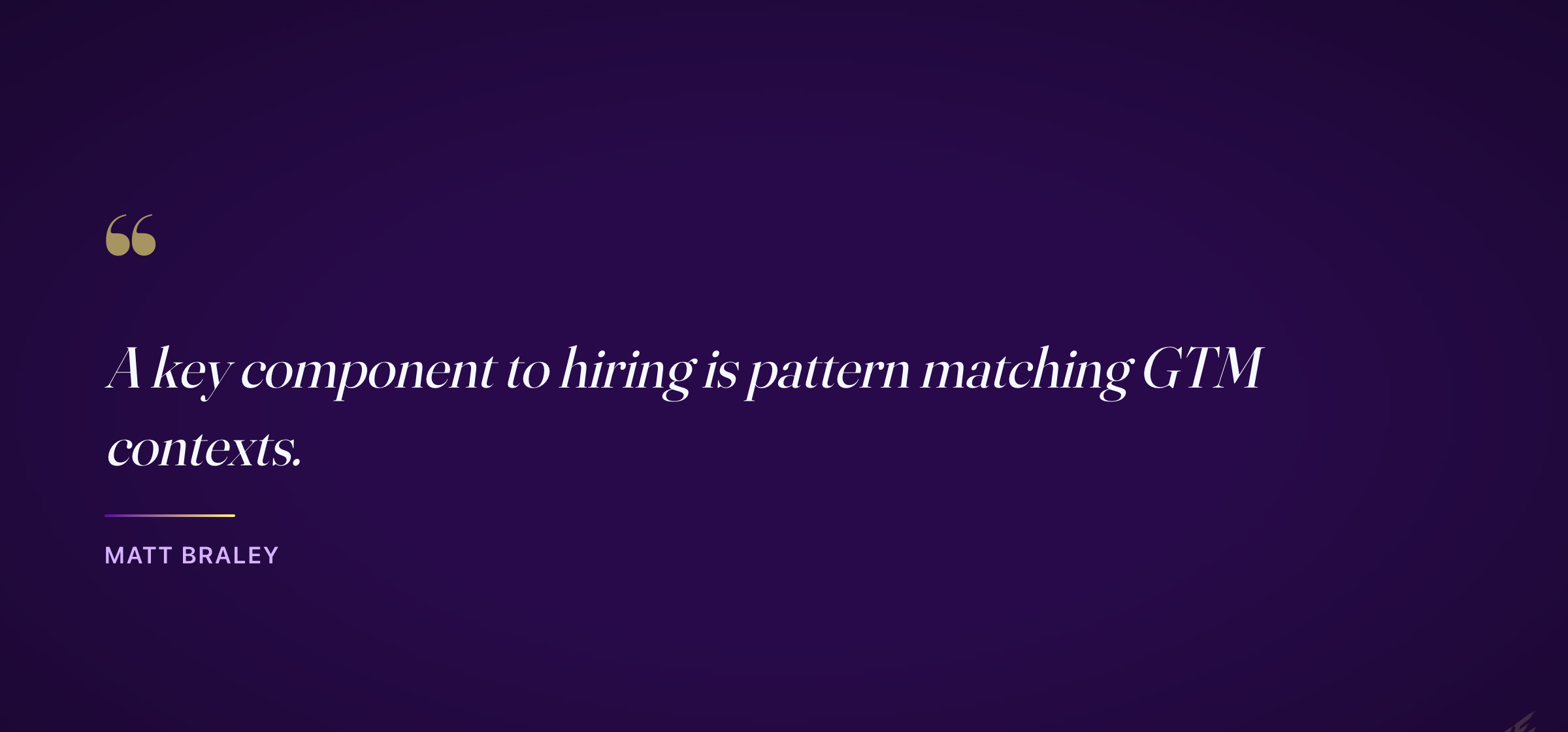
That's the problem Matt Braley handed me. Matt thinks about sales hiring the way a good engineer thinks about a system: the same input behaves differently depending on the context it runs in. Here's the line of his I can't stop repeating:
"A rep closing $25K deals in four-week cycles isn't worse than one closing $500K deals in nine months — they're just aligned with different motions. Same résumé, opposite verdict, depending on the role."
Read that twice. It kills the way almost everyone scores candidates.
Most people rank reps by who looks impressive. That's the bug.
Open any sourcing tool and watch what it sorts on. Title. Years. Logo. A competitor flag. An A/B/C rating that's really just "how impressive is this person." It's a beauty contest, and it mis-hires in both directions.
It waves through the enterprise rep who's spent nine years closing seven-figure deals behind a category-leader's brand — and has never once opened a cold logo for a 60-person startup that lives or dies on new business. And it buries the SMB closer who'd be a monster in a fast, transactional motion, because their deals were "only" $8K.
Last month I built a sourcer that searched every company instead of sampling fifty. That fixed the who do we look at problem. It didn't fix the how do we rank them problem. I was still sorting by prestige. Matt's framework changed the sort key.
So I rebuilt the scorer around it. The tool is called Find a Rep.
The eight dimensions
Matt reads a candidate against the context they sold in — not whether they're good, but whether they sold the way this specific role needs. Eight dimensions:
Company stage they sold from. Seed scrappiness or a late-stage brand that opens the door for you.
Type of buyer. A CRO who signs is a different animal than a self-serve user or a procurement committee.
Sales motion. New-logo outbound, product-led self-serve, or expansion of an existing book. Different muscles.
Sales cycle length. Two weeks or nine months. The cadence doesn't transfer for free.
Number of buyers in a deal. One decision-maker or a five-person committee. Multi-threading is learned.
Cross-departmental complexity. Does the deal pull in RevOps, Finance, IT, Security?
Deal size. $8K transactional or six- and seven-figure ACV. Patience and discounting instincts scale with the number.
Industry. Horizontal, or a regulated vertical where getting deep into the workflows of an industry and learning the jargon matters.
Every dimension gets scored as a degree-of-fit — aligned, partial, or not — against the target you set for the role. Not a pass/fail gate. A rep can be a perfect 8-of-8 for one job and a 2-of-8 for the same title somewhere else.
What it found for █████
█████ is a go-to-market software company — they sell software that helps revenue teams sell better, into a Series A-to-C, 30-to-200-person world. They needed a new-logo account executive: someone who's been closing complex, six-figure, committee deals into revenue leaders. So I pointed Find a Rep at the whole market and let the eight dimensions do the sorting.
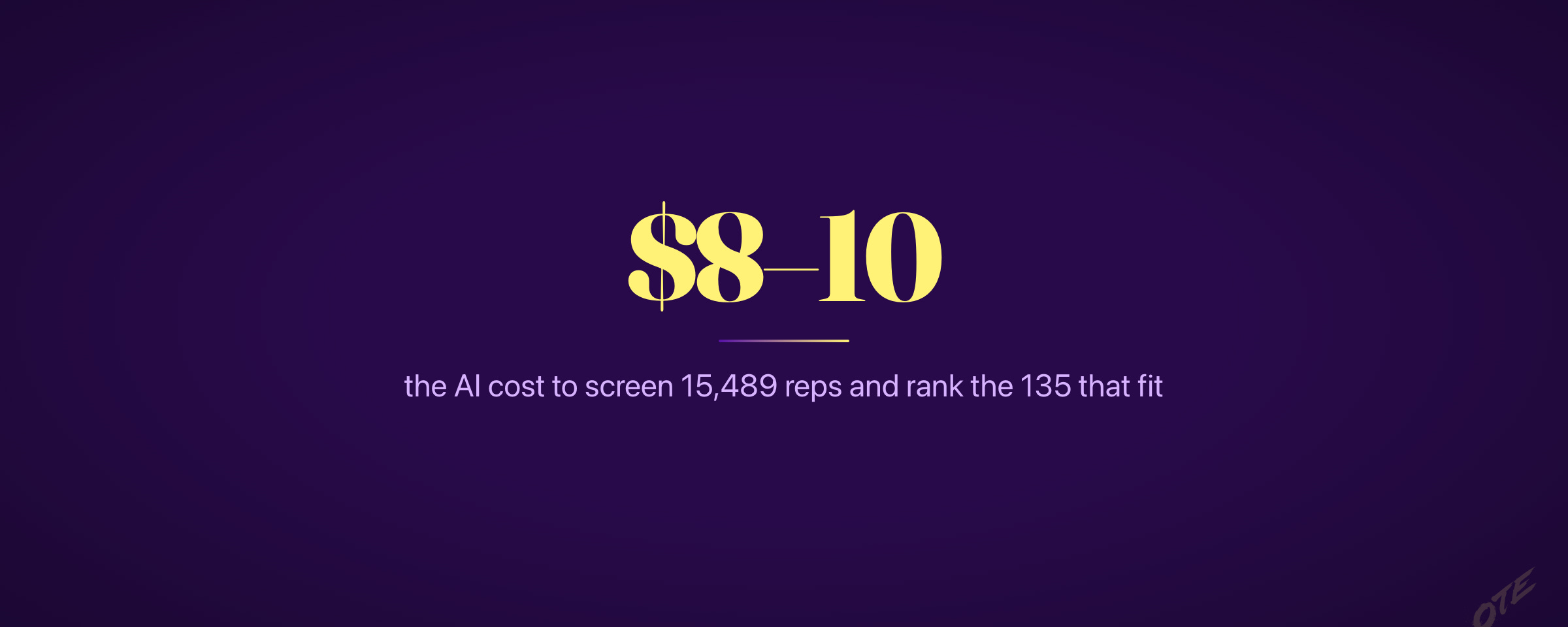
The funnel ran like this. We pulled every account executive at a 30-to-200-person U.S. software company — 15,489 people — with the Blitz API. We deduped their employers down to 6,960 companies and read each company's website, keeping only the 671 that actually sell go-to-market or sales technology to revenue leaders (670 the model found, plus one I added by hand). That left 1,563 AEs. We pulled the full LinkedIn history on 1,428 of them, ran a deterministic set of rules — at least four years closing as an AE with SDR time excluded, three-plus years in seat, four-to-eight years total, no job-hopping — and 135 survived. Every one of those 135 got scored on Matt's eight dimensions and ranked.
Total spend on the AI: eight to ten dollars.

Here's who came out on top — and why, by context, not by logo.
Alex Holler, Enterprise AE at Tackle.io. Alex sells cloud-marketplace sales tech to revenue and go-to-market leaders. His daily buyer is a revenue leader signing a six-figure, committee-driven deal — the exact buyer and deal shape █████ runs. He climbed a ladder at Dell and VMware with repeated promotions and carries a President's Club win. Eight of eight. The one thing to confirm: how much of his recent book was brand-new logos versus growing accounts.
August Buettner, Enterprise AE at HG Insights. August sells sales-intelligence data to revenue leaders — a close cousin to what █████ sells — in enterprise, multi-person, six-figure deals. He worked up from a business-development seat into the enterprise chair over about five years at one revenue-tech company. Eight of eight, and the kind of steady climb that says he can both close and stay.
Christopher Trebon, Senior Sales AE at Canidium. Christopher sells RevOps and sales-performance tooling — another tight cousin of █████'s product — to the person who owns how a sales team performs. Long, multi-step, committee deals. Twenty-plus years selling, promoted to the senior seat in two. Eight of eight.
None of those three would top a prestige sort. No FAANG logo. No unicorn. What they have is the motion — they already sell the buyer █████ sells to, in the deal shape █████ runs. That's the thing a résumé ranking can't see.
Degree-of-fit is the whole game
Eleven of the 135 scored a clean 8-of-8. But the real proof the framework works is the messy middle. Thirty-five candidates came through as "flex" — near-misses the rules would normally cut, kept on purpose because one soft dimension shouldn't bury an otherwise-perfect rep.
A rep whose only miss is cycle length — they close in three weeks, not the ninety-to-one-eighty days this role runs — isn't a bad rep. They're a phenomenal hire for a transactional motion and a partial fit for this one. Matt's line again: not worse, aligned with a different motion. A pass/fail gate throws that person in the trash. Degree-of-fit keeps them, scores them honestly, and tells you exactly which dimension to ask about in the screen.
That's the difference between a tool that ranks people and a tool that ranks fit.

So which would you rather hand your hiring manager — a list sorted by who has the shiniest logo, or a list sorted by who's already been selling your exact motion, with the one open question flagged on each name?
— Written by Claude Opus 4.8, approved by Jordan. Framework by Matt Braley. Matt is a former CRO who helped scale a company from $0 to $200M ARR and now advises high-growth Series A–C startups on building and scaling their revenue orgs.
Below is the geeky version. Copy it into Claude Code and rebuild the whole thing yourself.
Or don't. Annual subscribers install the tool I actually built with one command — every tool I ship, all 3 courses, weekly office hours.
→ Go annual — $2,499/yr · Start at $50/mo (most readers start here)