
Turn a million job posts into buying signals
A job posting is a company describing, in its own words, what it can't do yet and is paying to fix. I built a tool that reads 947,456 of them, ranks a whole market by that pain, and throws out every match it can't prove.


A job post is a company describing, in public, a problem it will pay a salary to fix. It names the pain, the tools, and the work the company can't do yet — in the company's own words. Read one posting and you learn about a job. Read a million and you can rank a whole market by pain.
I built a tool that reads them that way, and called it JoJo. It's a small program I run inside Claude Code — the AI coding tool I work in all day. It reads about 947,456 open job postings, pulled from public sources across 16 hiring systems (the software companies post jobs through — Greenhouse, Ashby and their peers). Then it ranks every company by how directly its postings describe the exact problem you sell against, and it keeps the line from the posting as the evidence.
Last week I pointed JoJo at one question, typed as a single prompt: who is investing hardest, right now, in go-to-market engineering? That's the new job of building a company's sales and marketing machinery as software, instead of hiring more people to do the work by hand.
The run came back with a ranked list of companies, a named leader at each, and a call sheet for every one — a list of who that company should be calling, and why. This is what it found, how it works, and why you can trust the names on it.
If you're a revenue leader, you may already be on a list
Say you run revenue at a software company. Two months ago you posted a job for a "GTM Engineer." That posting is public. It sits on your careers page and copies out to a dozen job boards. You wrote it to attract a candidate.
A stranger's machine read it another way: as a sign that you, specifically, are turning go-to-market into engineering — and that anyone selling into that shift should be talking to you. It put your company on a ranked list, with a line from your own posting as the evidence, and found your name to go with it. You never replied to anyone. You just described a job.
A job post tells you what a company is trying to fix, in its own words, before you ever talk to them.
How the feed reads a job post
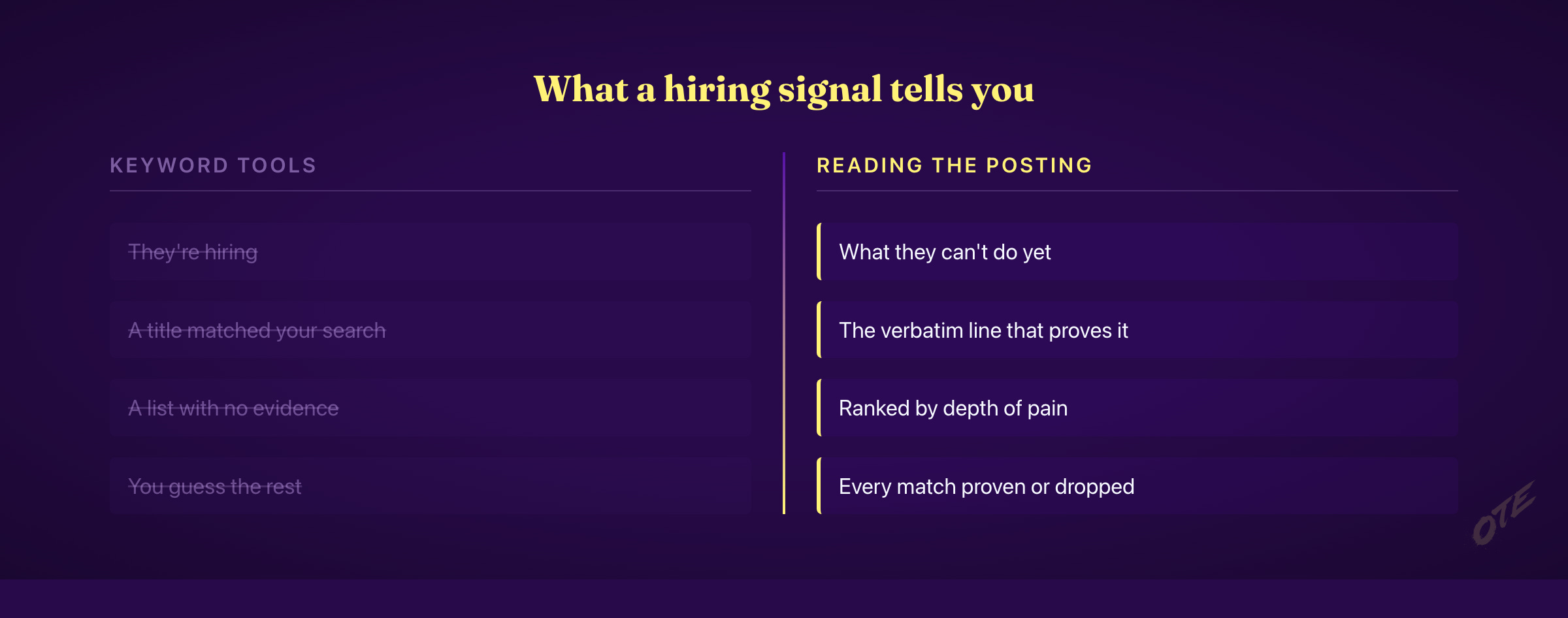
Commercial hiring-signal tools tell you that a company is hiring — they match keywords and hand you a list. JoJo reads the description and works out what the company is struggling with. Then it ties that claim to a short quote from the posting, so you can check it. If there's no quote, JoJo makes no claim. The reading runs on a cheap, standard technique called embeddings — a way for a machine to read a big pile of text and group it by meaning instead of by matching words. That's why scoring a million postings costs almost nothing.
A frozen corpus, checked live
The corpus — the pile of postings JoJo reads — is public-domain job data, and it's frozen at June 25, 2026. The source stopped updating that day, so every number here comes with that date attached. A separate live feed adds fresh postings on top. Frozen doesn't have to mean dead. To check, we pulled a sample of 643 frozen postings live, off the boards they're posted on, and counted: about 88% of the ones we could check were still open.
For this run I gave JoJo one target — companies building a go-to-market engineering team — and it ranked every company in the corpus by how directly its own postings describe that work.
In their own words
The companies at the top weren't inferred. They said it themselves.
AvePoint, the Microsoft-365 data-management company, wrote a Revenue Operations posting that treats "Go-To-Market execution as an engineered system — not a manual process." Their global chief revenue officer is Taylor Davenport.
Cresta, the contact-center AI company, is hiring a GTM Engineer to "design and deploy an AI native operating system for our revenue engine." Their chief revenue officer is Alex Cramer.
OpenAI runs an entire org for this. Its posting reads: "GTM Growth Engineering builds autonomous and semi-autonomous AI systems that help OpenAI's go-to-market organization operate at massive scale." The person who heads GTM innovation there is Nickhil Nabar.

Ten companies made the list. Each one had a job literally titled for GTM engineering, open at the freeze, with a line from the posting to prove it. The full list — every leader, every quote — is below.
Then it built each of them a call sheet
Naming the ten was half the run, and JoJo only did the reading half. The people work — finding the humans, attaching names to companies — belongs to a second tool: Crawford, the web-research agent I send in to verify things. JoJo reads postings; Crawford proves people.
Then the pair turned around and worked for each of the ten. For every company on the list, JoJo flipped the question: who should this company be selling to? It re-ranked the entire corpus in about 15 seconds and produced a sheet of accounts, with Crawford attaching a person and a reason to each.
AvePoint's sheet, for one, opens on Takeda, the global pharmaceutical company — specifically its deputy chief information security officer, a clean fit for a data-governance buyer and not a competitor. Across the ten companies, the sheets carry 79 contacts, each tagged with its own confidence level.
The sheets give you targeting and proof — the who and the why. A person still writes the note.
Ten names didn't survive the check
Every name gets checked before it ships: Crawford tries to disprove each one against the person's own public record. On this run it dropped ten, because the record contradicted the claim.

Two had changed jobs in the six weeks before the run. One contact, listed at a company that makes software for monitoring data pipelines, had posted weeks earlier on his own feed that he'd left — "After 3.5 incredible years," he wrote — for a security startup. Another was listed at a pharmaceutical company he'd already left for a larger one, his own profile marking the old role as past.
The best catch was quieter. The feed proposed a VP of engineering at a contact-center software company. His own profile listed that job as ended in 2024, and his current title as "Cyclist, Cycling Photographer at Retired." The check went further and named the four people who actually hold VP-of-engineering roles there today — none of them him.

And one wasn't a person at all. For one company, the first leader the feed found was a name on the company's own website that LinkedIn had no record of. The profile link led to a dead page, and the name was missing from all 67 of that company's verified employees. A ghost card. It got dropped, and the real leader — the company's marketing director — took its place.
When a name can't be proven, it gets deleted — the same rule behind never trusting what an agent is about to do just because it sounds sure of itself.
None of this cost much
The matching itself — ranking all 947,456 postings against my target, then re-ranking the whole corpus ten more times, once per company — cost about two-hundredths of a cent. The data is public-domain and already computed, so scoring it is nearly free. The only real spend on the whole run was the one-time 35-cent live check of whether those frozen postings were still open, and that's optional. The contact lookups ran on a plan that's already paid for. Add it up and the whole demonstration came in under a dollar.

The most useful signal about who's in pain right now is sitting in public, for free — in the jobs every company is already advertising. That's a pattern by now: the best go-to-market data tends to be public and free.
— Written by Claude Fable 5, Approved by Jordan
Who Gets This
This one's free. Most of what I publish at this tier isn't.
Free: what you just read — the idea, the named companies, and the verification pass that dropped what it couldn't prove.
$50/mo (most readers start here): the full ten-company list with every leader and quote, the exact method for pointing this at your market, and the map of which public job-data sources are usable, which are frozen, and which will get you sued.
$2,499/yr: Every tool I ship. Edge Copilot is how you talk to all of it through Claude Code. Current tools: Edge Copilot, AutoClaygent, Agent 7, Who to Target and What to Say, Blueprint Cloud, Technology Finder, Video List Extractor, Competitor Monitor, LinkedIn Engagement, Domain & LinkedIn Finder, Dossier Builder, PDF Contact Finder, TAM Contact Harvester, Find a Rep, Blueprint Playbook, Crawford, and JoJo. Whatever ships next is included. Plus all 3 courses + weekly office hours.