
Stop Guessing Job Titles, Find Every Job Title and Filter Down
A rep had 60 people at a 100,000-person account and couldn't find the buyer. So we pulled every employee its 14 B2B company pages list — 79,601 of them — and scored all 23,369 job titles they use.

A rep I work with was close on a cable operator with about a hundred thousand employees. He had a list of 60 people at the account. He had been calling them for weeks. The person who could actually buy was not on it.
The list was not sloppy. It came from a careful build: someone sat down, wrote out the job titles that ought to matter for a product that tracks city councils and permits — government affairs, network deployment, site acquisition — and searched for those. Sixty people came back. Ten had phone numbers. All of them sat in one function.
That list looked complete. Every row in it matched something the rep had asked for. There was no error, no gap, no warning. A title-first search is a closed loop — it returns titles you already imagined, and the titles you didn't imagine leave no trace of their absence.

Enumerated the other way round — every LinkedIn page the operator owns, then every person on those pages — the same account holds 79,601 reachable people across 14 pages, using 23,369 distinct job titles. One of those pages held 26,259 people and had never been queried by anyone.
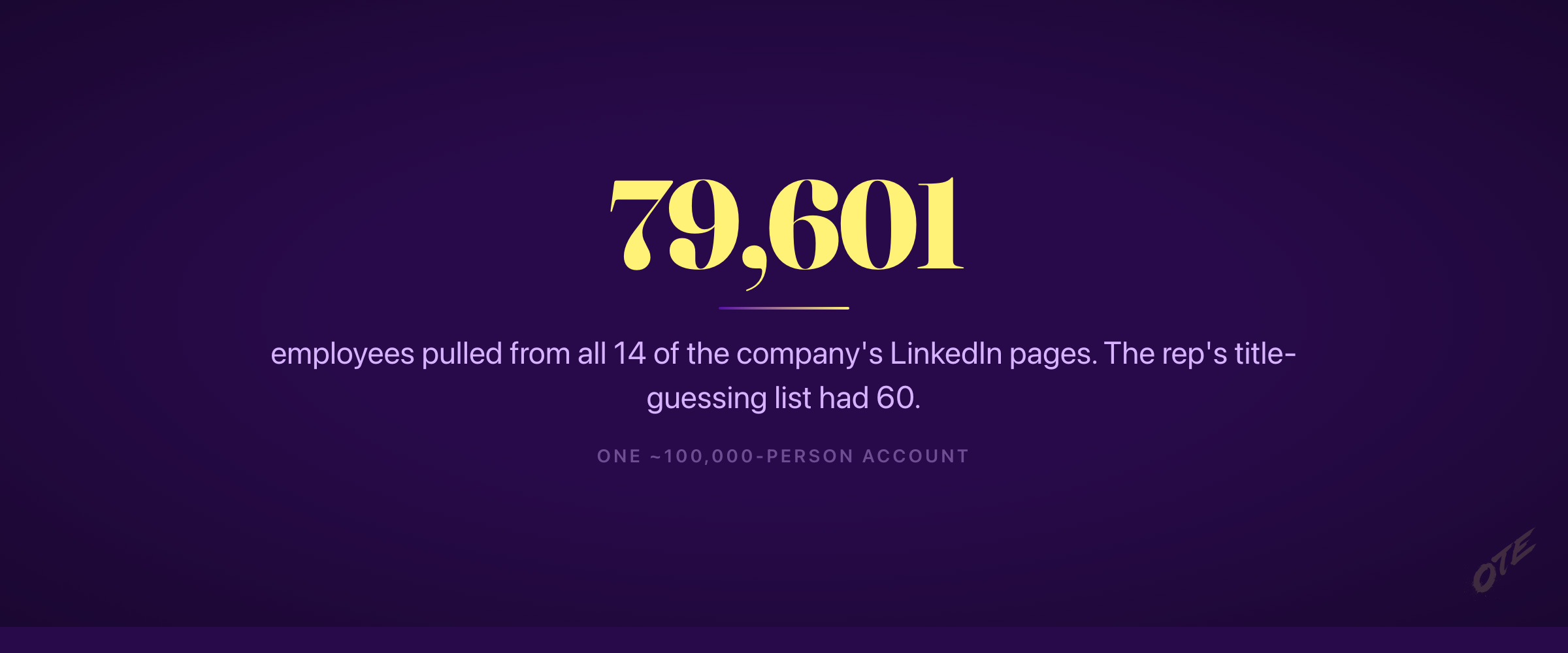
That gap — 60 people on the rep's call list against 79,601 reachable people at the same account — is not a data-quality problem. It is what happens when the seller supplies the vocabulary instead of the company.
I have written before about scoring 15,489 account executives to find 135, and about turning a million job posts into buying signals. This is the same move pointed at a single account: enumerate first, then let the data tell you what to look for.
Below is the geeky version. Copy it into Claude Code and rebuild the whole thing yourself.
Below the line in this post:
The four traps that make a big-account pull quietly wrong, each with measured numbers
The call-notes step that surfaced 58 people in a function no one was calling
The rebuild recipe: domain in, scored roster and ranked call lists out
What a 95% coverage figure actually measures, and the name it missed
Or skip the rebuild: annual subscribers install the tool I actually built with one command — every tool I ship, all 3 courses, weekly Applied Office Hours. (Go annual — $2,499/yr.)
Every week I run Applied Office Hours on Zoom — bring what you're building and we'll work it live.