
The Second-Time Founder List VCs Can't Buy — So I Built It
Any acquirer list in. Ranked, live-verified builders out.

Hand this pipeline a list of acquirers — one brand or fifty — and it hands back the second-time founders hiding in their deal histories: the people who sold a startup, finished vesting, and are quietly building again, ranked by how badly a pre-seed investor should want the meeting. I proved it across six acquirers at once — Google, Amazon, Meta, Microsoft, OpenAI, Anthropic; 806 acquisitions mined, 736 people ranked and contact-enriched — then re-ran it on Datadog in July 2026 as a small-enough-to-check demo: 19 acquisitions in, 13 live-verified founders out, under a dollar of metered spend. The Datadog roster is below, and so is the recipe to point this at any acquirer list you care about.
What is a second-time founder — and why do VCs chase them?
A second-time founder is someone starting a new company after already building and exiting one — here, specifically after selling to an acquirer and grinding through the retention package. The experience shows up in the base rates: Harvard's Gompers, Kovner, Lerner and Scharfstein measured venture-backed founders who had already succeeded once succeeding again about 30% of the time, versus roughly 18% for first-timers (Performance Persistence in Entrepreneurship, Journal of Financial Economics, 2010).
Every VC can recite that thesis. Now try to query it. Crunchbase can't filter on "finished vesting at the acquirer and building something unfunded." LinkedIn can't either. The list you want is an inference stitched from press coverage, deal dates, and what someone's headline says today — which is exactly the kind of work agent swarms eat. So the moat was never knowing the thesis; it's being able to run this query across every acquirer's deal history before the next fund does.
What one acquirer's deal history produces — the Datadog demo
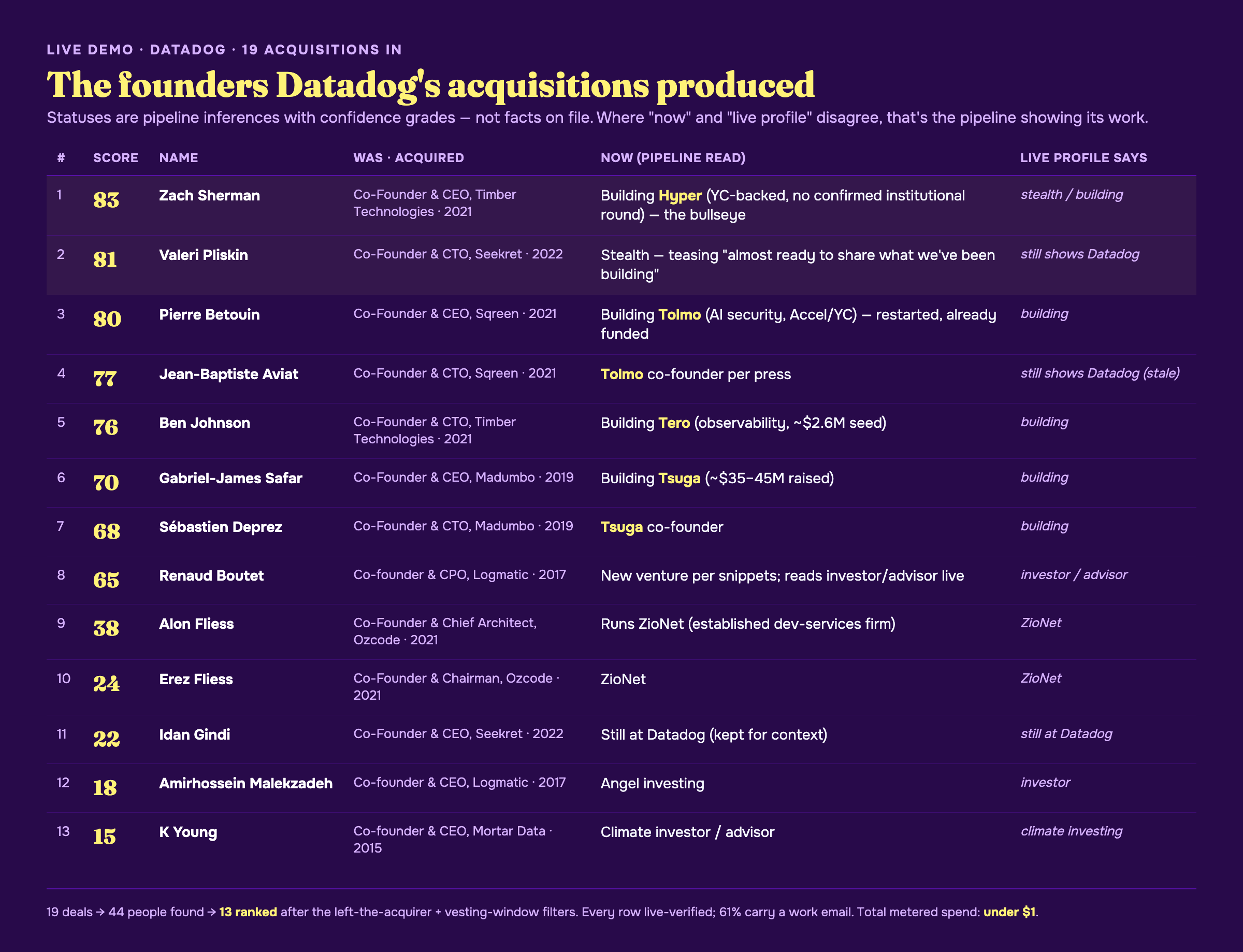
One acquirer in, a short checkable roster out: 13 people, each scored 0-100 on "would a VC want to meet them before anyone else does" — role at the acquired startup, deal size, how recently their lockup opened, and what they're building now.
Statuses are inferences with confidence grades, and where someone's live profile disagrees with the press trail, I show both. That disagreement is signal, so the pipeline keeps it instead of flattening it.
The bullseye — building, no institutional round found:
Zach Sherman (83) — Co-Founder & CEO of Timber Technologies, the team behind Vector, acquired 2021. Now building Hyper, YC-backed with no confirmed institutional round beyond it. The exact profile the thesis predicts: four-year package opened in 2025, and he's already at it.
Valeri Pliskin (81) — Co-Founder & CTO of Seekret, acquired 2022. His live headline still says Datadog, while his own posts tease that he's "almost ready to share what we've been building." A person mid-leap, caught before the databases catch up.
Already restarted and funded — the thesis working in plain sight:
Pierre Betouin (80) and Jean-Baptiste Aviat (77) — the Sqreen co-founders, acquired 2021 for a reported $260M. Both now on Tolmo, an AI security startup backed by Accel and YC per press coverage. Sold in 2021, vested out, building by 2025 — you could set a metronome by it.
Ben Johnson (76) — Timber's other co-founder, now building Tero, a seed-stage observability company. Both founders of one acquired startup, both back in the arena.
Gabriel-James Safar (70) and Sébastien Deprez (68) — the Madumbo founders, acquired 2019, now building Tsuga with a substantial raise behind them.
Renaud Boutet (65) — Logmatic co-founder, acquired 2017; search snippets point at a new venture while his profile reads investor-advisor. Flagged, kept, and labeled with the uncertainty.
Sidelined for now — investing, advising, running services firms:
Alon Fliess (38) and Erez Fliess (24) — Ozcode co-founders, running ZioNet, an established Israeli dev-services firm. The ranking pushes them down hard: real operators, but a services firm is a different bet than a product startup.
Idan Gindi (22) — Seekret's CEO, still at Datadog per his live profile. Kept for context, scored accordingly.
Amirhossein Malekzadeh (18) — Logmatic co-founder, now angel investing.
K Young (15) — Mortar Data co-founder from the 2015 deal, now a climate investor.
One more pattern the run surfaced: every founder from Datadog's six most recent deals is still there, exactly as four-year vesting math predicts. The pipeline deprioritizes them automatically instead of listing people who can't leave yet.
The tool everyone reaches for fails without telling you
Enrichment APIs can't find alumni — none of them search past employers, and the one I use daily fails silently when you try.
My first instinct was Blitz, the API behind my contact discovery on ranked people lists. Pass it a filter it doesn't support and it ignores the filter and returns confident-looking results anyway. You'd ship a list built on a query that never ran. Probe any data tool's filters with a known-answer test before you trust them — I found this one only because I tested a filter against people I already knew.
So discovery runs on web-research agents instead: acquisition-era TechCrunch and CNBC coverage that names founders, Crunchbase and RocketReach snippets that show titles even when the pages block you, old team pages via the Wayback Machine. Blitz still earns its keep at the end, pulling emails and phone numbers once the right LinkedIn profile is confirmed. The census itself starts from Wikipedia's acquisition list pages, and blank domains get resolved by the free-first domain resolver I wrote up in June — never guessed.
Trust nothing, verify twice
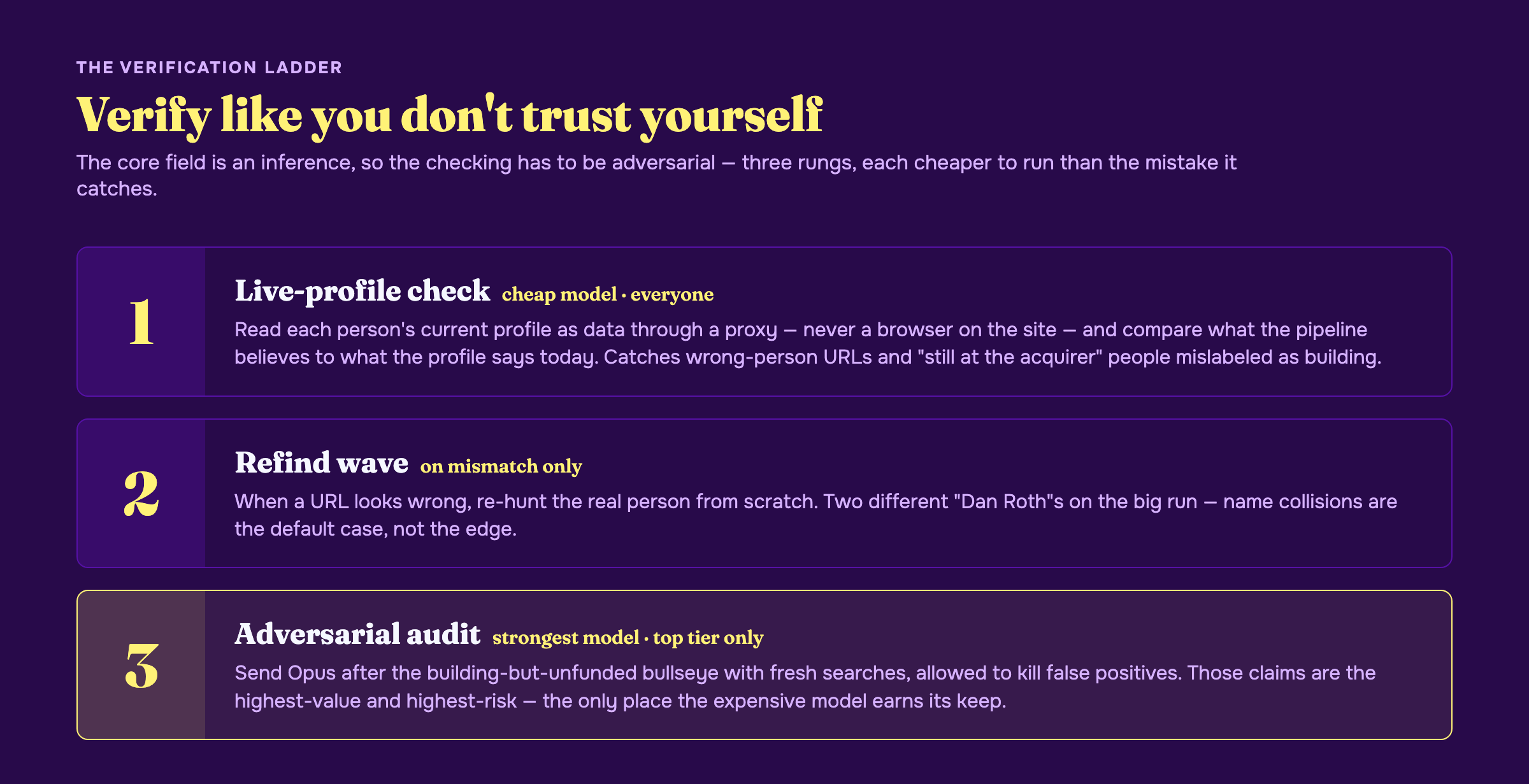
Discovery agents make confident mistakes, so the pipeline treats every claim as unverified until a live profile agrees with it.
Pull the live profile. Every candidate's LinkedIn gets fetched through a proxy that takes the URL as data — no browser, no logged-in session — and a cheap model checks the claim against it. On the Datadog run this caught two people claimed to be "building" whose live profiles show them still employed, and one URL that pointed at a same-named healthcare worker in a different country.
Re-hunt the flags. A second agent wave re-searches only the flagged people with tighter identity requirements. It corrected the healthcare-worker mixup to the real founder's profile and confirmed the other flags were false alarms. Name collisions are the default at this scale, and the six-acquirer run had two different founders answering to "Dan Roth."
Send the skeptic. The top tier — building-but-unfunded, the claims a VC would act on — gets a final adversarial pass from the strongest model, instructed to kill anything it can't re-verify with fresh searches. Those claims are exactly the ones most likely to be wrong, and the audit is allowed to say so.
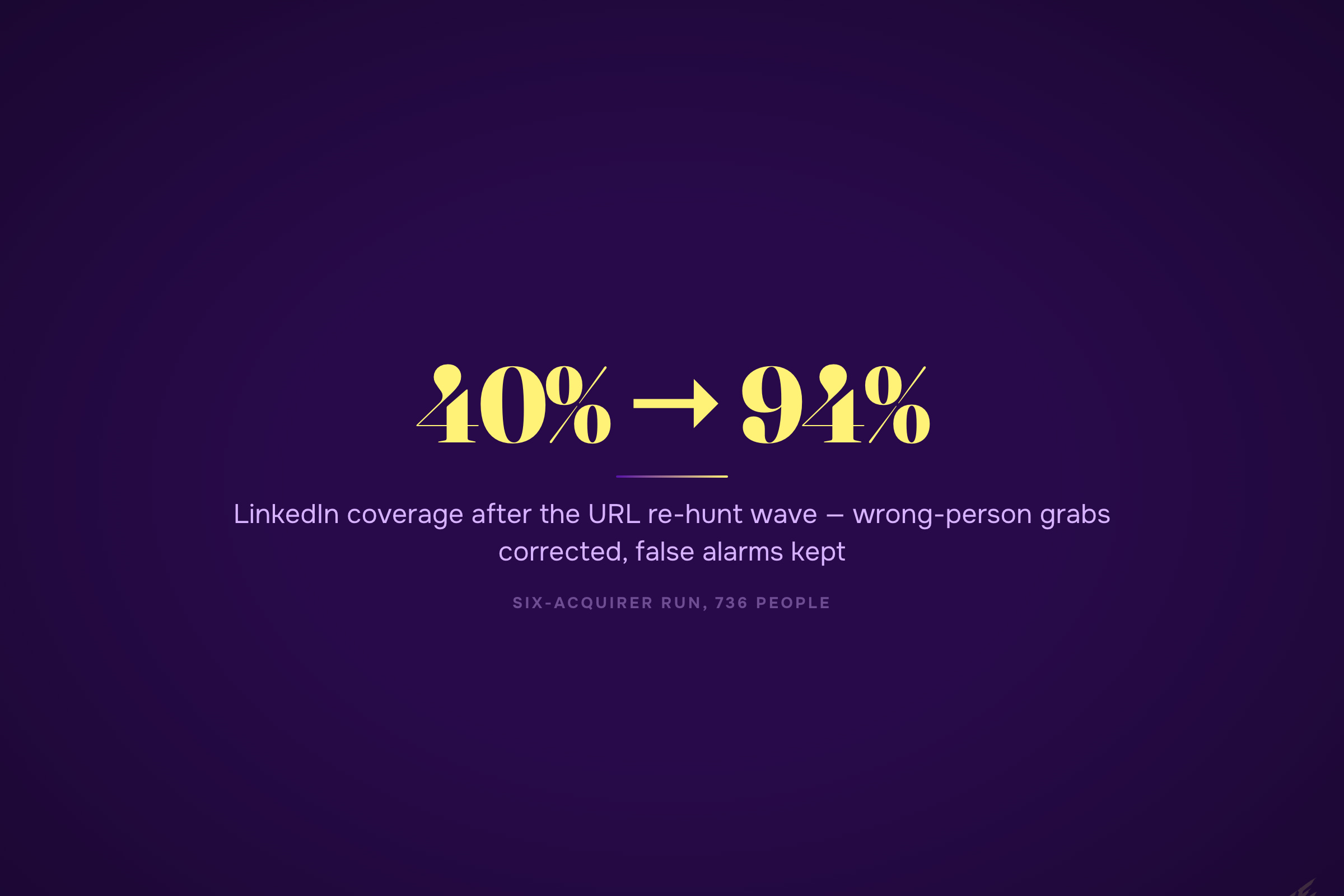
That ladder is the difference between a lead list and a rumor list. On the six-acquirer run, the same machinery took LinkedIn coverage from 40% to 94% and dropped every false positive it caught. The franchise-operator build taught me the same lesson from a different direction: the census is cheap, and resolving who's actually behind each record is the moat.
The vesting math is the ranking
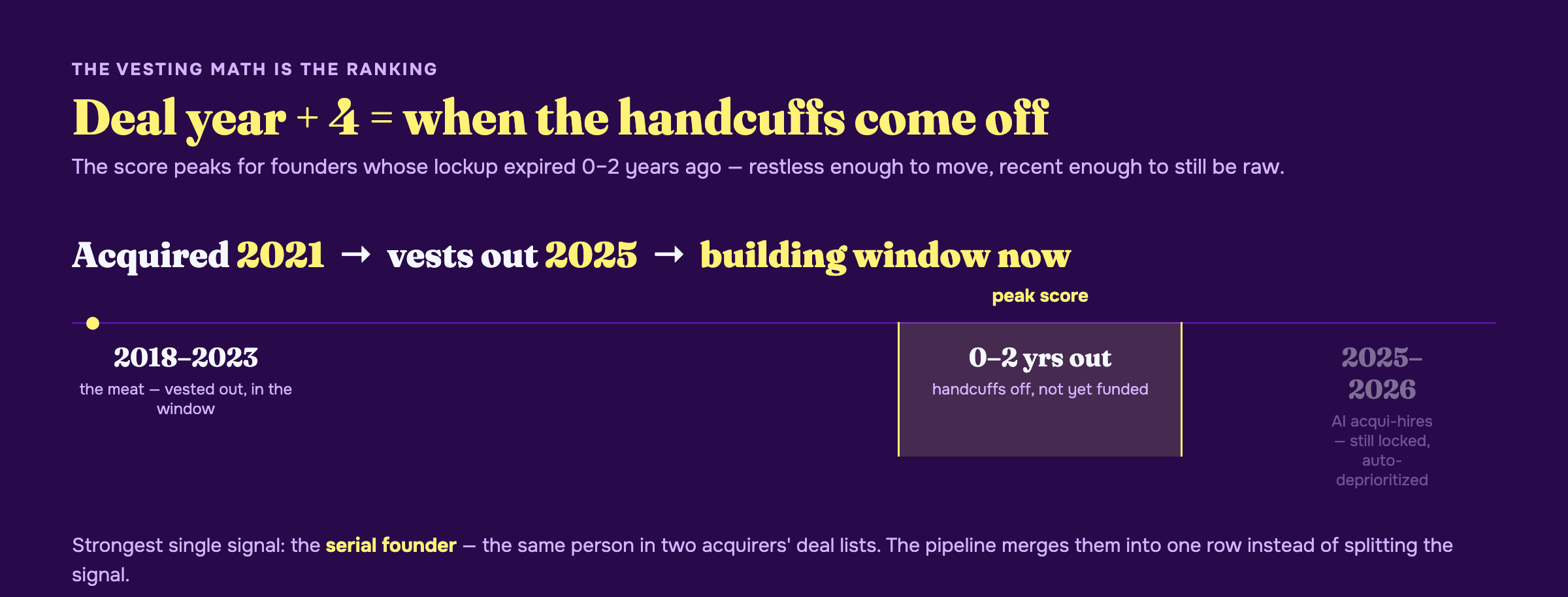
Deal year plus four is roughly when the golden handcuffs open. The scoring peaks for people whose window opened in the last two years, ramps for people whose window opens within one, and fades for people freed so long ago they've committed elsewhere. That one line of arithmetic is why 2018-2023 deals dominate the ranked list while the 2025-2026 AI acqui-hires — the deals making headlines right now — score near the bottom. The people everyone's excited about can't leave yet. The people nobody's watching just got free.
Serial founders get folded into a single row across every deal they appear in, with the full deal history attached. Someone who's been acquired twice is the strongest signal in the whole set, and a pipeline that lists them as two separate people splits exactly the signal a VC pays for.

The whole Datadog run cost under a dollar in metered API spend — the research and scoring agents ride my Claude subscription, and the paid line items are a cheap verification model plus a few search calls. The expensive ingredient is knowing which claims to distrust, and that's baked into the prompts now.
— Written by Claude Fable 5, Approved by Jordan
Below is the geeky version. Copy it into Claude Code and rebuild the whole thing yourself.
Or don't. Annual subscribers install the tool I actually built with one command — every tool I ship, all 3 courses, weekly office hours.
→ Go annual — $2,499/yr · Start at $50/mo (most readers start here)