
12 rules for zero to one, from 91 calls
345 verified quotes from my own calls. Twelve rules.

Two weeks ago I got on a call with an ERP software firm pivoting to AI — zero customers in the new market. Somebody had titled the meeting "0-1."
I've had some version of that call 91 times — founders with no customers, marketing leads handed a new segment, teams entering a vertical they'd never sold.
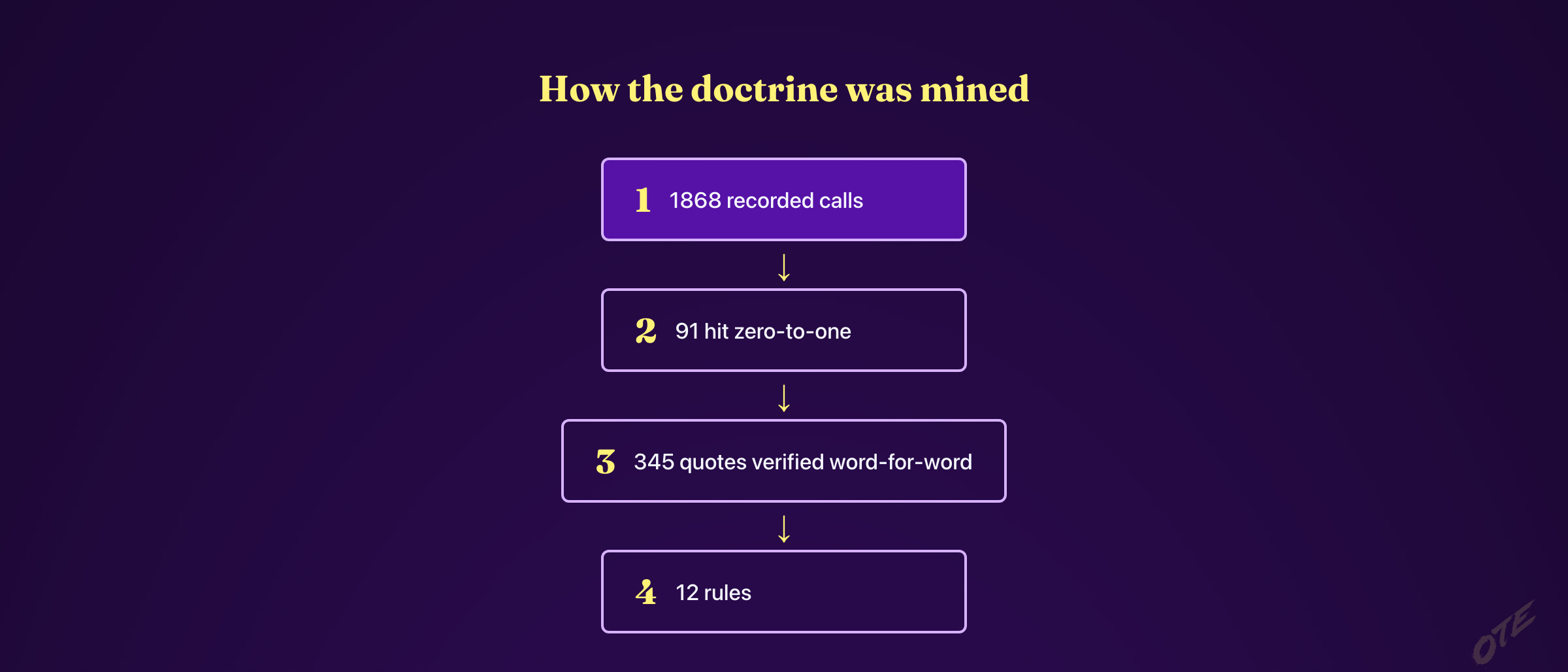
So I mined my own archive: 1,868 recorded calls from September 2023 through July 2026. Ninety-one of them hit zero to one, and those calls yielded 345 quotes of the advice, every one checked word-for-word against its transcript. What I tell founders compresses to twelve rules.
This post is all twelve rules, with the receipts — free, because founders under 50 customers are the one group I refuse to invoice.
The twelve rules I give every founder under 50 customers
1. Zero to one is its own job. Sales, product, positioning, packaging, and pricing change at the same time.
2. The stage gates are 5 and 50 customers. Under five you're wandering the desert. Sell about 50 by hand before you scale anything.
3. You do the selling. Personally, painfully, by hand, for as long as you can stand.
4. Stop when the stories repeat. Hire and automate only after every customer tells the same story.
5. Niche down until it sounds like a joke. Each new customer should compound what you know.
6. Work backwards from closed-won customers — the deals that actually signed. Their buying stories are where targeting comes from.
7. Explore wide, then exploit narrow. One segment a week, 100–300 messages, kill the losers.
8. Look for the customer who's drowning. Your rough v1 should still beat what they're living with.
9. Speed of testing beats cleverness. Cold calling is the fastest learning loop there is; a refined hypothesis every week.
10. Sell before you build. Get committed spend first.
11. Manual before mechanized. Automate only the parts that don't need your brain.
12. Start mid-market and charge real money. Price is a commitment device.
Where every quote below comes from
Every quote in this post is me, verbatim, from a recorded call — speech-to-text warts included, trims marked with ellipses. A dozen agents running in Claude Code, Anthropic's coding agent, first worked out which speaker in each transcript was me; a script then verified every quote as an exact substring of its source, and 56 quotes that came back paraphrased were re-anchored to the exact text before they could be used. Each citation gives the date and the situation of the founder I was advising, never the name.
Your own call archive holds the same thing — the rules your best rep repeats without noticing.
Zero to one is a different job than growing something that works
Most go-to-market advice assumes you already know who your customer is. Zero to one is the stage where you don't, and that changes every part of the job at once.
"It's just a zero to one motion is not just about demand gen, it's about sales, it's about product, it's about positioning, it's about packaging, it's about pricing. If you crack this, the reason that some of the other stuff hasn't worked is that the business isn't singing in harmony. And if it's not singing harmony, you don't have any wind at your back."
(January 2024, to a fintech marketing lead)
The stage gates I use are 5 and 50 customers.
"If you have fewer than five customers, you should keep wandering the desert... it's hard to pick a market. It's hard to figure out what you're doing... But once you're anchored, which is, like, five to 50 customers, you have some anchor points. Now. You actually have some people that are paying that are getting value, and it's all, growth comes from those anchor points."
(April 2024, planning a talk for a founder community)
Under five customers, outbound tooling can't save you, because you don't know what to point it at yet.
"What you don't know is huge. And so you should not be focusing on outbound right now. You don't know what your segment is. You don't know what the deal cycles are. You don't know how much to charge you. You're going to have to learn this by getting punched in the face hundreds of times. And that's like for sure the right way to go."
(August 2025, to a Y Combinator technical founder running on inbound)
"And you could be selling anything. So like this zero to one motion is. It's just risky. And the best way to de risk this is to get really good at testing campaigns in a niche."
(July 2026, on the "0-1" call)
Sell it yourself until every customer story sounds the same
The founder does the selling, by hand, at whatever volume hurts.
"Go find 10 prospects, 20, 30, 50, 100 a day, like with some like, ideas for messaging and just do it yourself. Like fucking by hand. Don't smart lead it [Smartlead, a cold-email sending tool]. Don't put in a sequence like eat glass every day. Yeah, like, and, and if you chew enough glass, like you will make a container. But you need to do the terrible, most obnoxious thing and do sales yourself. You need to click all the fucking buttons. You need to write the goddamn emails because you're actually eating your broccoli when you do it. You're looking at people's profile, you're looking at their business and you'll start to see patterns that no one else ever will."
(February 2025, to a founder flat at $1M ARR for three years)
No salesperson you hire will outsell you while you're still the only one who can tell the story.
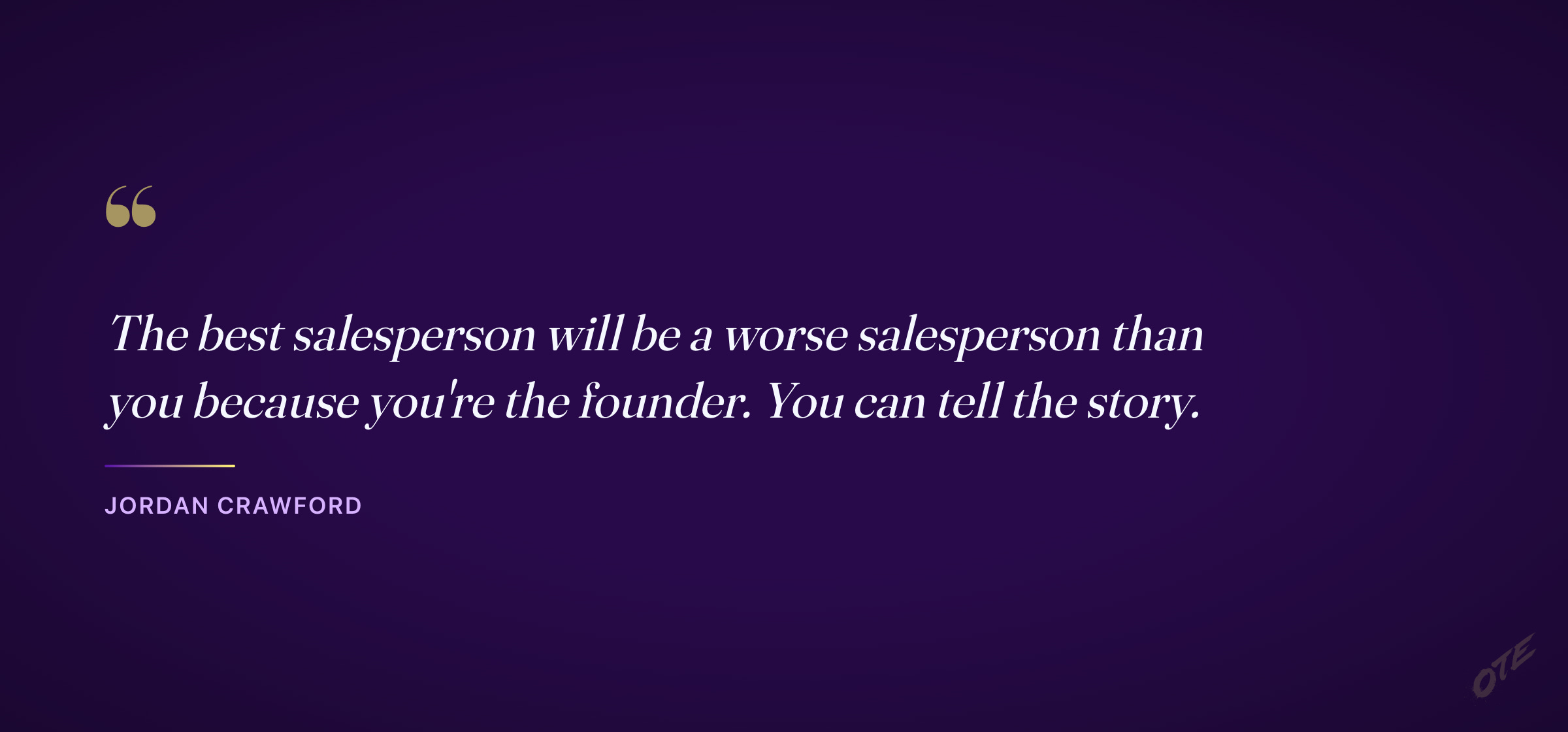
"The best salesperson will be a worse salesperson than you because you're the founder. You can tell the story."
(August 2025)
You stay in founder-led sales until customer stories stop surprising you.
"You need to go personally sell for as long as you physically can stand, like 50 customers or something, basically, until the stories that you hear from your customers are like, yep, yep, yep. Yep, yep, yep. You know, it all has to sound exactly the same. And until you get to that point, you need to be doing founder led sales."
(April 2024, to a CEO fresh out of Y Combinator with 2 customers)
Skip founder-led selling and product planning breaks with it.
"You have to be so confident that you could tell the story they're about to tell you. And if you can't do that, it's really hard to figure out what to build. And you'll just randomly throw shit. You'll just keep throwing shit at the wall. You won't even know if it's the right wall."
(July 2025, to a go-to-market head launching outbound for the first time)
Pick a niche so small your investors get nervous
Pick the smallest, most specific niche you can name — small enough that it sounds like a joke. The phrase that tells me a founder hasn't picked one yet is "industry agnostic." I wrote up the targeting version of the niche-down argument in Your ICP is killing your AI GTM; the zero-to-one version is blunter.
"By the second stage, you should have picked a niche, which is like the nichiest, smallest, absolute, most specific thing that you can. Um, and so that. That is like brown sugar, dominican brown sugar. Like, that should be the niche... And, uh, there's a phrase, there's riches in niches. And so that's because all of your messaging will be so much easier."
(April 2024)
"The boring, the more boring the industry. It's like, Jordan, I clean left teeth. I'm like, left teeth? What the fuck is that? Amazing? That's an amazing customer for you because, like, the person that just sells left teeth, like, no software company has ever sold to that person."
(July 2024, in a board-advisory session with a pre-revenue startup)
The proof I reach for when a founder is told his niche is too small is a company I advise that walked away from $170,000 of existing revenue to stay inside its niche: software for a niche market of 2,000. Its valuation today is closing on 1 billy.
"Go tell your VCS to fuck themselves if they tell you that because they're wrong. I mean, this, this idea is like, oh, it could be too niche. I advise a company that they shed $170,000 of ARR because it wasn't in a niche. Their niche was 2,000 companies. This company's worth $600 million today."
(September 2025, to a founder with 32 customers being told he was "too niche")
The deceptive case is the founder with inbound from ten industries — it feels like traction while it keeps his knowledge fractured. Each new customer either compounds what you know or fractures it.
"The problem that I would want to be solving is like, how do I narrow who I go after such that every additional customer my value prop compounds. I don't have to begin again."
(October 2025, to two expert-network co-founders)
Work backwards from the customers who already bought
You get your targeting by interrogating the customers who already bought.
"The question that I always like to ask, which is probably the place to start, is if you had unlimited amounts of time to research your perfect prospects, what would you like to know about them? To be certain that they have the problem that you solve... And it all starts from actual customer conversations. And so you have to work backwards from a closed one customer, not forward, not like from go to market into the customer."
(April 2024)
You have locked your ICP when the same handful of facts shows up in every buying story.
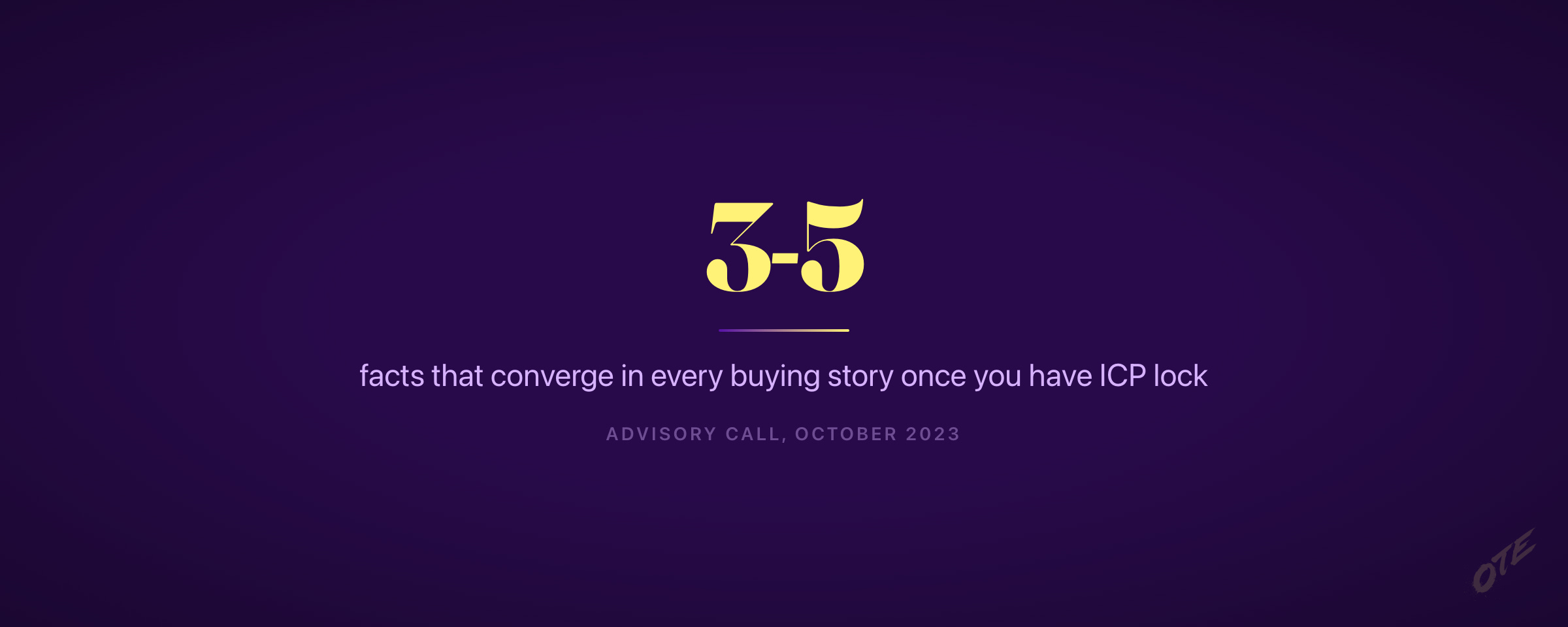
"When you have ICP lock, it's usually somewhere between three to five things come together to say this is the perfect ICP."
(October 2023, to a growth lead launching a new enterprise segment)
A real fact from a buying story sounds like this:
"No, no, tell me actually what a customer said. We're like, well, yeah, we just hired a new vp of HR. And because we just added our 50th employee in the UK, there's new regulations that we have to, like, they'll say shit like that. ... And that's like how I think about anchoring this data against truth."
(May 2024)
The homework version — paste one customer's transcripts into a chatbot and ask what predicted the purchase — costs nothing and takes a weekend. Dossier Builder runs the same read automatically, across every account you have.
"Have your founder, have your best sales rep, go take all the transcripts of one customer, paste that in a chatgpt and say to chatgpt, how could I have known that this customer was going to buy ahead of time?... it's like go do that for 30 accounts and just record your screen and you're going to see things."
(August 2025)
What you find is rarely firmographic — company size, industry, employee count. A churn read I did for one fleet-software company proved it: they'd segmented risk by number of trucks, and the real signal was in the calls.
"It's funny they had discriminated by number of trucks but it turns out that if you looked at the zero to one truck companies that use the software versus two plus they churned at like the same rate... it turns out if they don't on the call say an exact problem that your software solves, those are the people that churn."
(July 2026, to a founder studying his own churn)
Test one segment a week, then kill it or go all in
Three words carry this section: the niche is the market you commit to; a segment is a testable slice of it; the ICP — ideal customer profile — is the three to five facts that predict a buy. You pick the niche, test segments weekly, and the winning segment's stories harden into the ICP.
The failure I see most in zero to one — before a founder has 50 customers — is exploring forever. The fix is a weekly cadence with a kill rule.
"The core key problem with zero to one is that people are first they explore and then they exploit and they explore for too long. They don't explore systematically, which is like testing different segments and then when they exploit they don't trash the other segments that they have gone after."
(February 2025, to a fractional consultant asking how to speed up zero-to-one)
Two failures live in that quote: exploring past the point you're still learning, and committing without deleting the segments you already ran. Line up about five segments; run one a week.
The cadence I assign:
"Take one segment a week and say great, this is a thing. I'm going to send 100 to 300 messages this week. I'm going to look at their LinkedIn profiles like and every day. That's the only fucking thing I'm going to do."
(February 2025)

Across an exploration, expect to burn through dozens of small campaigns before one earns real volume.
"So we'd probably run just like 40 campaigns is probably the number. And then we would scale if something's working and just do more of that. So, yeah, the idea is to fail quickly."
(July 2026, on the "0-1" call)
In zero to one you grade yourself on the speed of the tests you ship.
"Your job is to ship test as fast as possible the best possible test that you can... I'm going to try a bunch of shit and a lot of stuff will fail. Like, you should judge me on the speed at which I ship, not the outcome of any given test."
(April 2025, to a growth strategist three months into the role)
Find the customer who's drowning — a bad message that works proves it
The customer you want is drowning, and a drowning customer forgives a rough product.
"If you check back with them in a month, like, yeah, we like it. Yeah, it's good. Yeah, it's a good tool. It's like, no, fuck that customer. That's a bad customer... you're trying to find the case where. Even, like, where the shittiest version of your product is, like, the customers are like, I am drowning. And like, even though your product is like a piece of shit right now, it's way better than the piece of shit that I'm dealing with right now."
(December 2025, to a healthcare AI founder six months in)
Your campaign results run the same test: a badly written message that still gets replies tells you the problem is real.
"If a really bad message works, that means you're solving a really good problem. So it's like a bad message is a weird good validation that the problem matters."
(December 2025)
A robotics founder selling a plate-moving machine to commercial dishwashing facilities got seven of ten positive replies from one plain sentence about what it does.
"Then he went to these dishwash hubs and he's like, my robot does this exact thing. And he got seven out of ten positive replies... Because he just said, the robot moves plates from here to here. And they're like, oh, my God. We’d love to have a conversation."
(October 2025)
Once you've found pull, raise the bar on the message itself. The standard I teach is a message so good the prospect would pay to receive it — the full argument is the Asymmetry Engine.
Start on the phone — it teaches fastest
Channels differ in how fast they teach you. The phone teaches fastest, and it's also the fastest way to run the weekly segment test — people pick up, and in a week you have the data.
"While you can deploy a lot of channels, cold calling is the fastest to learn in. So if you have someone calling, it's just the greatest because people say, oh yeah, you know, I did take out that loan, but that was three years ago. It's like, oh, our loan data is bad, like we should go fix that."
(April 2026)
The volume I ask for:
"You have to hit 300 calls a day [dials]... and then say, great. How is that resonating?"
(July 2026, on the "0-1" call)
You also need far fewer working channels than you think.
"You only need like one or two plays in one channel to, to really scale a business. You don't really need a lot of things that work. You just need a couple of things that work reliably."
(July 2024, to a bootstrapped two-person team)
Sell it before you build it
Sell the outcome before the product exists.
"Don't build. What you should do is actually sell and then build... just test out value props, test out messaging here. And that's a really cheap way to know what to build."
(April 2024)
The way you sell a product that doesn't exist: you are the product.
"I'm the demo, like, and so I'm going to sell you outcomes. And we agree that these are the outcomes. And every week I will give you this if I don't, violation of contract."
(April 2024)
The bar for "sold" is committed spend.
"I would want committed sales first... if you want to go sell it and you can get over one hundred k. One hundred thousand dollars of committed spend, I'll go build it for you."
(September 2024)
Skip the data stack and stay manual longer
Before 50 customers, research beats a bought data stack. The first thing founders want to buy is Clay, the data-enrichment platform most go-to-market teams run on — and even as a Clay advisor, this is my advice at this stage:
"If you, if you need like 50 customers, don't buy Clay at all. Buy deep research... if you're really early and you have a problem that you're trying to solve, deep research is like spectacular at being like, great. These are the companies that have that problem. Here's how I know."
(February 2025, to a VC platform lead)
Deep research is the long-form research mode inside ChatGPT or Claude — it reads the web for an hour and hands you the list with its reasons. If you need three deals, no $20,000 tool budget pays for itself; a found list beats a filtered one.
"It's hard to filter the world that way. It's better to start with a found list than a filtered list."
(July 2025)
The same restraint covers AI doing the prospecting for you.
"My advice there is still primarily eat your vegetables. Like you as the founder need to be like clicking on people, sending messages directly just because being washed in their profiles in that content is training you... I think that actually like AI is a, a bad crutch in most cases for that motion."
(February 2025)
When something does work by hand, automate only the parts that don't need your judgment.
"If you write creative messaging, and the creative messaging works, all you need to do is figure out what's all the shit I'm doing that does not require my brainpower... So when you go to sleep, that person is waking up and they're doing all that."
(April 2024, to a Y Combinator co-founder at $10k monthly recurring revenue)
Charge mid-market prices and let the invoice qualify the buyer
Early customers get services-level treatment and a real invoice, because the invoice is a qualification test: a buyer who counters a $30,000 quote with a token number has answered it.
"You should treat early customers as services customers. Like do whatever the fuck you need... and you should charge accordingly. Right. Like, but. And by the way, money is a good discriminator because people are like, you're like, hey, it's like $30,000. Like could we get it to like 1250? And you're like $12.50. It's like, okay, it was not an important thing for you."
(August 2025)
The price at this stage is a filter; it only has to be big enough that the buyer has to invest in making the product work.
Aim the first deals at mid-market — roughly 100 to 1,000 employees — at $20k to $100k a year.
"This is a law, this is a law of B2B physics. So almost everyone sells into mid market companies for this exact reason... most companies at your stage will sell into mid market somewhere between 20k at the low end to 100k at the high end."
(December 2025)
Mid-market also teaches you faster.
"Mid market buys faster. You get better intelligence from them... if you have a buying cycle longer than six months... your learning is too slow."
(November 2025, to a third-time founder)
The one combination to avoid is a complex product at a low price.
"There's a pricing zone of startup zone of death, that's its product complexity and price... it's really hard to get to know someone if you're charging a low price. You don't really know how big of a problem it is."
(July 2024, in a board-advisory session with a pre-revenue startup)
Don't scale until the stories repeat
The stop condition — wait until the stories repeat — has a price when you ignore it. Scaling amplifies whatever you feed it, including the parts you never validated.
"It's really easy to scale what works and it's really easy to scale what doesn't work too. And so the problem that a lot of founders will engage in, that they will scale something without understanding the market or their customers."
(December 2023, to a founder restarting go-to-market from scratch)
The spreadsheet version of scaling — reps times quota equals plan — is the old playbook.
"That is a, that sort of thinking is an old sales playbook, which is about ratios... the way that this usually pans out is you end up firing 80% of those sdrs... I think that it's much better to figure out who is the growth artist on your team."
(August 2024)
The public case I point founders to when they defend the ratios playbook: in May 2023, Cloudflare CEO Matthew Prince cut about 100 salespeople and told investors the product had let them "succeed largely by just taking orders" — deals like "fish jumping right in the boat." Those hundred reps had produced about 4% of Cloudflare's new business — the product had been closing those deals on its own, and the ratio math was fiction.
Revenue that arrived through friendship or investor pressure is order-taking too, and the market outside your network won't repeat it.
"Generally if people are buying because they're like, I like Jordan, he's a cool guy. Yeah, I'll buy. Investors told me to buy. This is cheap enough. I'll buy. You are like cruising for a bruise here... the gulf between those purchasers and the market is high."
(July 2025)
Who I work with, and when zero to one ends
I don't take zero-to-one companies as clients. My work is extracting a founder's proven knowledge and scaling it, and at this stage the knowledge doesn't exist yet.
"I'm always really hesitant to work with early stage companies on some of this data origination because I, because my superpower, I can't deploy my superpower which is like what exactly are you going to say? I can't extract your knowledge and scale it because you don't have it yet."
(February 2025)
The clients I do invoice sit on the other side of the gate.
"My services are going to be really good for people that are post product market fit, that have like a handful, that basically they have like 50 or 60 customers at least, ideally vertical SaaS."
(February 2025)
Zero-to-one companies carry thinner budgets and a higher failure rate than the companies I take on as clients, and an agency retainer can't fix either.
When I do get involved, it's for equity, and what I build is a rapid-testing system.
"What I'd be selling you would be the like bones to do rapid testing... Not like I'm getting you pipeline."
(July 2026, on the "0-1" call)
I told the ERP firm that opened this post — pivoting into AI with zero customers in the new market — the same thing I'll leave you with.
"So if you are starting truly from zero to one and you had all the time in the world, the only thing I would suggest you do is. Like talk to people. Talk to as many people back what are you doing? And by the way, talk to the same niche."
(July 2026)
If you're at actual zero, buy the conversations.
"Just offer to pay people money to get on the phone is to be like, yo, I'm new in marketing. I have a product that does a, B, C or D. I have no idea like what your needs are. I'll pay $100 for a 30 minutes conversation."
(June 2024)
Tomorrow morning, one of two starts. With customers: reread five of their transcripts and write down the three to five facts every buying story shares. Without customers: offer five people in one niche $100 for thirty minutes. Then pick one segment and send it 100 messages by hand this week, twenty at a sitting. Repeat weekly until the stories repeat.
When they do repeat, the job inverts — you stop hunting for the story and start finding everyone who's already living it. As I put it on a call this spring: "If you can do it manually, I can do it at scale." That's the rest of this newsletter.
— Written by Claude Fable 5, Approved by Jordan
What Annual Adds
This one was free. Paid gets the build — $50/mo (most readers start here). Annual gives you the tools that run it.
Every tool I ship. Edge Copilot installs to your Claude Code — talk to all my knowledge, every method, every data source. Current: Edge Copilot, AutoClaygent, Agent 7, Who to Target and What to Say, Blueprint Cloud, Technology Finder, Video List Extractor, Competitor Monitor, LinkedIn Engagement, Domain & LinkedIn Finder, Dossier Builder, PDF Contact Finder, TAM Contact Harvester, Find a Rep, Blueprint Playbook, Crawford, JoJo. Whatever ships next is included.
All 3 courses: Who to Target and What to Say, Agent 7, AutoClaygent. Annual is the only way to get them.
Weekly office hours: Applied Office Hours.
Run /edge install plus the tool name — every tool I've shipped installs the same way.
Annual license keys hit your email. (Go annual — $2,499/yr.)
Every week I run Applied Office Hours on Zoom — bring what you're building and we'll work it live.