

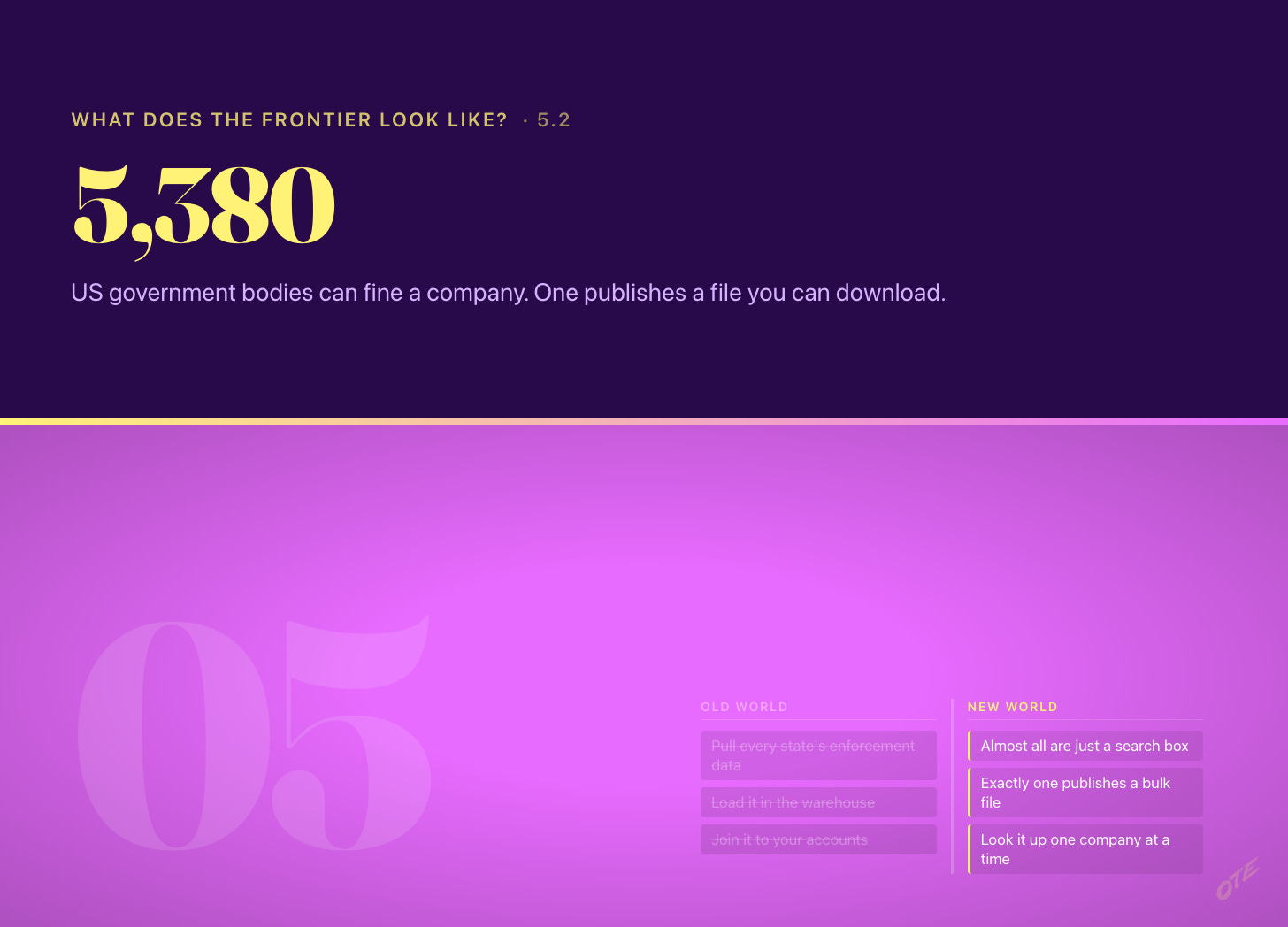
A fine is a dated, public record that something went wrong inside a company
Most buying signals are guesses about intent. Somebody visited a pricing page, somebody's headcount grew, somebody downloaded a whitepaper. You are inferring a problem from the shadow of a problem.
An enforcement action is not a guess. It is a government agency stating, in writing, with a date on it, that a specific company did something it was not supposed to do. A consent order. A revoked licence. A civil penalty with a dollar figure attached.
That is about as close to ground truth as commercial data gets. If you sell compliance software, safety training, environmental remediation, licensing workflow, insurance or legal services, a company that just got cited has a named, dated, documented problem — and somebody inside it has already been told to fix it.
Government records are usually the best free list you can build — I have made a full market of named contacts for $0 out of them. So the question worth answering is whether enforcement works the same way. Not for one agency. For all of them.
The answer is mostly no.
First you need a list of the agencies, and America, you’re beautiful, but she does’t publish one
There is no register of American regulators. No federal agency lists every body that can punish a company, and no state does either. Before you can ask where do you publish your enforcement actions, you have to build the list of who to ask.
The federal side had a trick available. A 2015 law requires every federal agency that can levy a civil monetary penalty to publish an inflation adjustment to that penalty, in the Federal Register, on a schedule. Filing that adjustment is therefore evidence of the power itself — an agency files one because it has penalties to adjust.
I read every one of those filings and came out with 104 federal agencies. That is a proof rather than a guess: the authority comes from a statute and the filing is the receipt.
It is also a floor rather than a census. Two obvious enforcers were missing — the Consumer Product Safety Commission and the National Labor Relations Board. Both act against companies constantly. Neither files the inflation rule the sweep catches, so neither appeared. Probing their sites directly found both, and each was added with the probe recorded as the reason. 106 federal bodies.
The states have no equivalent law, so we read 51 rulebooks one at a time
Nothing like the inflation filing exists at state level. What every state does have is an administrative code: the standing body of rules that creates its boards, commissions and divisions and says what each may do.
So the state lane is fifty-one separate passes, every state plus Washington DC, reading each state's own rulebook for the bodies inside it.
That also answers how do you know what state a body belongs to. I never looked it up. A body's state is the rulebook it came out of. There is no city either, because these are statewide boards and commissions rather than municipal offices.
That produced 5,274 state bodies — boards of nursing, contractor licensing boards, insurance divisions, environmental quality commissions, alcohol control boards, water quality boards.
We will not claim those 5,274 can fine anyone
Appearing in a state's rulebook proves a board writes rules. It does not prove the board can punish a company. Those are different powers, and plenty of bodies have the first without the second.
One research pass naming a board as a penalty authority is one source. The standard this project holds itself to is two independent sources before anything gets recorded as established.
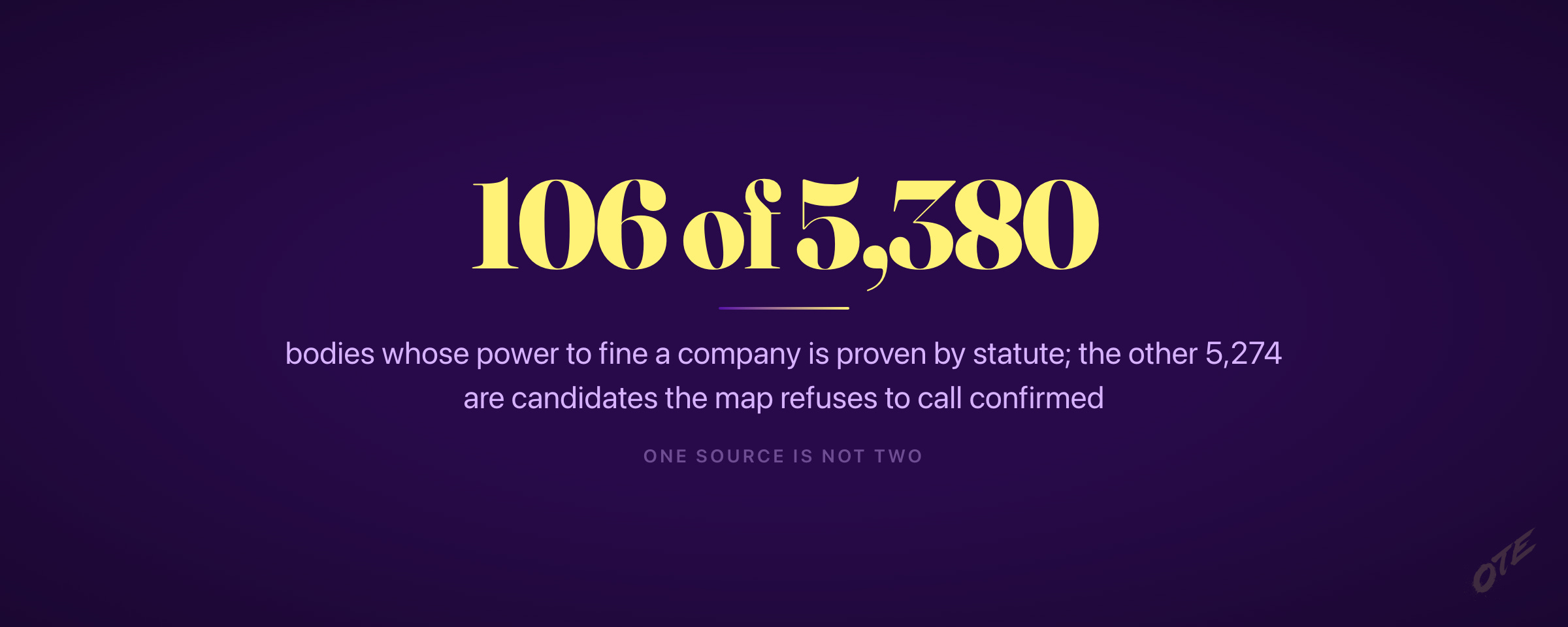
So all 5,274 state rows carry "can it fine a company? — not established." Only the 106 federal rows say proven, and they say it because a statute and a filed rule say it.
That is the difference between a list of 5,380 confirmed enforcers and what this actually is: 106 proven, and 5,274 strong candidates I have not verified one by one. The sheet marks which is which on every row, because the alternative is a bigger number that means less.
Then we asked all 5,380 where they publish it
The work ran inside Crawford, the research agent I shipped in July, which spends down a ladder from free sources to paid ones and stops as soon as an answer is good enough. At the paid rung it used Exa, which reads the live web on request: one address back per body. Free code of mine then downloaded every address and worked out what was really there from the file itself, rather than trusting the description.
That division matters more than any single number here. The agent is excellent at finding where something lives and unreliable at saying what it is. 70.5% agreement between the agent's label and a byte-level check

Across the 3,905 addresses that both loaded and got a label, its description matched the actual file 70.5% of the time. It called 151 of them downloadable. Downloading those exact 151 found one real bulk file, 106 ordinary web pages, 38 that refused, 5 single PDFs and 1 dead link.
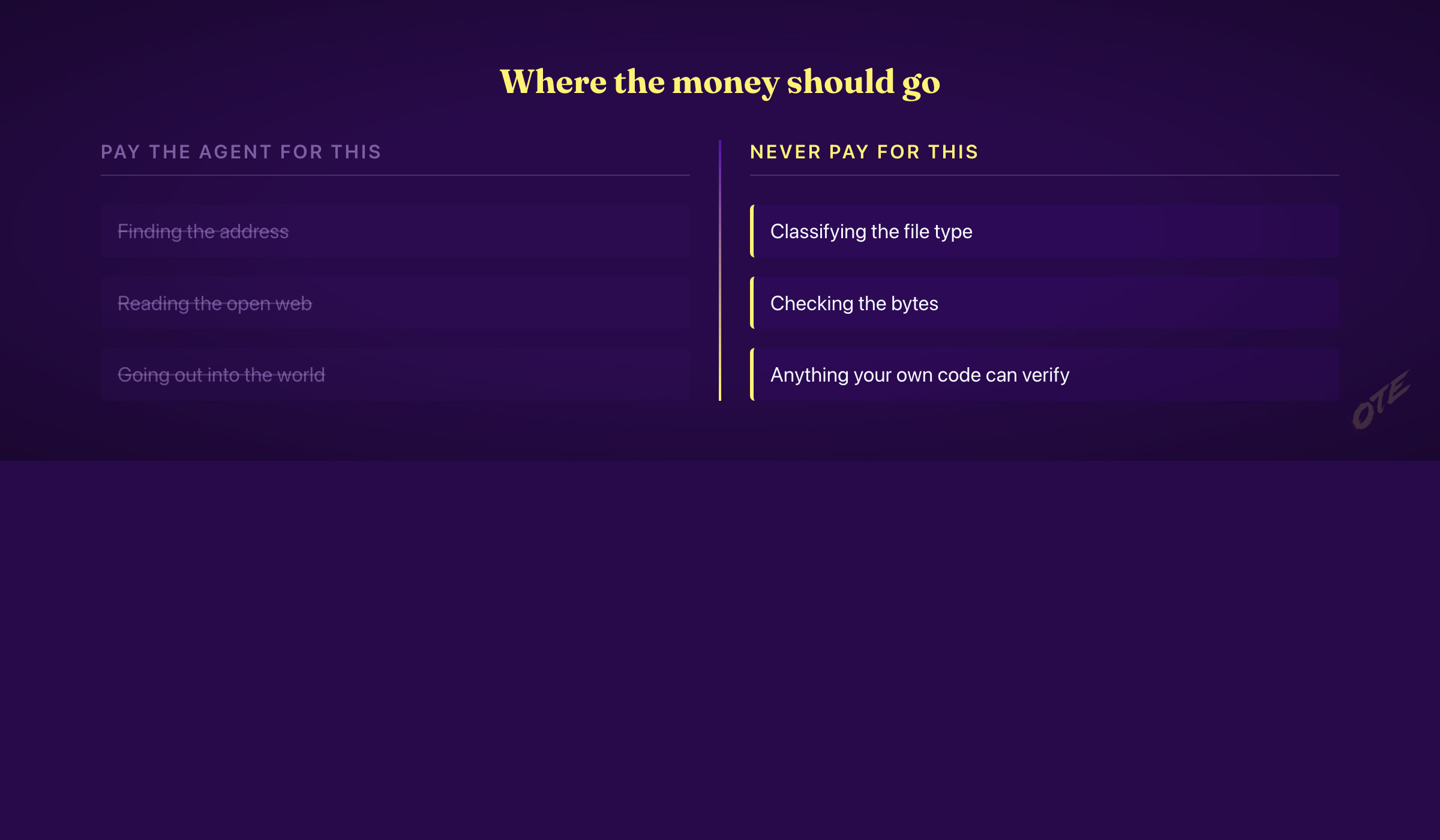
Pay for the part that requires going out into the world. Never pay for the part your own code can check, because on that part the thing you are paying is worse than a short script.
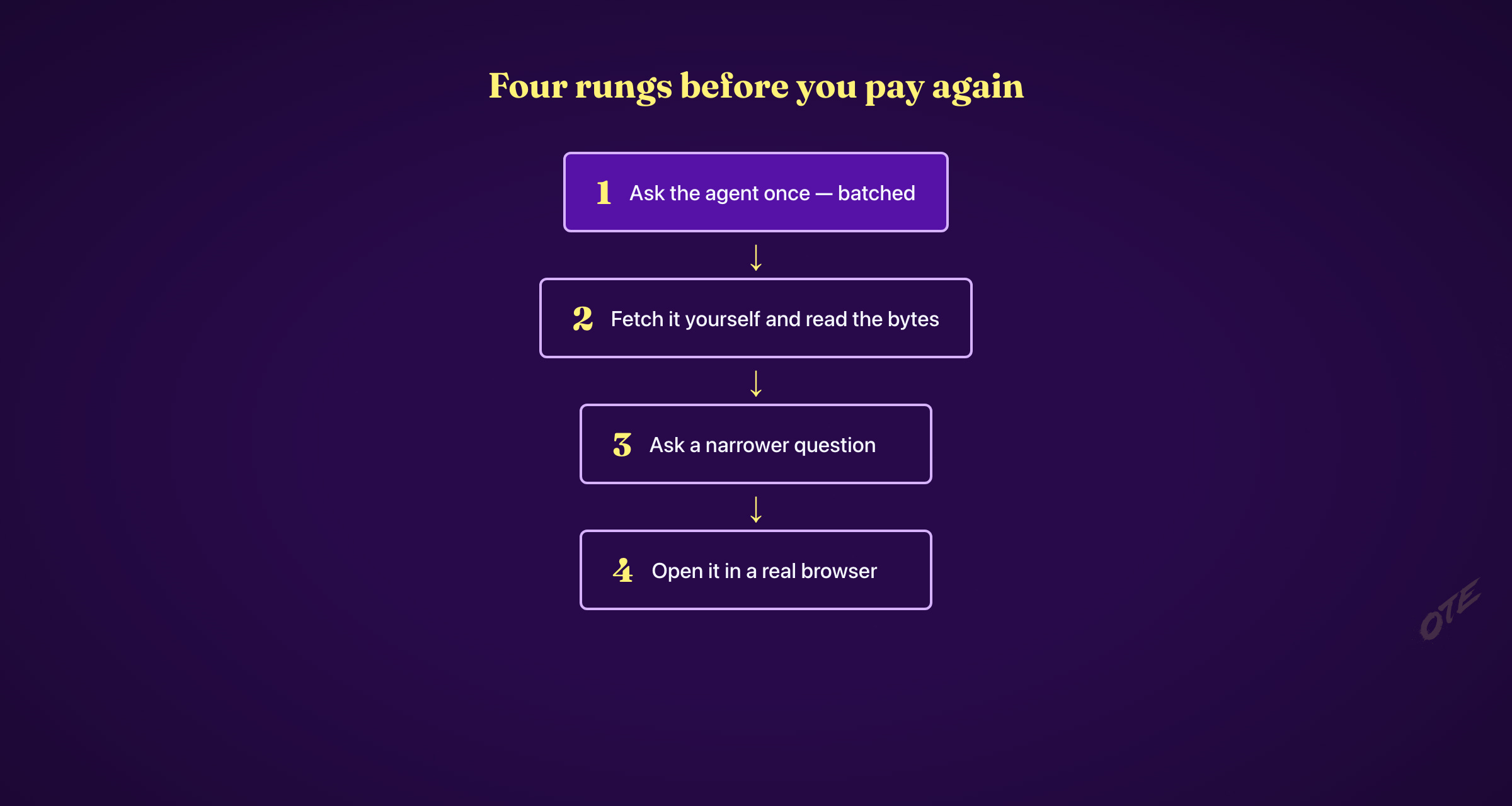
Three cheap steps rescued a lot of apparent dead ends, and they transfer to any data job.
Ask a narrower question before you believe an empty answer. 1,728 bodies came back publishing nothing, or with an address that no longer loaded. Asking again — naming the actual documents, disciplinary actions, consent orders, licence revocations, notices of violation, inspection results, board minutes — turned up a real address for 783 of them, for $9.40. Nearly half of "there's nothing here" was the question's fault.
Open it in a real browser before you call it dead. 536 addresses could not be read by a plain script request. Running those through an actual browser opened 330. Of the rest, 95 refuse even a browser, 21 were genuinely wrong addresses, and 90 timed out or errored. A single spot check had already written off Massachusetts entirely; the full run opened 70 Massachusetts addresses.
When one site refuses everything, suspect your own request. The Securities and Exchange Commission nearly went into this map as blocked, because all five addresses refused. The SEC asks automated traffic to identify itself and leave a contact address, and answers normally once you do. I re-ran it today, while writing this: sent with a browser's identity, the server answers 403, its code for forbidden. Sent with a declared automated identity and a real contact email — exactly what the SEC's own guidance asks for — the same page answers 200.
What we found: 18 of 5,380 will hand you a file
Here is the result in one line. Of 5,380 bodies, 18 publish their enforcement records in a form you can take in bulk — 6 as a downloadable file, 12 as a data feed. Fifteen of those 18 are federal.
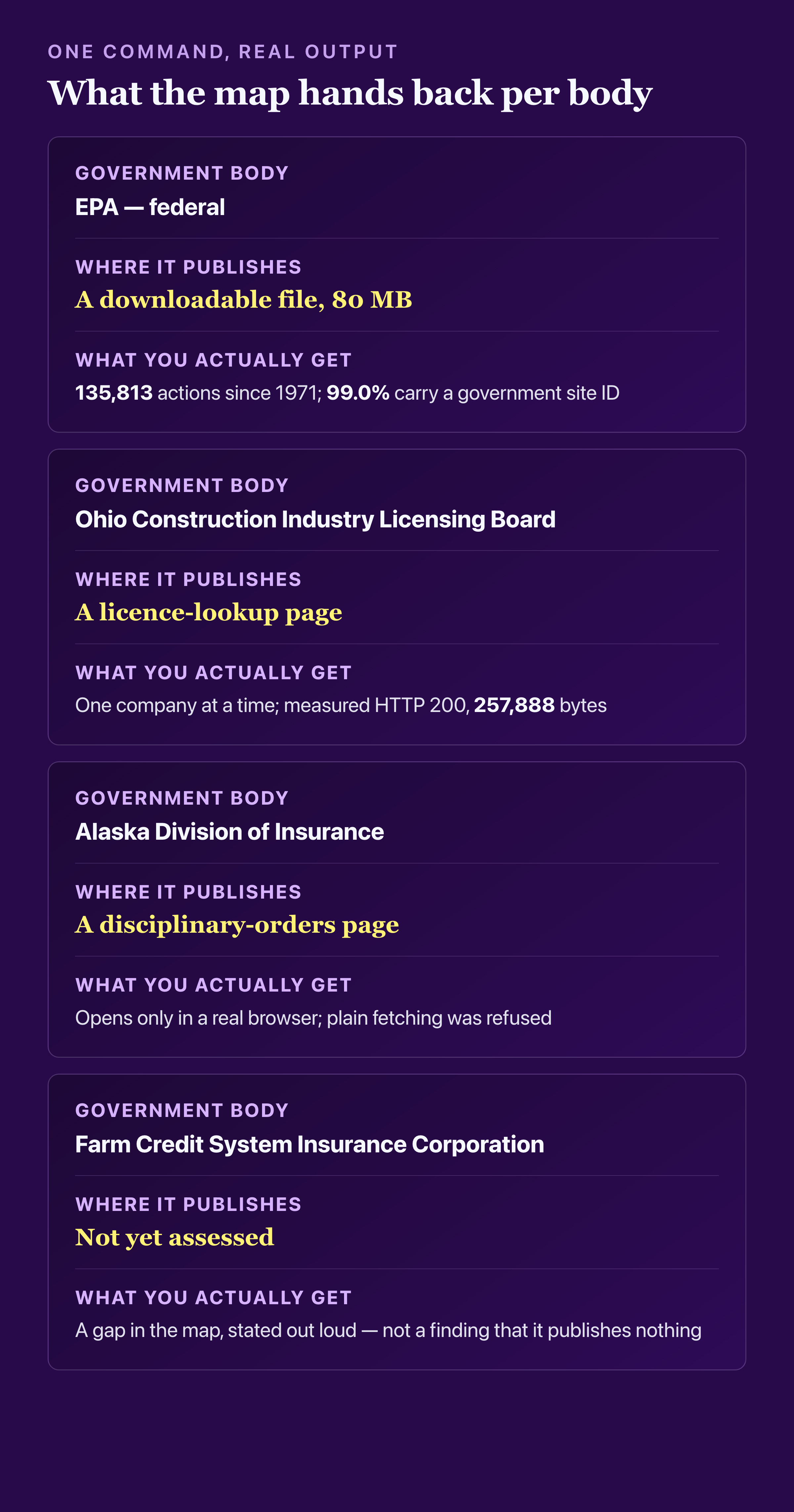
Among the 5,274 state bodies, exactly one publishes a downloadable file: the Oregon Board of Accountancy. Two more offer a feed.
3,997 are a look-up page or a pile of PDFs. You type a company name in and read what comes back, one company at a time, forever. There is no export.
1,363 have not been assessed at all. That is a gap in the map, recorded as a gap rather than as a finding that they publish nothing.
So if you were planning a month of work around pulling every state's enforcement data into your own database, that month does not exist. The data is not there to pull. Worth knowing before you scope it.
The sheet is free, and it is all 5,380 rows
Every body we found, what it is, which state it belongs to, whether its power to fine is proven or merely alleged, where it publishes, on what domain, what kind of page that is, whether you can bulk-download it, and the measured evidence behind each judgement.
Open the sheet — every US body that can punish a company
Names, states and body types are complete on all 5,380 rows. A publishing address and its measured evidence sit on 4,017 of them — 74.7% — across 1,339 distinct domains. What each body can do to a company is on 99.1%, in the regulator's own wording, which means inconsistent wording that I have left raw rather than tidy into something cleaner than the source.
It holds no company names. Each row is an agency, and the companies it punished live behind that agency's own door.
What we deliberately did not build
I never built the thing that walks into 3,697 look-up pages and pulls the records out.
That was the design rather than an omission. The point was never to warehouse every fine in America. It was to know the full scope, so that when someone needs the records for one agency or one state, an agent can be pointed at that row and go get them.
A scraper per portal is real work, and it is work you only want to do for the handful of bodies that regulate your buyers. The map tells you which handful, and what you are walking into before you start.
The one exception is the proof that the format works. We downloaded a single body in full — the enforcement database of the Environmental Protection Agency — and it yielded 201,056 findings, each naming a party, 99.0% carrying a stable government-issued site identifier so the rows need no name matching at all. That is what a good one looks like. There are 17 others.
807 said they publish nothing, twice, and the map still will not write it down
945 bodies were asked twice, the second time in deliberately different words. On 807 of them the second pass agreed with the first: this body publishes nothing.
The map still records all 945 as unknown.
Marking them confirmed would have been defensible, and it would also have pushed the map's coverage score over the 80% pass mark set before any of this ran. Two AI passes agreeing is better evidence than one, and it is still not a person opening the page and looking.
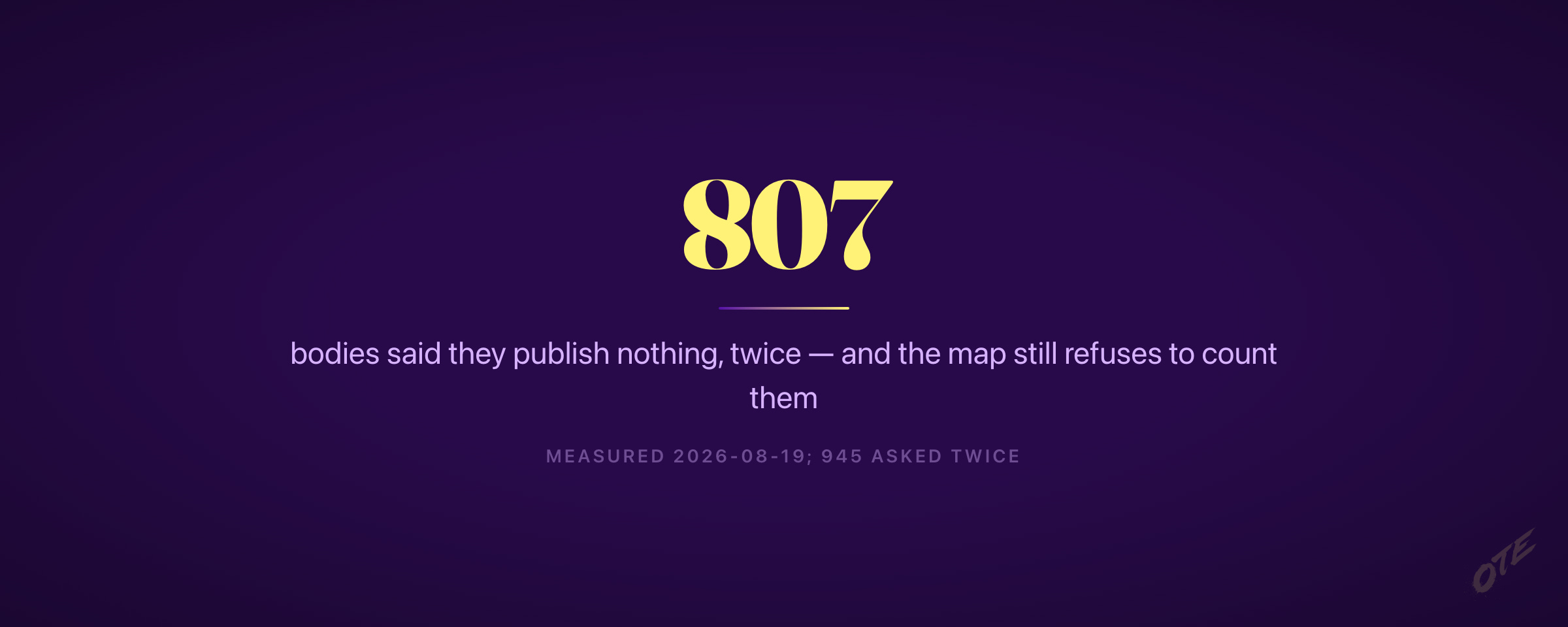
So the scoreboard reports 74.7% coverage and stamps itself BLOCKED — deliberately short of its own bar, and saying so out loud.
It also asks two separate questions and refuses to average them. Do we know where each body publishes? That is 74.7%. Do we actually hold the records? Near zero, because holding means downloading and parsing, done for one body so far. Letting either score wear the other's number is how a thin dataset gets sold as a complete one.
— Written by Claude Opus 5, approved by Jordan
Who Gets This
This one's free, and so is the sheet. Most of what I publish isn't.
Free: the theory, the method, the headline result, and every one of the 5,380 rows.
$50/mo (most readers start here): everything below the line in this post, and every paid article.
$2,499/yr: Every tool I ship. Edge Copilot is how you talk to all of it through Claude Code. Current tools: Edge Copilot, AutoClaygent, Agent 7, Who to Target and What to Say, Blueprint Cloud, Technology Finder, Video List Extractor, Competitor Monitor, LinkedIn Engagement, Domain & LinkedIn Finder, Dossier Builder, PDF Contact Finder, TAM Contact Harvester, Find a Rep, Blueprint Playbook, Crawford, JoJo. Whatever ships next is included. Plus all 3 courses + weekly Applied Office Hours. (Go annual — $2,499/yr.)
Below the line in this post:
The six buckets every regulator falls into, and what each costs you to work.
The 18 bodies that hand you a file, named, with what each contains.
Which states are worth a scraper and which are not.
The five checks that caught four bad numbers in my own published work.
Every week I run Applied Office Hours on Zoom — bring what you're building and we'll work it live.