

Chapters:
00:00 — A LinkedIn listing written like a machine
01:01 — Why models write in fragments
03:20 — An orchestra of soloists makes no music
04:21 — Better at code, worse at making sense
05:28 — Start with the story, then send the model in
06:36 — The 20 articles I deleted
07:46 — Five questions to answer before any build
08:48 — "You're only here because you're good at PowerPoint"
09:56 — The listing, rewritten as a story
11:02 — Where I'll be: Chicago, Miami, Austin
There's a LinkedIn post in this video that I call pure AI slop, and I want to be a little careful with it, because I'm probably the wrong audience for it. It's a commercial real-estate listing: a McDonald's, $3 million, a 3.5% return. It reads in a rhythm you already know. "New 20-year lease. Corporate credit. 10% bumps every five years. Texas growth corridor." Tick, tick, tick, tick. Fragment after fragment, and then one line that decides the deal: "It's a ground lease."
I have a theory about why machines write like this.
Why models write in fragments
A model answering you is trying to compress everything it knows into one note. Each three-word fragment is a shard of that knowledge — lease term, credit rating, rent bumps — stacked next to the last shard. The output reads like a summary of everything the model knows, because that's what it is. It never began with a story.
The failure gets sneakier as the tools get better. I send agents down rabbit holes that come back with genuinely useful material — software engineering, context engineering, what I care about and why, the problem itself, all compiled. Blend all of that into one answer and you get word soup, and word soup is credible enough to ship. I've shipped some. I've read my own Substack drafts before they went out and thought: this is good enough, it describes the concept, I'm tired of editing — send it. The insidious part is the randomness. Give a model a problem straight down the fairway and it writes just fine. More often lately, the output comes back too dunked in context to translate. I've written before about why readers punish this: people don't hate AI writing, they hate thin content.

An orchestra of soloists makes no music
Gather the best orchestra players alive and tell each one, individually: play the best thing you can imagine. The violinist delivers something brilliant. So does the cellist. Now hand a conductor the recordings and ask them to make sense of it all. Every individual part is excellent, and the music has no story — a series of disconnected acts, disconnected intelligence.
That's what a long agent run hands you when you ask it to write. I suspect this gets worse from here, because the labs train these models to get code right — a job where a single semicolon decides whether the thing runs. Understanding an argument at that depth, and holding a longer context window while doing it, is exactly what makes the models better at code. Sensemaking is a different job, and I don't think they're being trained for it.
Start with the story, then send the model in
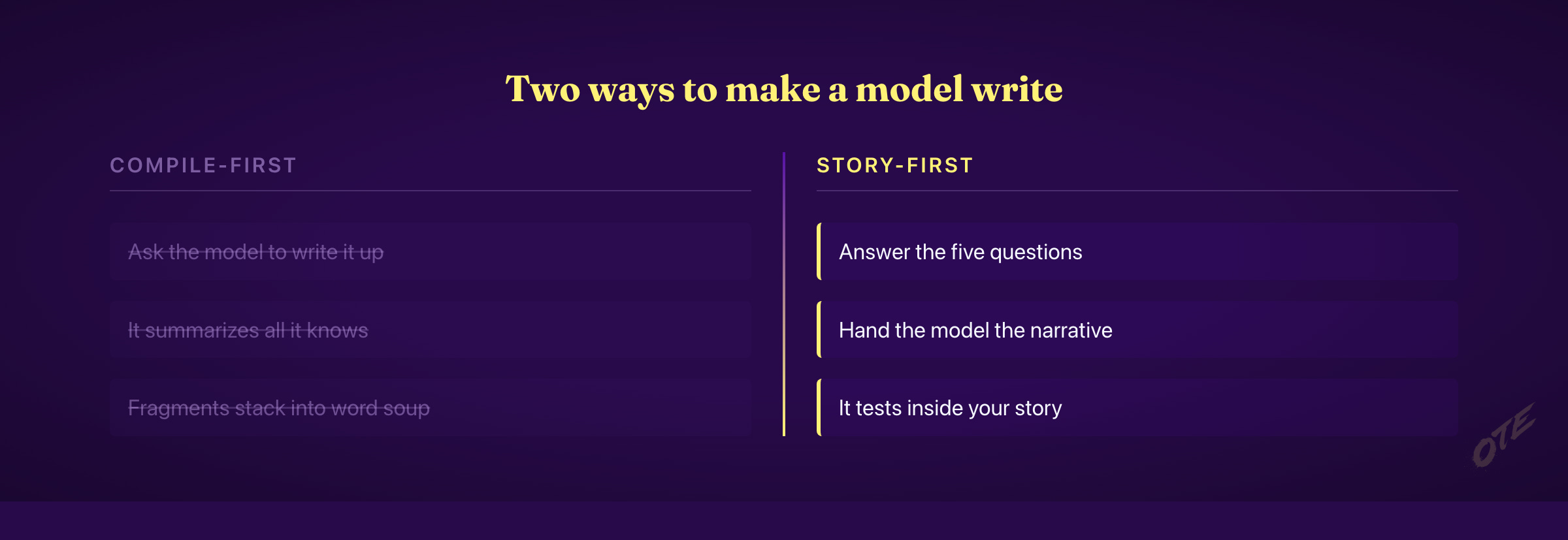
Knowing the limitation, you can control for it. Go understand the individual pieces of the problem yourself, as a human. Once you understand them you can put them together, and once they're together you can wrap a narrative around them. Now the model has a framework to attack the problem inside. It knows the intention and the intuition behind what you're building. The instruction stops being "write this up" and becomes "test things within the confines of my narrative." The narrative doesn't have to prove out to be right — it's a structured argument about trying to make sense of the world, and the model works better inside one.
The story is context, and context is the bottleneck.
One trick from the video worth stealing: when you ask a model to tell the story of something you built together, don't let it replay your prompts back as the plot. Point it at the problems — what people said when they were deciding what to build, and why. The prompts record what you asked for; the problems are the story.
Answer five questions before any build
Before you begin a piece of work, stop and step away from the microphone:
What's the idea?
What's the intention?
How will we know if it works?
What's the outcome?
Who does this matter to — and why?
Writing the answers down exercises the part of your mind this workflow has been letting atrophy: the thinking. It's hard to go back to any other way of working once you can stream-of-consciousness ideas into a model and watch it build. But I have about 20 articles sitting unpublished because when I read them back, I didn't understand my own work. If I can't understand it, God bless the audience. The editing sometimes costs more than the piece is worth, and the real bill for skipping the story arrives at the end, as a delete.
Storytelling used to get you promoted. Now it gets you understood.
A friend of mine, on his way up at a big company, had a colleague tell him: "The only reason you're here is you're really good at PowerPoint." My friend would say the colleague was half right. The true half was the storytelling — the ability to tell a narrative inside an organization and have that narrative hold. That skill used to be how power worked in companies: tell the better story, get promoted. As more of the work goes to models, the same skill decides something more basic — whether anyone understands you at all.

The listing, rewritten as a story
Back to the McDonald's post. If the writer wanted to be understood, the story is sitting right there, and it's more emotional and more true than the fragments: "Imagine paying $3.2 million for land you can't actually own." Then the line that lands the pass: "The prettiest credit on the page is usually where the return goes to die." You can only take the fat of the land; you're never an owner. One sentence of story does the work a page of fragments couldn't.
Let the models do the work
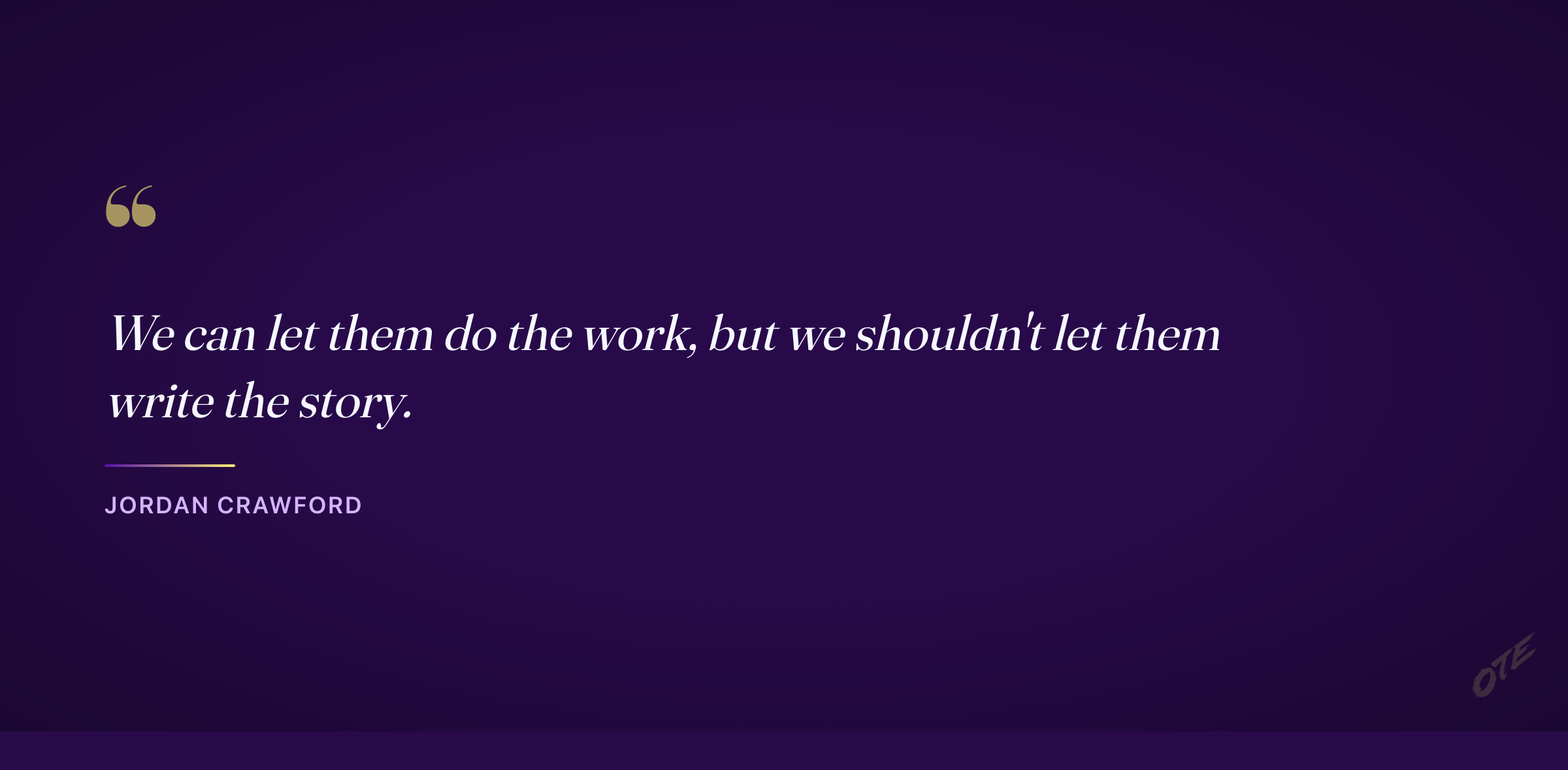
The rule I'm working by now: the models do the work, and the story stays mine. Before your next build — the pipeline, the deck, the post — stop, answer the five questions, write the narrative, and then send the agents in to test it. You'll be easier to understand. So will your work.
A thank-you, and three cities. On the Edge is #35 on Substack's business leaderboard as I record this. That's you, handing me 10–15 minutes of attention at a time — what a world, where someone can make money with their thoughts. (And yes, Niqui is a real person. People keep emailing to ask.)
I'm also going on a small tour: Chicago, Miami, and Austin — speaking at Vertex in Florida, plus two GTM Shift events in October. I'm not a dates person; if you're in one of those cities and want to come, send me a message.
— Written by Claude Fable 5, Approved by Jordan
What Annual Adds
This one was free. Paid gets the build — $50/mo (most readers start here). Annual gives you the tools that run it.
Every tool I ship. Edge Copilot installs to your Claude Code — talk to all my knowledge, every method, every data source. Current: Edge Copilot, AutoClaygent, Agent 7, Who to Target and What to Say, Blueprint Cloud, Technology Finder, Video List Extractor, Competitor Monitor, LinkedIn Engagement, Domain & LinkedIn Finder, Dossier Builder, PDF Contact Finder, TAM Contact Harvester, Find a Rep, Blueprint Playbook, Crawford, JoJo. Whatever ships next is included.
All 3 courses: Who to Target and What to Say, Agent 7, AutoClaygent. Annual is the only way to get them.
Weekly office hours: Applied Office Hours.
Run /edge install <slug> for any tool I've shipped — they all install the same way.
Annual license keys hit your email. (Go annual — $2,499/yr.)
Every week I run Applied Office Hours on Zoom — bring what you're building and we'll work it live.

